Synopsis
- The strikes form part of a broader campaign known as Operation Epic Fury, a joint effort involving Israel and the United States that military sources say has already seen over 6,500 bombs dropped on Iranian military infrastructure since the campaign began last weekend [Source.
IgMp Bulletin
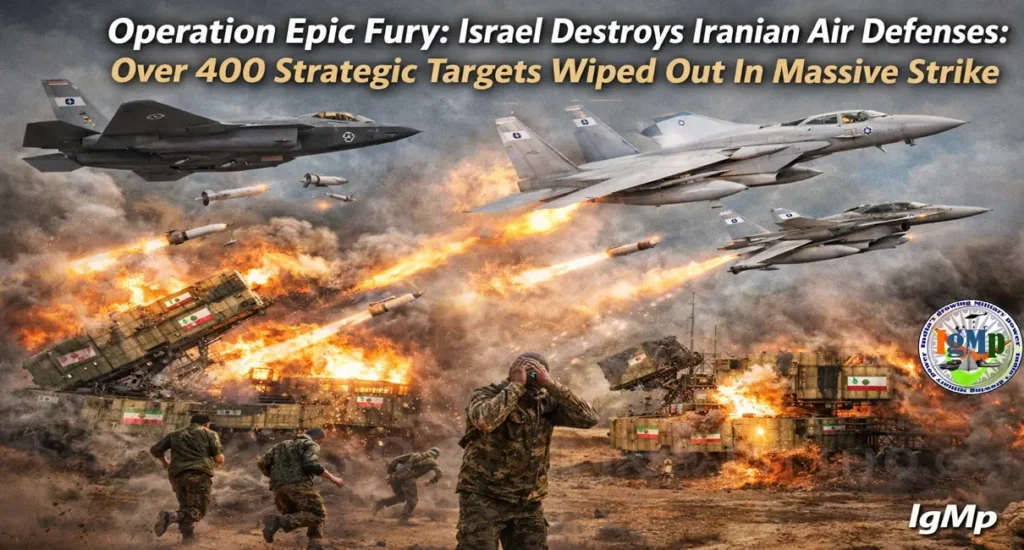
A sweeping aerial offensive by the Israeli Air Force has dramatically escalated the ongoing war between Israel and Iran, with Israeli officials claiming that more than 400 strategic targets were struck across Iran in a single 24-hour period on Friday, March 6. The strikes form part of a broader campaign known as Operation Epic Fury, a joint effort involving Israel and the United States that military sources say has already seen over 6,500 bombs dropped on Iranian military infrastructure since the campaign began last weekend [Source: Zee News].
According to the Israel Defense Forces, the operation is no longer focused solely on missile launchers and drone facilities. Instead, it has expanded into what analysts describe as a “decapitation strategy” targeting Iran’s senior command structure and strategic coordination centres. Israeli officials say the goal is to weaken Iran’s ability to organize large-scale retaliatory attacks while dismantling its missile launch capability.
One of the most dramatic strikes reportedly occurred in central Tehran on March 6. Israeli sources say approximately fifty fighter jets conducted a coordinated attack on a hardened underground bunker located beneath a leadership compound. The subterranean facility was believed to have been built as a wartime command centre for senior Iranian leadership, including structures designed for crisis coordination by the late Supreme Leader Ali Khamenei. During the strike, Israeli aircraft reportedly dropped around one hundred bunker-penetrating munitions and air-launched ballistic missiles designed to destroy deeply buried targets.
Military analysts say the attack likely involved specialized weapons such as the Blue Sparrow missile along with heavy bunker-buster bombs intended to penetrate reinforced underground tunnels. Destroying such facilities can significantly disrupt command-and-control operations by severing communication between political leadership and field commanders.
Another key incident during the latest wave occurred near Shahroud, a region associated with Iran’s missile infrastructure. Israeli aircraft reportedly detected a mobile surface-to-air missile system mounted on a truck that was being relocated to protect Iran’s eastern defensive flank. The vehicle was struck and destroyed before it could be deployed, a move that analysts say demonstrates Israel’s ability to track Iranian military movements in near real time through advanced intelligence, surveillance and reconnaissance networks.
The conflict has already produced heavy casualties and widespread destruction across the region. As of March 7, 2026, the death toll in Iran has surpassed 1,300 people, with more than 780 fatalities officially reported by the Iranian Red Crescent Society. Civilian infrastructure including schools and medical facilities has also been damaged in several provinces, highlighting the mounting humanitarian consequences of the conflict.
The escalation followed a dramatic turning point on February 28 when a joint U.S.–Israeli strike reportedly killed Iran’s Supreme Leader. Since then, Tehran has launched retaliatory missile and drone attacks against both Israel and American military installations in the Gulf region. Bases in Kuwait, Bahrain and the United Arab Emirates have all been targeted as part of Iran’s broader response.
One of the most significant incidents occurred on March 1 when a drone strike hit the Shuaiba port area in Kuwait, killing six U.S. service members and injuring others. The attack triggered intense political debate in Washington but ultimately failed to halt continued U.S. support for the Israeli campaign.
Pentagon assessments suggest the sustained bombing campaign has severely degraded Iran’s military capabilities. Officials estimate that Iran’s ability to launch ballistic missiles has dropped by roughly 90 percent, while drone launch capacity has declined by about 83 percent due to repeated strikes on launch facilities and storage depots.
War Status Snapshot
| Strategic Metric | Status as of March 7, 2026 |
|---|---|
| Operation Name | Epic Fury (U.S.–Israel joint campaign) |
| Primary Target | Command & Control networks and missile launchers |
| Iran Leadership | Khamenei deceased; Tehran bunker destroyed |
| Regional Retaliation | Missile and drone strikes on Kuwait, Bahrain, UAE |
| U.S. Casualties | 6 KIA in Kuwait, additional losses during operations |
Israeli strikes earlier in the campaign also reportedly targeted a building where the Assembly of Experts was expected to meet to begin selecting a successor to Iran’s Supreme Leader. By disrupting the location of the meeting, analysts say the strikes may have temporarily frozen the Iranian leadership’s ability to reorganize politically during wartime.
With air operations continuing and retaliatory attacks spreading across multiple countries, the conflict has evolved into one of the most dangerous regional crises in decades, drawing several Middle Eastern states and global powers into an increasingly volatile security environment.