Synopsis
- If an adversary launches a swarm of 40 or 50 inexpensive loitering munitions toward a high-value radar site, firing long-range interceptors at each incoming drone becomes economically and tactically unsustainable.
IgMp Bulletin
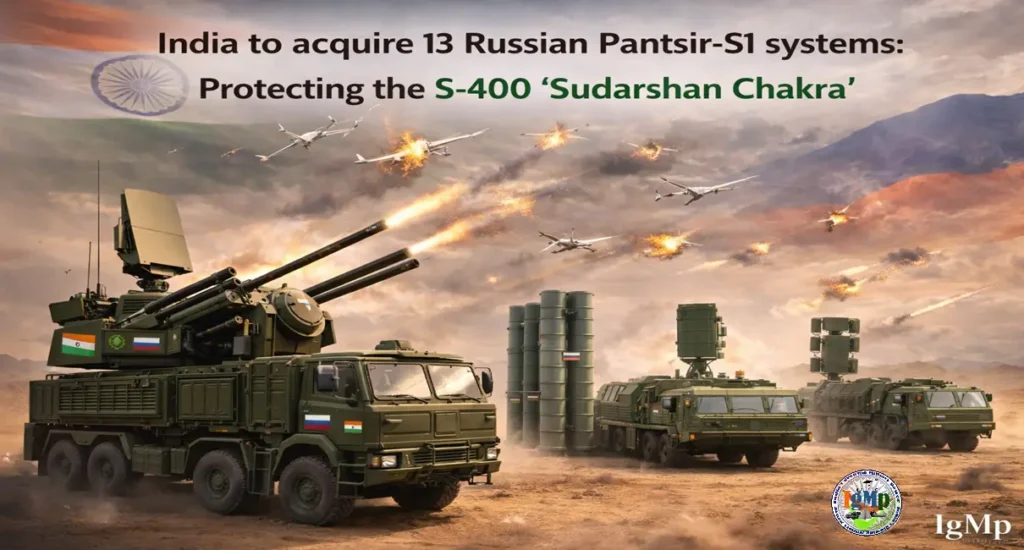
India’s air defence network is steadily evolving into a layered shield designed to counter everything from ballistic missiles to low-cost swarm drones. As part of this architecture, the Defence Ministry is awaiting formal proposals from the Indian Air Force and the Indian Army to procure 13 Pantsir-S1 systems from Russia. The objective is clear: protect India’s high-value S-400 Triumf batteries—sometimes referred to domestically as the “Sudarshan Chakra”—from close-range threats [Source: Hindustan Times].
The proposal reportedly envisages 10 Pantsir units for the Air Force to secure its S-400 regiments and three for the Army to deploy along sensitive border sectors. This is not an isolated purchase; it reflects a doctrinal shift toward strengthening India’s Very Short Range Air Defence (VSHORAD) and point-defence layers.
The “Bodyguard” Doctrine: Why S-400 Requires Close-In Protection
An S-400 battery is a strategic asset capable of intercepting aircraft and missiles at ranges of up to 400 km. However, its strength at long range also makes it a prime target. Modern conflicts—from Syria to Ukraine—have shown that even advanced air defence systems can be probed and saturated by low-cost drones and precision-guided munitions.
If an adversary launches a swarm of 40 or 50 inexpensive loitering munitions toward a high-value radar site, firing long-range interceptors at each incoming drone becomes economically and tactically unsustainable. This is where the Pantsir functions as the “bodyguard.” Positioned alongside the S-400’s radar and launchers, it provides close-in protection, intercepting threats that slip through outer layers.
India’s layered air defence approach resembles the logic behind systems like Israel’s Iron Dome: multiple tiers working together, each optimized for a specific range and threat type. Long-range deterrence must be supported by robust point defence.
Technical Specs: How the Pantsir-S1’s Hybrid System Neutralizes Swarm Drones
The Pantsir-S1 is a hybrid air defence platform combining 12 surface-to-air missiles with twin 30mm autocannons mounted on a mobile chassis. Its missile range extends to roughly 20 km, while the guns can effectively engage targets within about 4 km. This dual capability allows operators to select the most cost-effective response depending on the threat.
Unlike single-role systems, Pantsir integrates radar tracking and electro-optical targeting. It can track multiple targets simultaneously and switch between missile and gun engagement modes in seconds. This flexibility is particularly valuable against small drones, cruise missiles and low-flying helicopters.
Operational lessons from Syria and Ukraine have influenced its evolution. Earlier deployments highlighted vulnerabilities when systems were left isolated or unsupported. In some cases, small drones exploited radar blind spots. However, upgraded variants—often referred to as Pantsir-S1M—reportedly feature improved radars designed to detect micro-UAVs and enhanced fire-control systems to counter swarm tactics. This iterative improvement reflects how air defence technology adapts under battlefield pressure.
Autocannons vs. Missiles: The Economics of Air Defence
One of the most critical yet underappreciated aspects of the Pantsir is cost-per-kill efficiency. An S-400 interceptor can cost millions of dollars. Using such a missile against a $20,000 drone represents strategic imbalance. In prolonged conflicts, this mismatch can drain resources quickly.
By contrast, the Pantsir’s twin 30mm autocannons can fire up to 5,000 rounds per minute. Engaging small drones with cannon fire dramatically reduces interception costs. The price of a few hundred rounds is negligible compared to a high-end missile. This layered engagement philosophy ensures that expensive long-range interceptors are preserved for high-value targets like fighter aircraft or ballistic missiles.
In essence, the Pantsir safeguards not just the physical S-400 system, but also its missile inventory.
India’s Point Defence Layer: Pantsir-S1 vs. Indigenous Alternatives
As India evaluates the Pantsir, it also continues to develop indigenous air defence capabilities, including VSHORAD systems from Defence Research and Development Organisation. The comparison illustrates how each system occupies a distinct layer within the broader shield.
India’s Point Defence Layer: Pantsir-S1 vs. Indigenous Alternatives
| Feature | Pantsir-S1 (Russia) | VSHORADS (DRDO) | S-400 Sudarshan Chakra |
|---|---|---|---|
| Primary Role | Close-in Protection | Low Altitude / Portable | Long-Range Deterrence |
| Armament | 12 Missiles + 2x30mm Autocannons | Man-Portable Missiles | Multiple Long-Range Missiles |
| Max Range | ~20 km (Missile) / 4 km (Gun) | ~6–7 km | ~400 km |
| Engagement Type | Hybrid (Gun-Missile) | Single (Missile) | Multi-Layer Missile |
| Best Used For | Anti-Drone / Cruise Missiles | Helicopters / Low UAVs | Fighter Jets / Ballistic Missiles |
The table underscores that Pantsir is not a replacement for indigenous systems but a complement. Man-portable VSHORADS are essential for infantry formations, while long-range S-400 batteries provide strategic coverage. Pantsir bridges the gap, forming the crucial inner ring.
Strategic Deployment: 10 for IAF, 3 for Indian Army Borders
The proposed allocation—10 systems for the Air Force and three for the Army—reflects operational priorities. The Air Force’s S-400 regiments are high-value deterrence assets requiring dedicated close-in shields. Meanwhile, the Army’s requirements focus on protecting forward formations and sensitive installations against cruise missiles, armed drones and short-range rockets along border areas.
India’s geography adds complexity. With two active borders and an 11,000-km coastline, air defence coverage must extend across diverse terrain—from deserts to mountains and coastal zones. Mobility is therefore critical. The Pantsir’s self-propelled configuration enables rapid redeployment in response to shifting threat vectors.
Procurement decisions will likely factor in not only operational performance but also maintenance, technology transfer and private-sector participation in overhaul and support. India’s broader defence policy emphasizes combining urgent acquisitions with long-term indigenization goals.
Completing India’s Layered Air Defence Shield
The prospective acquisition of 13 Pantsir-S1 systems signals India’s intent to close a crucial gap in its air defence matrix. By pairing long-range S-400 capabilities with hybrid close-in protection, the country is strengthening its ability to counter both high-end missile threats and low-cost drone swarms.
Modern warfare increasingly revolves around layered resilience—ensuring that no single system becomes a single point of failure. In that context, the Pantsir is not merely another missile battery; it is the protective ring that allows India’s strategic deterrence assets to operate with greater confidence in an era defined by saturation attacks and asymmetric aerial threats.