Synopsis
- If timelines remain on track, detailed design work could conclude within the next few years, with construction beginning toward the end of the decade and the first submarine entering service in the late 2030s.
IgMp Bulletin
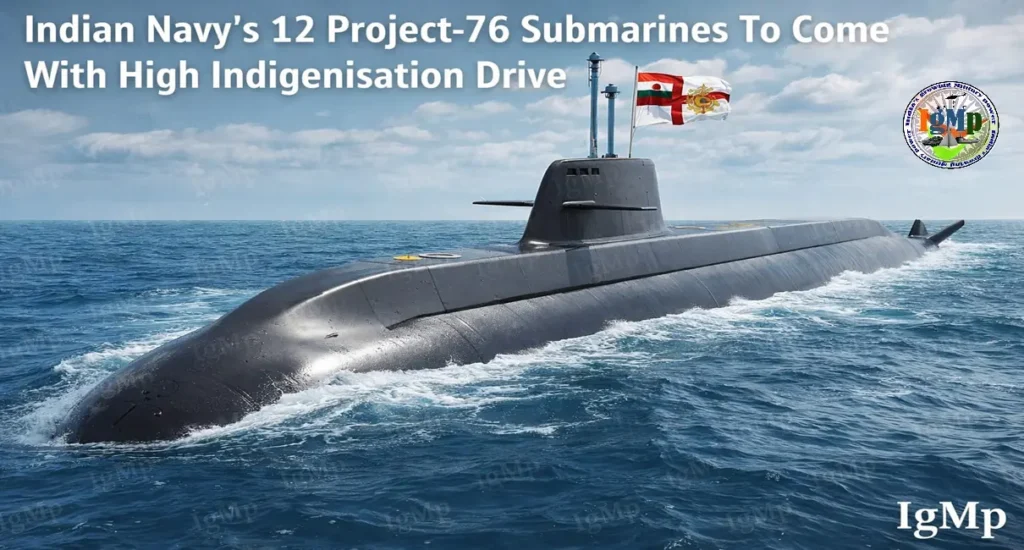
India’s next generation of conventional submarines is being designed with a very different philosophy from earlier programs. The upcoming Project-76 aims to move India beyond foreign blueprints and licensed production toward a submarine that is largely designed, engineered and supported within the country. For the Indian Navy, the program represents a decisive push toward sovereign intellectual property in undersea warfare technology.
The concept is being developed jointly by the Defence Research and Development Organisation and the Navy’s Warship Design Bureau. Their goal is to create six advanced diesel-electric submarines in the 3,000–4,000-ton category with more than 80 percent indigenous content—an ambitious level for a platform traditionally dependent on foreign subsystems.
As of March 2026, the feasibility study for Project-76 is approaching completion, and the design focus has shifted toward what engineers describe as “hybrid endurance.” This concept combines India’s fuel-cell-based Air Independent Propulsion system with high-capacity lithium-ion battery banks. Together, these technologies could give the submarine a unique operational advantage in underwater persistence.
India’s AIP system has already progressed beyond laboratory development. The indigenous fuel-cell module is scheduled to be installed aboard the INS Khanderi for sea trials expected to begin later in 2026. These trials will effectively serve as a real-world technology demonstrator for Project-76, validating endurance and performance under operational conditions before the new submarines are built.
The hybrid propulsion architecture works by dividing the submarine’s operational modes. The AIP system enables slow, extremely quiet patrols lasting weeks without the need to surface or snorkel. Lithium-ion batteries, developed through collaboration between the Navy and domestic industry, provide the opposite capability—short bursts of high power for rapid maneuvers, evasive movement or pursuit. Compared with traditional lead-acid batteries, Li-ion systems store more energy, recharge faster and maintain performance under high loads.
This combination is expected to produce a submarine capable of remaining underwater for more than 20 days during low-speed patrols while still retaining the agility required for combat scenarios. For the Indian Navy, that endurance profile is particularly valuable in the vast expanse of the Indian Ocean Region.
| Feature | Project-76 Specification (2026 Update) | Strategic Value |
|---|---|---|
| Displacement | 3,000 – 4,000 tonnes | High endurance for deep Indian Ocean patrols |
| Endurance | Hybrid AIP + Li-ion | 2+ weeks submerged with burst power capability |
| Propulsion | Pump-jet (under evaluation) | Ultra-low acoustic signature |
| Indigenous Content | 80–90% target | Full life-cycle control in India |
| Weaponry | 18 torpedoes + 12 cruise missiles | Anti-ship and land-attack capability |
Stealth is another defining priority. Engineers are studying pump-jet propulsion systems for the new submarines—technology usually associated with nuclear attack submarines such as the Barracuda-class submarine and the Virginia-class submarine. A pump-jet replaces the traditional propeller with an enclosed rotor system that reduces cavitation and underwater noise, making the submarine significantly harder to detect.
The program also aims to localize some of the most complex subsystems in submarine warfare. For the first time in an Indian conventional submarine project, the “fight” category—traditionally dominated by imported technology—will feature indigenous weapon control systems, sonar suites and periscopes. This shift could dramatically improve the Navy’s ability to upgrade systems during the submarine’s multi-decade service life.
Strategically, the size and endurance of Project-76 submarines are optimized for silent persistence in key maritime chokepoints across the Indo-Pacific. Long underwater endurance allows submarines to maintain covert presence in sensitive areas such as critical sea lanes and island chains, providing both surveillance capability and deterrence.
From an industrial perspective, the program will also reinforce India’s growing naval manufacturing ecosystem. Construction is expected to involve major domestic shipbuilders such as Mazagon Dock Shipbuilders Limited and Larsen & Toubro under the government’s Strategic Partnership model. Both companies already possess experience in complex submarine construction, giving India a stronger industrial foundation for the project.
If timelines remain on track, detailed design work could conclude within the next few years, with construction beginning toward the end of the decade and the first submarine entering service in the late 2030s. By then, the Navy hopes Project-76 will represent not just another submarine class, but a turning point in India’s journey toward fully indigenous undersea warfare capability.