Synopsis
- The RHH-150 targets the Mach 10 performance regime, placing it in the same strategic bracket as hypersonic weapons like Russia’s Kh-47M2 Kinzhal and China’s DF-ZF hypersonic glide vehicle, but with a crucial difference.
IgMp Bulletin
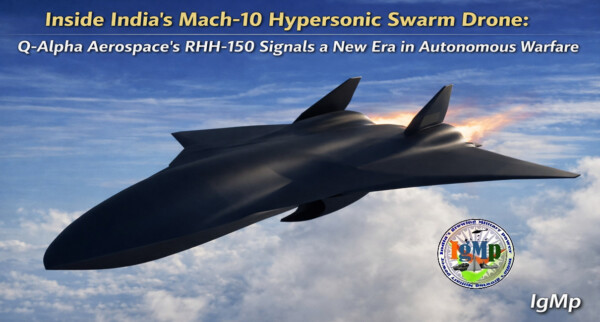
India’s growing defence innovation ecosystem is beginning to explore one of the most complex frontiers in aerospace technology: hypersonic unmanned combat systems. Bengaluru-based startup Q-Alpha Aerospace is drawing attention for its ambitious RHH-150 programme, a hypersonic swarm-capable unmanned combat aerial vehicle designed to operate at speeds approaching Mach 10 while carrying out coordinated multi-role missions. The project reflects a broader shift in India’s defence technology landscape where startups are beginning to tackle capabilities traditionally dominated by government laboratories.
The RHH-150 targets the Mach 10 performance regime, placing it in the same strategic bracket as hypersonic weapons like Russia’s Kh-47M2 Kinzhal and China’s DF-ZF hypersonic glide vehicle, but with a crucial difference: it is envisioned as a reusable, unmanned platform rather than a single-use missile. This approach could eventually combine the speed of hypersonic weapons with the flexibility of drones, enabling repeated missions ranging from reconnaissance to high-precision strike operations.
Technical Snapshot
| Parameter | Specification |
|---|---|
| Max Speed | Mach 10 (Hypersonic) |
| Propulsion | HTJ-160 Air-Breathing Engine |
| Operational Range | ~3,600 km |
| Wingspan / Length | 14.2 m / 27.6 m |
| Mission Roles | ISR, SEAD, Kinetic Strike, Swarm EW |
At the heart of the platform is the HTJ-160 propulsion system, an advanced air-breathing ramjet–scramjet hybrid engine. Unlike rocket-powered hypersonic vehicles that carry their own oxidiser, air-breathing systems use atmospheric oxygen during flight, significantly improving fuel efficiency and enabling longer missions. This architecture theoretically allows the RHH-150 to sustain hypersonic speeds while still maintaining enough endurance for long-range operations exceeding 3,600 kilometres.
As of early 2026, the programme has moved beyond conceptual design into advanced prototyping stages, particularly for its AI-driven swarm coordination software and digital twin simulation systems. Digital twin technology allows engineers to create an exact virtual replica of the aircraft and simulate extreme flight conditions before real-world testing. One of its key advantages in hypersonic development is the ability to model plasma shielding—the layer of ionised gas that forms around vehicles at extreme speeds and often disrupts communications and sensor performance.
The swarm concept forms the operational backbone of the RHH-150. Instead of operating as a standalone drone, multiple units are designed to launch together and perform different tasks in a coordinated strike package. In a typical mission scenario, one drone could carry electronic warfare payloads to jam radar systems, another pair might act as decoys to trigger enemy defences, while the remaining aircraft conduct kinetic strikes on high-value targets. These saturation tactics are intended to overwhelm layered air-defence networks by forcing them to respond to multiple threats simultaneously.
Deployment flexibility is another core design objective. Unlike large strategic missiles that require fixed launch sites, the RHH-150 concept is being designed for multi-platform deployment. It could potentially be launched from mobile ground vehicles, naval platforms or even released from large transport aircraft as a “parasite drone.” This modular launch capability would allow rapid deployment across different theatres without requiring specialised infrastructure.
The programme’s propulsion ecosystem also includes another engine under development by the company: the QAL-J10 turbojet. While significantly smaller and designed primarily for advanced drones, this engine plays a crucial role as a technological bridge. The high-precision manufacturing processes required for the QAL-J10—particularly in turbine design and thermal tolerance—are expected to feed directly into the development of the much more demanding HTJ-160 hypersonic engine.
The concept first entered public discussion when a scaled model of the RHH-150 was displayed at Aero India 2025 in Bengaluru, one of Asia’s largest aerospace exhibitions. The display signalled how India’s startup ecosystem is increasingly attempting to complement the work of institutions such as the Defence Research and Development Organisation, which has been leading the country’s hypersonic technology demonstrations.
Strategically, the proposed 3,600-kilometre operational range places the RHH-150 in what analysts often describe as the “regional deterrent” category. From bases within India, a hypersonic platform with that reach could theoretically hold high-value targets across large parts of the Indo-Pacific at risk with extremely short response times. At Mach 10, such a system could reach distant targets in under twenty minutes, drastically compressing the decision window for defensive forces.
Significant engineering challenges remain before such a platform can become operational. Hypersonic vehicles must withstand extreme aerodynamic heating, maintain stable control surfaces at immense speeds and ensure reliable navigation in conditions where traditional communication links may be disrupted. Yet the rapid progress in simulation tools, advanced materials and AI-driven flight control systems suggests that experimental prototypes may become increasingly viable over the coming decade.
For India’s defence technology ecosystem, projects like the RHH-150 illustrate how private aerospace startups are beginning to experiment with frontier technologies that could redefine the country’s long-term military capabilities. If the programme advances from prototype to flight testing, it would represent a major milestone in the evolution of India’s indigenous unmanned and hypersonic aviation research.