Synopsis
- For a country like India that depends heavily on maritime trade, the ability to build, maintain, and deploy naval assets domestically is no longer just a military objective but an economic necessity.
IgMp Bulletin
The West Asia Catalyst: Why Maritime Security Is Now Economic Security
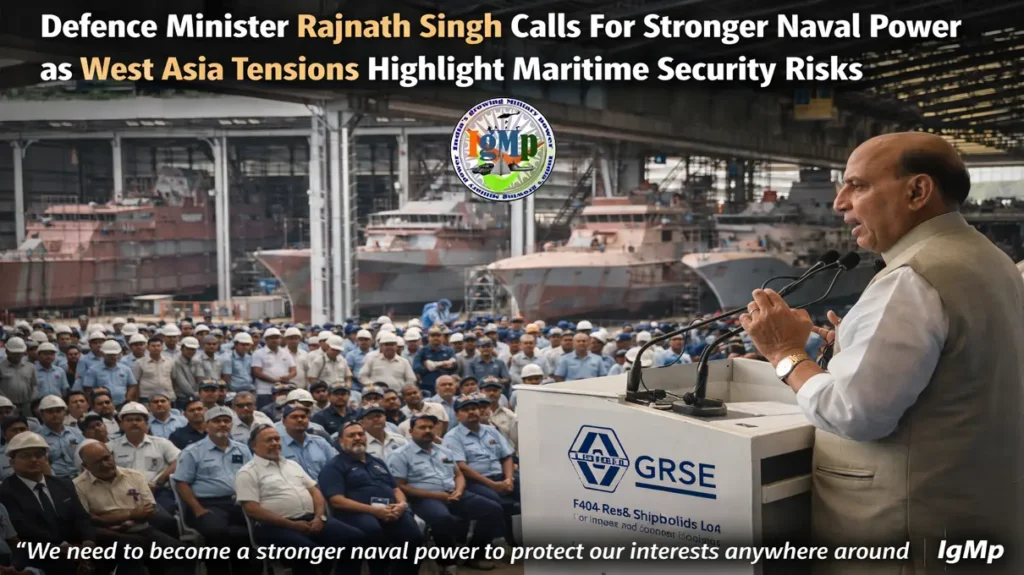
When Defence Minister Rajnath Singh spoke about India’s shipbuilding ambitions during his visit to Garden Reach Shipbuilders & Engineers (GRSE), the message went far beyond ceremonial remarks. The timing reflects a deeper strategic shift in India’s maritime thinking.
Instability across West Asia—from the Red Sea to the Gulf of Aden—has exposed how fragile global shipping lanes can become during geopolitical crises. For a country like India that depends heavily on maritime trade, the ability to build, maintain, and deploy naval assets domestically is no longer just a military objective but an economic necessity.
Nearly 90% of India’s trade by volume moves via sea routes, making maritime security inseparable from economic resilience. Supply chain disruptions in conflict zones have also highlighted a critical vulnerability: reliance on foreign shipbuilding ecosystems for components and technologies.
This is why New Delhi’s “Mission Mode” shipbuilding push is closely linked with the government’s broader industrial strategy under Maritime Amrit Kaal Vision 2047—a long-term roadmap designed to transform India into a major maritime power by the centenary of independence.
Operation Sindoor: A Case Study in Indian Naval Self-Reliance
Recent naval deployments have already demonstrated why indigenous shipbuilding capability matters. Operations such as Operation Sindoor highlighted the Indian Navy’s ability to maintain sustained deployments in sensitive maritime corridors even during periods of regional instability.
Modern platforms like the Visakhapatnam-class destroyer under Project 15B and the Nilgiri-class frigate under Project 17A represent a new generation of Indian-built warships designed for multi-domain warfare.
These vessels combine:
- Advanced AESA radars
- Integrated combat management systems
- Long-range surface-to-air missile capability
- Network-centric warfare integration
During sustained patrols in the Arabian Sea and adjoining waters, such platforms enable what naval strategists call “persistent presence”—the ability to maintain operational readiness in high-threat environments without depending on foreign logistics pipelines.
For policymakers, this capability validates the long-standing doctrine that a strong domestic shipbuilding base directly translates into strategic autonomy at sea.
The 2047 Roadmap: From ‘Builder’s Navy’ to Global Shipbuilding Titan
India currently ranks far below major shipbuilding powers such as China, South Korea, and Japan. However, the government’s maritime vision aims to dramatically change this trajectory over the next two decades.
India’s Shipbuilding Ambition: The Path to Top 5 (2026–2047)
| Metric | Current Status (2026) | 2030 Goal | 2047 Goal (Amrit Kaal) |
|---|---|---|---|
| Global Ranking | ~20th–25th | Top 10 | Top 5 |
| Indigenous Content | 75–90% (Warships) | 95%+ | 100% (Strategic Platforms) |
| Key Shipyards | GRSE, MDL, HSL, CSL | Integrated Shipbuilding Clusters | Global Export Hubs |
| Strategic Focus | P-17A, P-15B, P-75I | Next-Gen Destroyers | Indigenous SSNs & Aircraft Carriers |
The roadmap indicates that India’s ambition is not limited to naval self-reliance. The broader objective is to transform the country into a global shipbuilding and maritime engineering hub capable of exporting high-end vessels.
GRSE and the Private Sector: The PPP Engine of Aatmanirbharta
The visit to GRSE underscores the importance of state-run shipyards in this transformation. The Kolkata-based shipbuilder has emerged as one of India’s most efficient defence production facilities and is currently engaged in constructing advanced frigates under Project 17A.
However, the scale of the 2047 vision cannot be achieved by public shipyards alone. Increasingly, private-sector players are becoming essential partners.
Shipbuilding infrastructure developed by companies like Larsen & Toubro at Kattupalli and facilities associated with Reliance Naval & Engineering Limited illustrate how public–private collaboration could accelerate capacity expansion.
This PPP-driven model mirrors the approach used by leading shipbuilding nations, where defence contracts act as anchors for broader commercial shipbuilding ecosystems.
Technological Sovereignty: AI, Autonomous Systems and Indigenous Materials
India’s long-term shipbuilding ambitions also hinge on technological independence. Future naval platforms are expected to incorporate artificial intelligence-driven decision support systems, unmanned maritime vehicles, and increasingly sophisticated electronic warfare suites.
Indigenous metallurgy is another critical factor. Specialized naval steel developed by Defence Research and Development Organisation and domestic steel producers has already replaced imports for several warship classes.
The transition to DMR 249A/B indigenous steel has already saved the Indian exchequer billions while ensuring that the structural integrity of platforms like the INS Vikrant and Project 17A frigates remains entirely sovereign.
Looking ahead, the integration of AI-enabled combat systems, autonomous underwater vehicles, and next-generation propulsion technologies could define the next phase of India’s naval modernization.
By linking geopolitical realities with industrial policy and technological capability, India’s “Mission Mode” shipbuilding push represents far more than a defence production program. It reflects a strategic recognition that in an increasingly contested maritime world, the nations that build ships will ultimately shape the balance of power at sea.