Synopsis
- In this sense, the true strength of a submarine lies not just in its weapons but in the uncertainty it creates for adversaries.
IgMp Bulletin
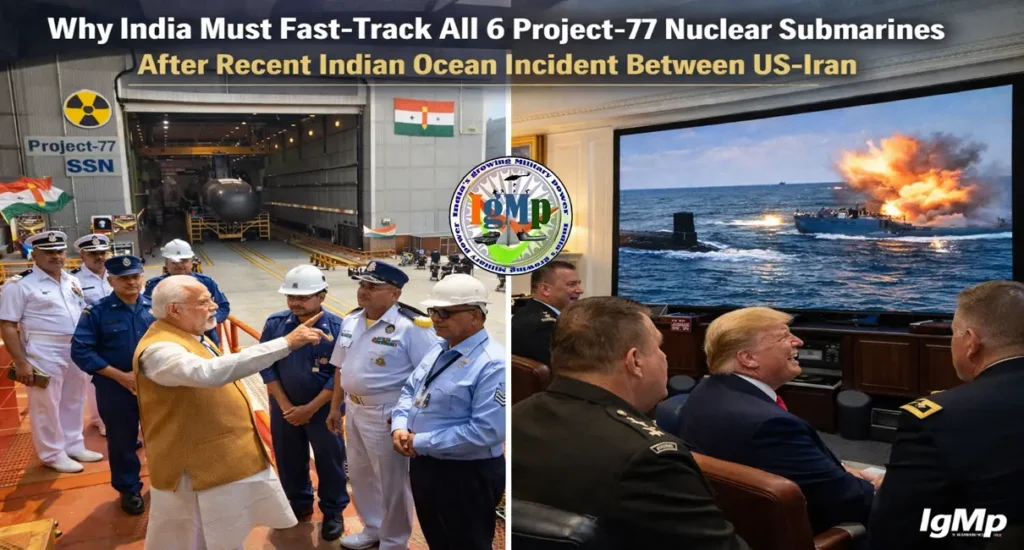
Silent Hunters Beneath the Indian Ocean: Why India’s Project-77 SSN Fleet Could Become the Ultimate Guardian of Maritime Sovereignty
Modern naval warfare is increasingly decided beneath the waves rather than on the visible surface of the sea. Aircraft carriers, destroyers and frigates often dominate public imagination, but the most decisive platforms in contemporary maritime strategy are submarines—particularly nuclear-powered attack submarines capable of operating silently for months. As the strategic competition in the Indo-Pacific intensifies, India’s long-term investment in nuclear attack submarines is emerging as one of the most consequential pillars of its maritime security architecture.
Across the world, leading naval powers have been steadily expanding their underwater fleets. The United States Navy maintains one of the most sophisticated submarine forces ever built, while the People’s Liberation Army Navy has dramatically accelerated submarine production over the past two decades. For the Indian Navy, the strategic imperative is clear: control of the vast Indian Ocean Region cannot rely solely on surface ships. It requires a powerful and persistent underwater presence capable of detecting, tracking and deterring potential adversaries long before they approach India’s maritime approaches.
The Subsurface Reality: Why Modern Naval Warfare Is Decided Underwater
Submarines offer a form of deterrence that surface fleets cannot replicate. Unlike destroyers or aircraft carriers, submarines operate largely unseen. A hostile fleet may never know that it is being tracked until it is too late. In this sense, the true strength of a submarine lies not just in its weapons but in the uncertainty it creates for adversaries. That uncertainty complicates military planning and can deter aggression without a shot ever being fired.
India’s current submarine fleet includes highly capable conventional platforms such as the Kalvari-class submarine. These diesel-electric submarines are extremely quiet and particularly effective in coastal waters, where they can ambush enemy ships and patrol critical maritime chokepoints. However, conventional submarines have inherent limitations. They must periodically surface or use snorkels to recharge their batteries, reducing their stealth and limiting their endurance.
The “Invisible Threat”: Why Nuclear Attack Submarines Change the Battlefield
Nuclear-powered attack submarines, commonly known as SSNs, operate in an entirely different category of naval warfare. Unlike conventional submarines, SSNs use nuclear reactors for propulsion, allowing them to remain submerged for months and travel thousands of kilometres without surfacing. This gives them unmatched endurance, speed and operational flexibility in deep ocean environments.
SSN vs SSK: Strategic Differences in Modern Naval Warfare
| Feature | Diesel-Electric Submarine (SSK) | Nuclear Attack Submarine (SSN) |
|---|---|---|
| Speed | 10–20 knots | 30+ knots sustained |
| Endurance | Limited; must surface/snorkel | Practically unlimited |
| Stealth | Extremely quiet but limited endurance | Silent operations for months |
| Operational Range | Coastal and regional | Global deployment capability |
| Strategic Role | Ambush and coastal defense | Deep-sea hunter and strategic deterrence |
Lessons From Recent Naval Conflicts
Because of these characteristics, SSNs often perform roles that conventional submarines cannot. They escort carrier groups, shadow enemy submarines, monitor sea lanes, conduct intelligence missions and maintain presence across vast oceanic spaces. In modern naval doctrine, they are frequently described as “hunter-killer” platforms.
Defence analysts frequently point out that modern surface warships, no matter how sophisticated, remain vulnerable to submarines operating undetected beneath the ocean surface. The very nature of underwater warfare makes detection extremely difficult, particularly in deep waters where acoustic conditions favour stealthy platforms. This reality has shaped naval strategies worldwide and reinforced the importance of undersea dominance.
Project-77: India’s Plan to Build Indigenous Hunter-Killer Submarines
For India, the answer lies in an ambitious long-term initiative known as Project-77 Indian SSN program. This program aims to develop a fleet of indigenous nuclear-powered attack submarines capable of protecting India’s maritime interests across the Indian Ocean Region. While India already operates nuclear ballistic missile submarines such as INS Arihant—designed primarily for strategic nuclear deterrence—SSNs are built for entirely different missions focused on conventional naval warfare and sea control.
The planned SSNs are expected to displace roughly 6,000 tons and incorporate advanced stealth technologies, powerful sonar systems and long-range cruise missile capabilities. Their nuclear propulsion systems would allow them to remain submerged for extended periods, enabling sustained patrols across key sea lanes stretching from the Arabian Sea to the western Pacific.
The Engineering Challenge Behind India’s SSN Program
Developing such platforms domestically is an extraordinary engineering challenge. Nuclear submarines require compact yet powerful reactors, advanced acoustic dampening technologies and highly sophisticated navigation and sonar systems. Achieving these capabilities demands decades of technological investment and collaboration between multiple sectors of the defence ecosystem.
India’s submarine development effort involves institutions such as the Defence Research and Development Organisation as well as major industrial partners including Mazagon Dock Shipbuilders Limited and Larsen & Toubro. These organisations play critical roles in designing hull structures, propulsion components, and onboard systems necessary for nuclear submarine construction.
The expertise gained during the development of the Arihant-class ballistic missile submarines has already laid important foundations for the SSN program. Those projects demonstrated India’s growing capability in nuclear propulsion, submarine design and complex naval integration—skills that will be essential for building a full fleet of attack submarines.
Budget Reality: Why Subsurface Dominance Requires Long-Term Investment
While SSNs offer enormous strategic advantages, they also represent one of the most expensive platforms in naval warfare. A single nuclear attack submarine can cost between $2 billion and $3 billion depending on its technology, sensors and weapons systems. Beyond construction costs, nuclear submarines require specialized infrastructure, highly trained crews and decades of maintenance support.
Despite these financial challenges, many defence planners view SSNs as a long-term investment in strategic autonomy. A single SSN can monitor enormous stretches of ocean, track adversary vessels, escort strategic assets and deter hostile naval activity. In some scenarios, the presence of even one such submarine can significantly complicate the operational planning of an entire naval task force.
The Geopolitical Reality of the Indian Ocean
The geopolitical importance of this capability becomes clearer when viewed against the backdrop of the Indian Ocean—one of the world’s most vital maritime regions. Nearly forty percent of global trade passes through these waters, including energy shipments that move through key choke points such as the Malacca Strait. Ensuring the security of these sea lanes is essential not only for India’s economic interests but also for the stability of international commerce.
Major naval powers increasingly operate submarines and surface fleets in this region, reflecting its strategic importance. As maritime competition intensifies, maintaining credible underwater capabilities will be essential for India to monitor activities in its extended maritime neighbourhood and protect critical infrastructure such as undersea communication cables and shipping routes.
Strategic Autonomy and the Future of Indian Naval Power
The expansion of India’s submarine capabilities is therefore not simply about building more platforms. It represents a broader shift toward comprehensive maritime domain awareness and long-term sea control. Combined with aircraft carriers, maritime patrol aircraft and advanced surveillance systems, SSNs would form a crucial layer in India’s evolving naval strategy.
For a country whose economic future is closely tied to secure sea lanes and open maritime trade, underwater deterrence offers a powerful form of strategic insurance. By investing in indigenous nuclear attack submarines, India is gradually building the capability to monitor and defend its maritime interests across one of the most strategically contested oceans in the world.