Synopsis
- Israel views India as a stable democratic power in the Indo-Pacific, while India sees Israel as a trusted defence innovator in a turbulent region.
Source : IgMp Bulletin
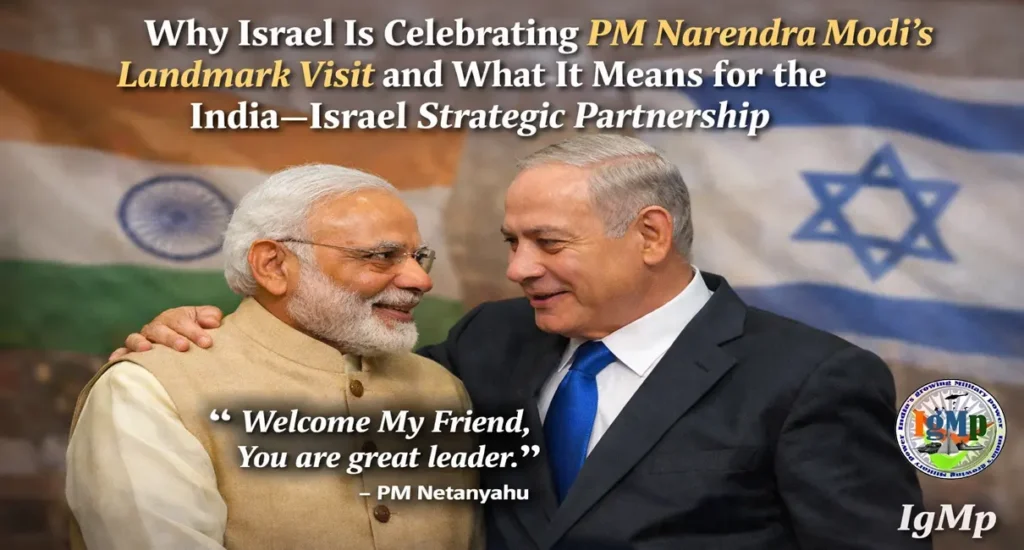
Prime Minister Narendra Modi’s recent visit to Israel has been described by officials in Tel Aviv as historic, and the public reception reflected that sentiment. For Israel, the visit symbolised not just diplomatic warmth but the consolidation of a relationship that has steadily evolved from quiet security cooperation into a visible strategic partnership.
The highlight of the visit was PM Modi’s address to a special session of the Knesset, Israel’s Parliament. Such an honour is reserved for leaders considered pivotal to bilateral ties. Following his address, he was conferred one of Israel’s highest civilian honours, a gesture that underscored how deeply New Delhi and Jerusalem now value each other’s partnership. Israeli leaders publicly acknowledged India’s rising global stature and described the relationship as one between two democracies facing complex security challenges.
The symbolism, however, was matched by substance. Defence cooperation dominated the agenda, reflecting years of growing collaboration. Israel has emerged as one of India’s most reliable defence technology partners, supplying systems that range from air defence to precision weapons. During the visit, both sides reiterated their commitment to expand joint development and co-production, moving beyond a simple buyer-seller framework.
One of the flagship joint programmes often cited as a model of this cooperation is the Barak-8 air defence system, developed by India’s Defence Research and Development Organisation in partnership with Israel Aerospace Industries. The system is now deployed across the Indian Navy and Air Force, offering layered air defence capability. The visit reinforced plans to enhance such collaboration, including upgrades and future variants.
India already operates advanced Israeli-origin systems such as the SPYDER air defence system and precision-guided munitions from Rafael Advanced Defense Systems. Discussions during the visit reportedly covered expanding joint manufacturing in India under the “Make in India” framework, with more components and subsystems to be produced locally. This aligns with New Delhi’s push for defence indigenisation while leveraging Israeli expertise in sensors, missiles and unmanned systems.
Unmanned aerial vehicles and counter-drone technologies were another focus area. Israel is globally recognised for its UAV ecosystem, and India has increasingly relied on Israeli platforms for surveillance and reconnaissance. Both governments signalled intent to deepen cooperation in next-generation drone systems, artificial intelligence-enabled surveillance and border security technologies.
There were also conversations around missile systems, electronic warfare suites and homeland security solutions. Officials hinted at new memorandums of understanding designed to facilitate joint research, faster technology transfer and closer industrial collaboration between private-sector companies from both countries. For Israel, India represents not only a major market but also a long-term manufacturing and innovation partner with scale.
The visit carried geopolitical weight as well. Israel views India as a stable democratic power in the Indo-Pacific, while India sees Israel as a trusted defence innovator in a turbulent region. Over the years, cooperation has expanded quietly in intelligence sharing and counter-terrorism coordination. Public acknowledgment of these ties during the visit marked a shift toward greater transparency and strategic confidence.
Beyond defence, agreements were also discussed in agriculture, water management and high-tech innovation, sectors where Israeli technology has already made inroads in several Indian states. But it was the defence pillar that defined the visit’s tone, reflecting a shared understanding of emerging security threats, including drones, missile proliferation and cyber warfare.
For Israel, celebrating PM Modi’s visit was about recognising a partner that has stood by it diplomatically and strategically. For India, the visit reinforced its image as a nation capable of building high-trust defence partnerships while pursuing technological self-reliance. The elevation of ties into what leaders describe as a “strategic partnership” suggests that future collaboration will likely move deeper into joint design, co-production and next-generation defence innovation, shaping a long-term security alignment between the two democracies.