Synopsis
- In a broader sense, the unveiling of this system underscores the maturation of India’s indigenous defence manufacturing base in the training and simulation segment.
Source : IgMp Bulletin
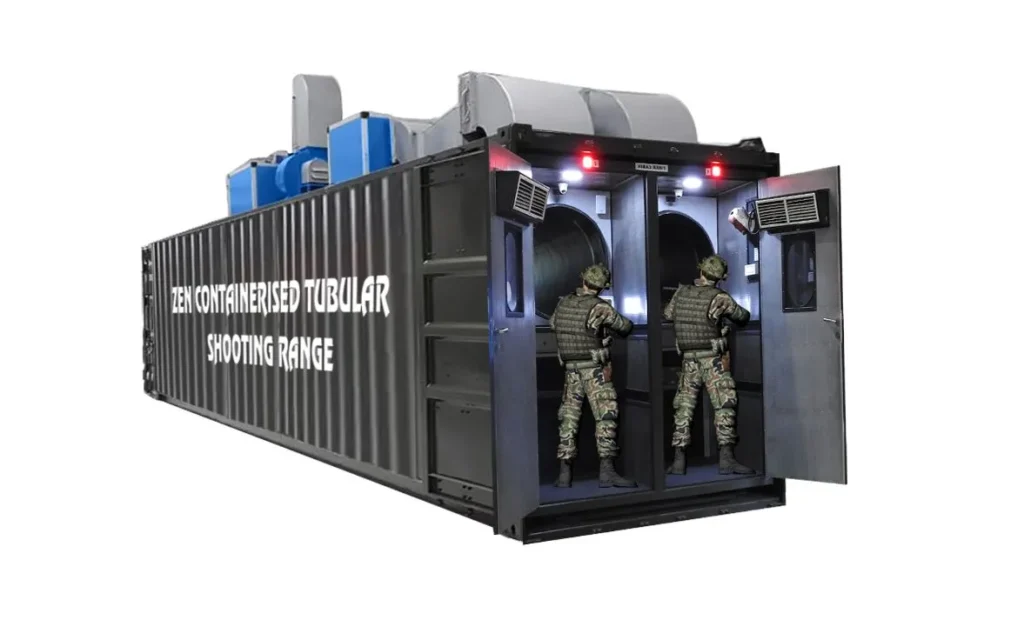
India’s defence training ecosystem is quietly undergoing a shift, and one of the more practical indicators of this change has come from Hyderabad-based Zen Technologies. The company’s newly unveiled Made-in-India Containerized Tubular Shooting Range (CTSR) reflects a growing demand for training solutions that are mobile, scalable and compliant with modern safety and environmental standards, without being tied down by heavy civil infrastructure.
At its core, the Containerized Tubular Shooting Range (CTSR) is designed to solve a long-standing problem faced by armed forces, police units and specialised agencies: access to safe live-fire training in locations where land availability, time and regulatory constraints make conventional shooting ranges impractical. Instead of permanent structures, the system relies on a self-contained, transportable module that can be deployed rapidly and relocated as operational needs change. This approach aligns closely with contemporary training doctrines, where flexibility and speed are becoming as important as realism.
What makes the system particularly relevant is its multi-role nature. Beyond functioning as a live-fire shooting range, the platform can be configured to support target retrieval systems, judgmental training through video simulators, or even forensic ballistic testing. This modularity allows a single installation to serve multiple users and training objectives, improving utilisation rates and reducing overall lifecycle costs. For organisations operating under tight budgets and high readiness demands, that versatility carries significant value.
From a technical standpoint, the emphasis on safety and environmental control is evident. The use of advanced acoustic treatments and ricochet-management materials helps create a controlled firing environment that minimises noise leakage and secondary projectile risks. This is especially important for urban or semi-urban deployments, where training facilities often operate close to civilian areas. Cleanliness and shooter safety are further enhanced by a sophisticated ventilation and air-conditioning system designed to manage lead particles and gunpowder residue during sustained firing sessions.
Power flexibility is another practical advantage. The range can operate on mains electricity or through generator support, allowing it to function in remote or forward locations where grid power may be unreliable or unavailable. This feature broadens its appeal beyond static training establishments to include temporary camps, border deployments and disaster-response staging areas where rapid setup is essential.
In terms of capability, the system supports training with small arms up to .50 calibre, covering a wide spectrum of service weapons used by military and law enforcement units. The provision for different types of soft bullet catchers allows the range to be tailored to specific applications, whether routine marksmanship, specialised tactical drills or controlled ballistic testing. Such adaptability reduces the need for multiple dedicated facilities and simplifies training planning.
The integration of target retrieval systems and video-based targetry simulators points to a blended training philosophy. Live-fire realism can be combined with scenario-driven judgmental training, enabling shooters to practice decision-making under simulated operational conditions. This hybrid approach reflects global best practices, where cognitive training is increasingly being paired with physical weapon handling to produce better-prepared personnel.
Operational oversight is addressed through 360-degree CCTV coverage, allowing instructors and safety officers to monitor every aspect of a firing session from a central control room. This not only improves safety compliance but also enables post-session review and performance analysis, which are essential for structured skill development.
Perhaps the most forward-looking aspect of the containerized tubular range is its scalability. Additional units can be added laterally or vertically, increasing length, width or even creating multi-level configurations. This “building block” design allows organisations to start with a basic setup and expand as requirements evolve, without discarding existing infrastructure.
In a broader sense, the unveiling of this system underscores the maturation of India’s indigenous defence manufacturing base in the training and simulation segment. Rather than focusing solely on headline-grabbing weapon platforms, companies like Zen Technologies are addressing everyday operational needs that directly affect readiness and safety. As security forces place greater emphasis on decentralised training and rapid deployment, containerized solutions such as this tubular range are likely to become an increasingly common feature across India’s defence and internal security landscape.