Synopsis
- In such scenarios, importing a mature or near-mature system off the shelf can act as a bridge, ensuring the aircraft enters service with credible firepower while domestic solutions continue to mature.
Source : IgMp Bulletin
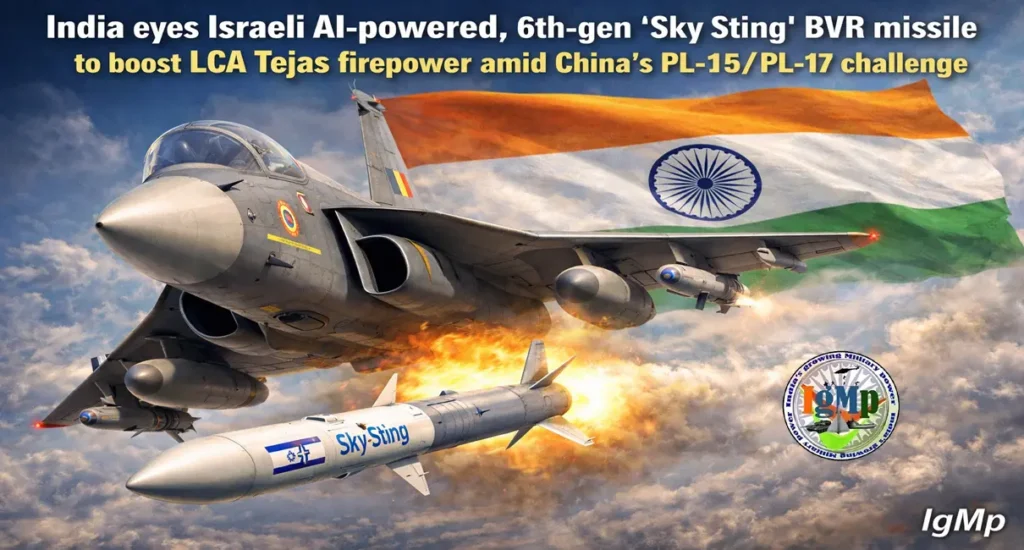
As Prime Minister Narendra Modi deepens strategic engagement with Israel during his visit, a key defence discussion is quietly gathering momentum in the background. India is evaluating Israel’s next-generation beyond-visual-range air-to-air missile, widely referred to as “Sky Sting,” as a potential game-changer for the Light Combat Aircraft Tejas and possibly even the Su-30MKI fleet. The move reflects not just a procurement choice, but a larger calculation about air superiority in a rapidly evolving regional threat environment.
China’s deployment of long-range air-to-air missiles such as the PL-15, and reports surrounding even longer-range concepts like the PL-17, have altered the air combat equation in Asia. These missiles, paired with advanced AESA radars and networked warfare systems, are designed to engage adversaries well before traditional visual or even mid-range combat begins. For the Indian Air Force, matching or exceeding that envelope is critical, especially along contested borders where response times are compressed.
Sky Sting, being developed by Rafael Advanced Defense Systems, is understood to target the 250-kilometre class, placing it in the upper tier of BVR capabilities globally. Its reported triple-pulse rocket motor would allow sustained energy in the terminal phase, giving it high end-game speed and maneuverability. More notably, its radio-frequency seeker is said to incorporate AI-driven target discrimination and advanced electronic counter-countermeasure features. In practical terms, that means better resistance to jamming and greater confidence in distinguishing real targets from decoys in dense electronic warfare environments.
For a lightweight fighter like the HAL Tejas, missile weight matters. A 180–200 kg class weapon with extended reach offers disproportionate lethality. The Tejas Mk1A, especially in its early batches equipped with the Elta Systems EL/M-2052 AESA radar, could see a significant boost in stand-off engagement capability. That matters at a time when the IAF’s squadron strength remains below sanctioned levels and legacy fleets such as Jaguars and older MiG variants approach retirement.
However, the discussion is not without sensitivity. India’s indigenous Astra missile programme, led by DRDO and produced by Bharat Dynamics Limited, has made steady progress. The Astra Mk1 has already entered service, while longer-range variants are under development. Critics argue that inducting a foreign long-range missile at this stage could dilute focus or funding for Astra Mk2 and Mk3, the latter expected to push into the 300-kilometre-plus category using advanced propulsion concepts.
The counterargument is operational urgency. Integration challenges between Astra Mk1 and the Israeli radar selected for the Tejas Mk1A have reportedly slowed timelines. When fighter deliveries are already under pressure, any delay in weapon integration compounds the problem. In such scenarios, importing a mature or near-mature system off the shelf can act as a bridge, ensuring the aircraft enters service with credible firepower while domestic solutions continue to mature.
India’s defence relationship with Israel has historically followed this pattern. From Derby and Python air-to-air missiles to SPICE precision-guided munitions and advanced targeting pods, Israeli systems have often filled capability gaps at critical junctures. Over time, cooperation has expanded into co-development and technology partnerships rather than simple buyer-seller transactions. A phased approach for Sky Sting—initial imports followed by local production and integration—would align with this trajectory.
The broader strategic question is not import versus indigenous, but sequencing. Air warfare technology evolves rapidly, and adversaries do not pause while development cycles run their course. The IAF must ensure credible deterrence today, even as it builds self-reliance for tomorrow. Importing a system that also exposes domestic industry to advanced seeker, propulsion or ECCM technologies can, if negotiated wisely, accelerate indigenous learning curves.
There is also the China factor. The People’s Liberation Army Air Force has invested heavily in long-range sensors, data links and missile reach. Matching that capability is not simply about headline range numbers; it requires network integration, secure data links and reliable mid-course updates. If Sky Sting’s two-way data link and AI-enabled seeker perform as advertised, they could significantly enhance survivability and engagement probability in contested airspace.
Ultimately, India’s choice will reflect a balance between immediate readiness and long-term autonomy. The Tejas programme itself demonstrates that self-reliance is a journey measured in decades, not procurement cycles. If managed carefully, acquiring an advanced Israeli BVR missile need not undermine Astra’s evolution. Instead, it could buy time, close near-term gaps and sharpen India’s technological edge in a domain where milliseconds and kilometres define the outcome.