

Synopsis
- Speaking at the Network18 Rising Bharat Summit, Defence Secretary Rajesh Kumar Singh made it clear that while discussions with Moscow continue, no commitment has been made on the Russian offer currently on the table.
Source : IgMp Bulletin

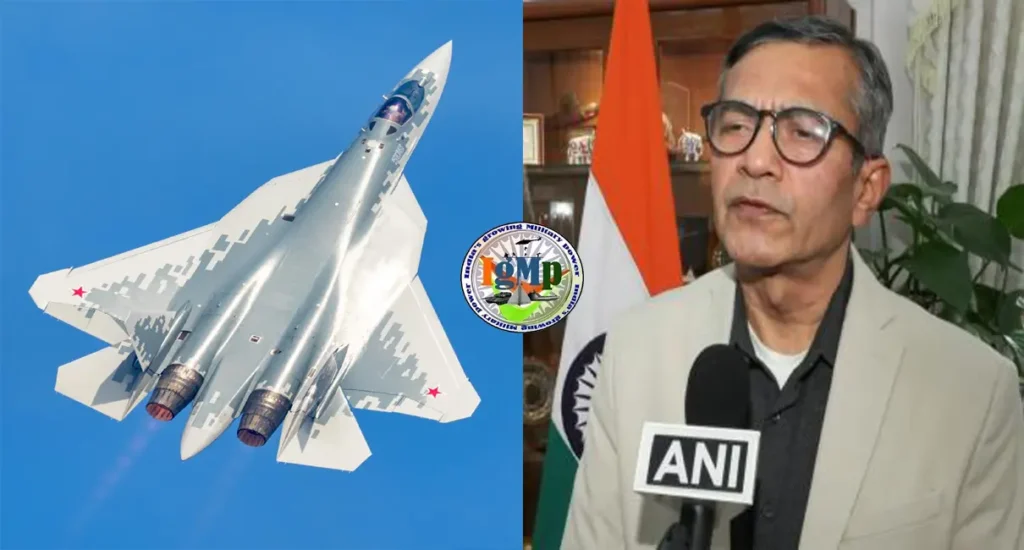
India has not taken a final call on acquiring Russia’s fifth-generation stealth fighter, the Sukhoi Su-57, signalling a cautious and methodical approach as the country weighs long-term air power priorities against near-term operational needs. Speaking at the Network18 Rising Bharat Summit, Defence Secretary Rajesh Kumar Singh made it clear that while discussions with Moscow continue, no commitment has been made on the Russian offer currently on the table.
The remarks come at a time when India’s fighter jet roadmap is under intense scrutiny, especially after recent operational lessons and growing regional competition. Singh underlined that the government’s primary focus for immediate capability enhancement remains the Multi-Role Fighter Aircraft programme, which continues to centre on the Dassault Rafale. However, this pathway is not just about numbers. New negotiations are expected to push hard for deeper indigenous manufacturing, greater technology absorption, and stronger integration with India’s domestic aerospace ecosystem.
On the Su-57, Singh struck a deliberately measured tone. He acknowledged that conversations with Russia are ongoing but stressed that these talks have not translated into a policy decision. When asked whether geopolitical pressures, including sanctions regimes or parallel trade negotiations with the United States, were slowing progress, he dismissed the idea that India’s defence engagement with Russia is being constrained externally. According to him, cooperation with Moscow continues on its own track, guided by India’s strategic interests rather than external timelines.
At the heart of India’s fifth-generation ambitions lies the Advanced Medium Combat Aircraft (AMCA) programme. Singh reaffirmed that AMCA is the country’s true long-term answer to fifth-generation requirements, with private industry now being shortlisted to participate in prototype development. This marks a significant shift from earlier state-led models, reflecting confidence in India’s growing aerospace manufacturing base and design capability.
While Singh avoided going into technical detail, his comments hinted at unresolved questions surrounding the Su-57 that continue to weigh on the decision-making process. Comparisons with other fifth-generation platforms, performance benchmarks, and integration challenges are understood to be part of the internal assessment. These factors, he suggested, contribute to why “no call has been taken yet,” despite the aircraft’s potential appeal as an interim stealth solution.
The broader strategic context is equally important. Post-Operation Sindoor, India’s defence planning has leaned heavily toward rapid indigenisation and targeted emergency procurements to close immediate gaps, rather than committing to large-scale imports of next-generation platforms. This approach explains the reluctance to rush into a foreign fifth-generation deal, even as regional air forces induct advanced assets such as China’s Chengdu J-20.
Russia’s proposal for supplying the Su-57, including the possibility of local production, remains active. Yet New Delhi’s response continues to be deliberately non-committal, reflecting a desire to balance strategic partnerships with the push for self-reliance. Singh’s disclosure at the summit effectively confirms that the door to the Su-57 is neither closed nor fully open; it remains under evaluation alongside allied options and indigenous programmes.
For the Indian Air Force, this wait-and-watch stance underscores a larger transformation. Rather than chasing quick fixes, India appears intent on shaping a fighter fleet that aligns with long-term industrial growth, operational flexibility, and strategic autonomy, even if that means living with interim capability gaps while indigenous solutions mature.


