

Synopsis
- To the Indian Army, the helicopter has been projected to be an essential element in the high altitude operations, such as logistics, reconnaissance, casualty evacuation, and transportation of troops expeditiously in some of the toughest territories in the world.
Source : IgMp Bureau

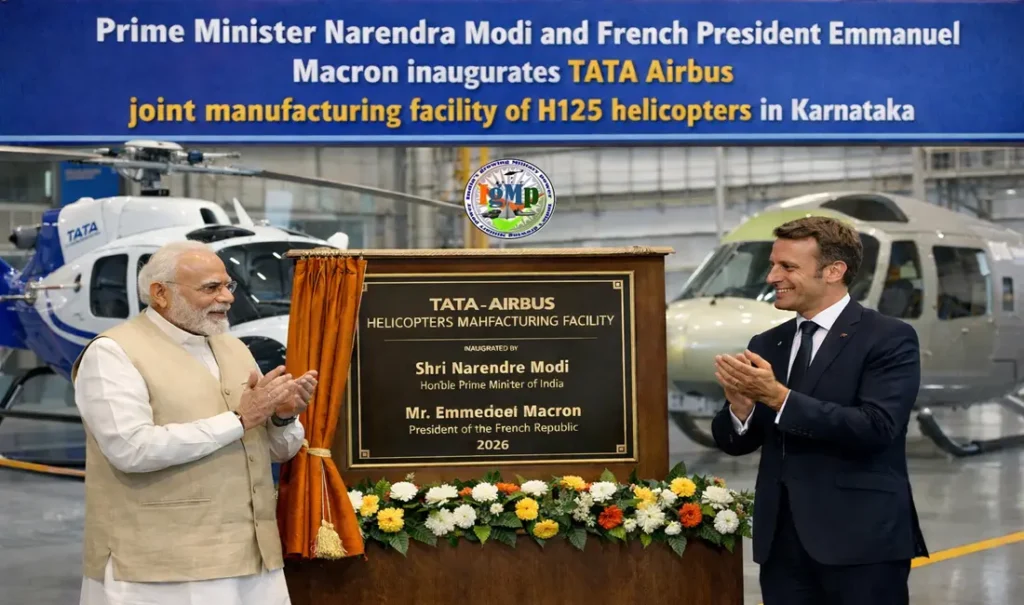
The virtual launch of the Tata-Airbus H125 Helicopter Assembly Line in Karnataka by French President Emmanuel Macron and Prime Minister Narendra Modi gave India a significant boost towards becoming a global aerospace manufacturing hub. The plant, which is a joint venture between Tata Advanced Systems Limited (TASL) and Airbus, is a major milestone in India-France strategic cooperation and an indication of New Delhi’s renewed confidence in the development of a complex aerospace platform in India.
The final assembly line, located at Vemagal in Karnataka, is the first of its kind for Airbus helicopters in India and signals a shift from simple assembly work to deeper industrial participation. In his address on the occasion, Defence Minister Rajnath Singh noted that the cumulative investment on H125 programme is to surpass ₹1,000 crore. He further highlighted the employment prospects of the programme, saying that it will provide both direct and indirect employment opportunities to the talented and technically-trained young population of India, further strengthening the overall goals of self-sufficiency and industrial development.
The centerpiece of the program is the Made in India H125 helicopter, a light single-engine platform, which has gained a worldwide reputation in respect of performance, reliability, and versatility. The helicopter will fulfill the long-term need of the Indian armed forces for a light multi-purpose helicopter that will work under harsh conditions, especially on the Himalayan borders. In addition to defence requirements, the programme is also set to create new options in the field of civil and para-public requirements, such as emergency medical services, disaster preparedness, law enforcement, and infrastructure assistance.
It is an important point that Karnataka has been selected as the location of the manufacturing base for this project. The state has gradually been building up to be a significant aerospace and defence centre, with a broad network of suppliers, scientific establishments, and high-quality human resources. Tata Advanced Systems Limited (TASL) will be responsible for the Vemagal facility to manufacture and test H125, including assembling, integrating, and testing structural, mechanical, and electrical systems. Final flight tests before delivery are also incorporated in the scope of work, which is a high degree of trust in Indian industrial capacity manifested through Airbus.
The relationship between Tata and Airbus does not end at the civil version. There are already plans to have a military variant, the H125M, which will be sold under the Indian production line, using a high indigenization of components and technologies. This is in line with the long-term expectations of India on decreasing dependence on imports and maintaining adaptable platforms to the unique requirements of operations. To the Indian Army, the helicopter has been projected to be an essential element in the high altitude operations, such as logistics, reconnaissance, casualty evacuation, and transportation of troops expeditiously in some of the toughest territories in the world.
Export orientation is another aspect that is most remarkable about the programme. Makers of helicopters in the Indian plant, including Tata and Airbus, have pointed out that their projects will not be restricted to domestic markets. Made in India H125 would be delivered in early 2027 and will also be exported to the South Asian region. This not only places India as an individual who consumes aerospace products, but also as someone who has the capability of supplying these products in the local and international markets, a move that has long been championed by policymakers.
The track record of the H125 makes such ambitions stronger. It is the highest-selling single-engine helicopter in its category in the world, and it is a part of the Airbus Ecureuil family that has actually developed in excess of 40 million flight hours all around the world. Its capacity to work in high-and-hot weather and extreme environments has made it a favorite in continents. The versatility of the helicopter enables it to be reconfigured for a wide range of missions, including aerial work and firefighting operations, law enforcement, search and rescue, air ambulance operations, and transporting passengers.
There is currently no aircraft of its category that represents high performance more than the H125. It is the only helicopter ever to have landed on Mount Everest, and this proved its agility, power margins, and ability to operate well in thin air, hence in poor conditions. In case of India, where much of the military and civil aviation is being conducted in mountain ranges and high-altitude areas, these features are not merely impressive on paper, but fully operationally necessary.
From the industrial point of view, the effect of this program will be multiplied. Local procurement of components, building the supplier networks, and transferring manufacturing expertise will strengthen the local aerospace ecosystem chain in the country. In the long-term, this would carry over to other rotary-wing and fixed-wing programs and make the country able to design, manufacture, and maintain complex platforms on its own. In case of Airbus, the Indian plant includes access to an emerging market and a competitive manufacturing base, whereas in case of Tata, it gets closer to becoming one of the key players in the global aerospace supply chains.
The opening of the inauguration by both Indian Prime Minister Modi and French President Macron has diplomatic value as well. Over the last ten years, India and France have continued to increase their defence relationships, which range from fighters, submarines, and helicopters to space technologies. H125 production line is a sign of a mature relationship in which it is no longer confined to only the buyer and the seller dynamics, but it also expands to co-production, absorption of technology, and the long-term industrial relationship.
With modernisation of the armed forces and the demands of civilian aviation, the H125 and similar aircraft are likely to be a transition point between older generations of aircraft and home-made aircraft. The performance of this programme will be highly monitored not only in terms of the delivery schedules and market of the product to be exported, but also its ability to make the Indian industry familiar with the international aerospace standards and practices. As the start of actual work on production starts in the coming few years and the first deliveries are planned in 2027, the Tata-Airbus H125 project can be described as a real-life demonstration of how strategic alliances, industry prowess, and the development of domestic policy can combine to change the status of India in the aerospace market.


