Synopsis
- The claim, attributed to the Islamic Revolutionary Guard Corps, has not been confirmed by the United States military, leaving analysts to assess the situation by examining both the technical realities of naval warfare and the strategic environment in which the incident reportedly occurred [Source.
IgMp Bulletin

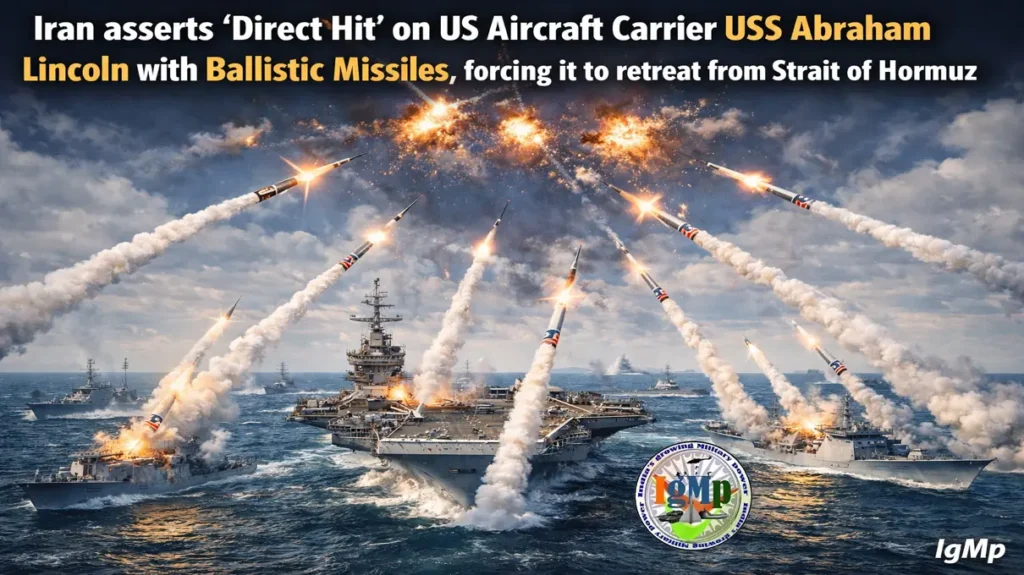
Tensions in the Persian Gulf have again entered the spotlight after Iranian officials claimed that the aircraft carrier USS Abraham Lincoln withdrew from waters near the Strait of Hormuz following an encounter with Iranian naval drones. The claim, attributed to the Islamic Revolutionary Guard Corps, has not been confirmed by the United States military, leaving analysts to assess the situation by examining both the technical realities of naval warfare and the strategic environment in which the incident reportedly occurred [Source: Middle East Monitor].
The Strait of Hormuz is one of the most sensitive maritime corridors in the world. Roughly one-fifth of global oil shipments pass through the narrow waterway, making it a focal point of geopolitical competition. For decades, Iran has sought to develop asymmetric strategies capable of threatening larger naval forces operating close to its coastline, while the United States and allied navies have invested heavily in layered missile defence and surveillance systems to protect their fleets.
Evaluating the Claim: Ballistic Missiles vs. Carrier Strike Group Defense
To understand the plausibility of the Iranian claim, it is essential to examine how a US carrier strike group operates defensively. The USS Abraham Lincoln does not sail alone. It typically operates within a heavily protected formation that includes guided-missile destroyers such as the Arleigh Burke-class destroyer. These vessels are equipped with the advanced Aegis Combat System, which integrates long-range radar detection with interceptor missiles capable of engaging aircraft, cruise missiles, and ballistic threats.
Central to this defence network is the AN/SPY-1 radar, a powerful phased-array radar capable of tracking hundreds of targets simultaneously across vast distances. Once a threat is detected, destroyers can launch interceptors such as the SM-3 missile designed to defeat ballistic missiles in space, or the SM-6 missile which can intercept both aircraft and cruise missiles in the atmosphere.
Iran has developed several anti-ship missile systems intended to challenge large naval vessels, including the Khalij Fars and the hypersonic-capable Fattah missile. In theory, such weapons are designed to strike moving ships at sea. However, successfully targeting a maneuvering aircraft carrier protected by multiple radar and interceptor layers remains an extremely complex task.
In practice, if a ballistic missile strike had actually hit a Nimitz-class carrier, analysts would expect significant visible damage. Satellite imagery from commercial providers such as Maxar Technologies or Planet Labs would likely capture smoke plumes, fire damage, or other signs of impact on a vessel that displaces more than 100,000 tons. So far, no such imagery has emerged publicly.
The Drone Swarm Factor: Strategic Signaling in the Strait of Hormuz
Iranian officials specifically referenced drones approaching the carrier group. In recent years, the IRGC has invested heavily in unmanned systems, including reconnaissance drones such as the Shahed-136 and the Ababil UAV. These platforms can monitor naval movements, relay targeting information, or conduct harassment operations against foreign vessels.
The use of drones in maritime encounters often serves a signaling purpose rather than an immediate attack. By deploying unmanned aircraft to shadow a carrier group, a coastal power can demonstrate surveillance capability and remind adversaries that their movements are being tracked. Such encounters occur regularly in contested maritime regions, from the South China Sea to the Persian Gulf.
The Tactical Environment: Strait of Hormuz Chokepoint
| Factor | Description | Strategic Significance |
|---|---|---|
| Width | About 33 km at its narrowest point | Ships entering the corridor become more predictable targets |
| Iran’s Capability | Development of anti-ship ballistic missiles | Designed to threaten large naval vessels from land bases |
| US Capability | Layered missile defence using Aegis and interceptors | Destroyers protect the carrier with long-range radar and missiles |
| Detection | Persistent drone surveillance | Enables continuous monitoring of naval movements |
Because of these factors, the strait is often described by analysts as a potential “kill zone” where shore-based missile systems could theoretically target passing ships. At the same time, the presence of powerful US naval defences makes such operations extremely risky for any attacker.
The Retaliation Cycle: Linking the Incident to Wider Regional Events
The timing of the claim is notable. It comes amid reports of an Iranian naval vessel sinking in the Indian Ocean, an incident that has been linked by some analysts to escalating tensions involving Iran, the United States, and Israel. The vessel often mentioned in regional reporting is the IRIS Dena, though details surrounding that event remain limited and contested.
If the carrier encounter occurred close to this timeline, some observers interpret it as part of a broader signaling cycle. Iran’s Revolutionary Guard frequently uses high-profile military announcements to demonstrate resilience or deterrence following losses at sea or elsewhere. Publicizing a confrontation with a US carrier could therefore serve both domestic messaging and strategic communication purposes.
Global Implications: Energy Security and Maritime Stability
Beyond the immediate military dimension, any confrontation in the Strait of Hormuz carries major implications for global energy markets. The narrow passage links the oil-producing states of the Persian Gulf to international consumers in Asia, Europe, and beyond. Even temporary disruptions can trigger volatility in oil prices and shipping insurance rates.
For countries like India, which relies heavily on energy imports passing through these waters, stability in the region is more than a distant geopolitical issue. It directly affects energy security, shipping costs, and broader economic planning.
Military analysts therefore watch every reported encounter in the Persian Gulf closely. Whether the latest incident represents a routine naval maneuver or a more serious confrontation remains unclear, but the episode underscores how fragile the balance of deterrence can be in one of the world’s most strategically important maritime corridors.