Synopsis
- Speaking during his State of the Union address on 25 February 2026, Trump asserted that the conflict in May 2025 could have spiralled into a disaster that might have killed millions, including Pakistan’s Prime Minister Shehbaz Sharif.
Source : IgMp Bulletin

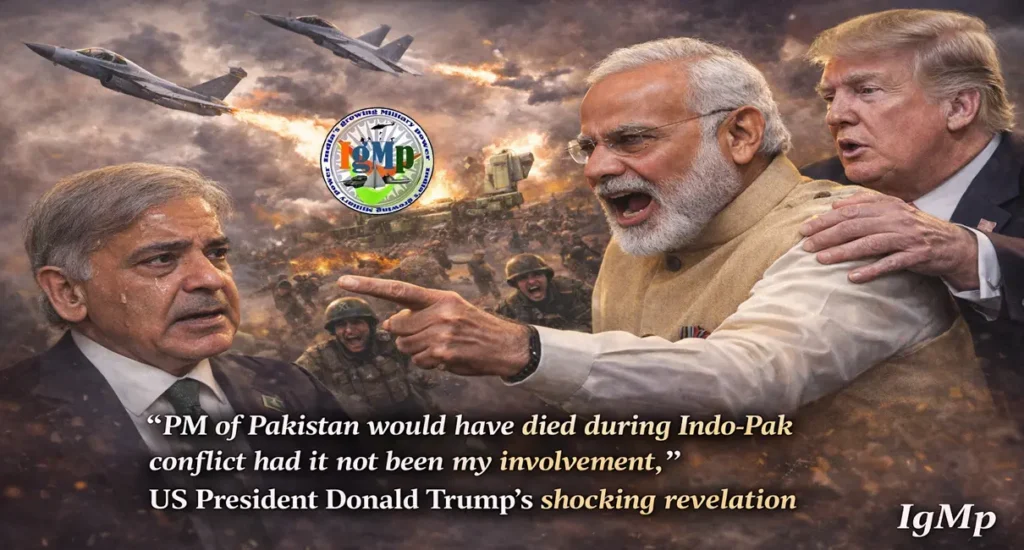
US President Donald Trump has reignited debate over last year’s India-Pakistan crisis by claiming that his personal intervention prevented a potential nuclear catastrophe. Speaking during his State of the Union address on 25 February 2026, Trump asserted that the conflict in May 2025 could have spiralled into a disaster that might have killed millions, including Pakistan’s Prime Minister Shehbaz Sharif. According to Trump, strong pressure from Washington, including the threat of steep tariffs, forced both sides to step back from the brink.
The remarks immediately drew attention in South Asia, where the brief but intense flare-up between India and Pakistan had already been a subject of close international scrutiny. The crisis was triggered by a deadly terror attack in Jammu and Kashmir’s Pahalgam region in April 2025, in which 26 civilians lost their lives. India attributed the strike to Pakistan-based militant groups and responded with cross-border precision strikes under what was widely referred to as Operation Sindoor.
New Delhi described its action as targeted and non-escalatory, aimed solely at dismantling terror infrastructure. Pakistan retaliated with drone incursions and heavy shelling along the Line of Control, raising fears of a broader military confrontation between two nuclear-armed neighbours. The hostilities lasted four days before both sides announced a ceasefire on 10 May 2025 through established military hotlines between their Directors General of Military Operations.
While Trump has repeatedly claimed that US pressure, including tariff threats, played a decisive role in enforcing calm, Indian officials have firmly rejected the suggestion of third-party mediation. Prime Minister Narendra Modi and senior diplomats have maintained that de-escalation was achieved through direct bilateral communication. India’s position has been consistent for decades: disputes with Pakistan are to be handled bilaterally without external involvement.
There has also been no public confirmation from Islamabad supporting Trump’s assertion that Sharif personally conveyed dire warnings about mass casualties. Analysts note that while Washington routinely monitors South Asian crises and engages both capitals diplomatically, concrete evidence of direct US brokerage in the May 2025 ceasefire has not emerged.
Trump framed his comments within a broader narrative of his foreign policy, highlighting what he described as multiple conflicts defused during his tenure. Domestically, the claim reinforces his long-standing projection as a dealmaker capable of using economic leverage to shape geopolitical outcomes. His administration had, in fact, signalled the possibility of punitive trade measures during that period, though subsequent tariff decisions were also linked to wider trade negotiations and energy policies.
For India, the episode underscores the delicate balance between strategic partnerships and sovereign autonomy. The United States remains a key defence and economic partner, yet New Delhi has been cautious about any suggestion that external actors influence its security decisions, especially regarding Pakistan.
The 2025 crisis also highlighted how rapidly regional tensions can escalate in an era of drones, precision strikes and information warfare. Despite the brief duration of the confrontation, global markets reacted sharply, and diplomatic channels across major capitals were activated. Nuclear risk, even if remote, amplifies every skirmish in South Asia.
As of early 2026, the ceasefire largely holds, though sporadic incidents along the Line of Control continue. Trump’s latest comments have added a fresh political layer to an already complex chapter in Indo-Pak relations. Whether seen as bold diplomacy or political hyperbole, the claim has once again drawn global attention to one of the world’s most sensitive nuclear fault lines.