Synopsis
- While he described the 11-day campaign as a “short-term excursion,” officials inside the United States Department of Defense suggested that operations may continue until the end of March if Iran refuses to halt its missile activities.
IgMp Bulletin

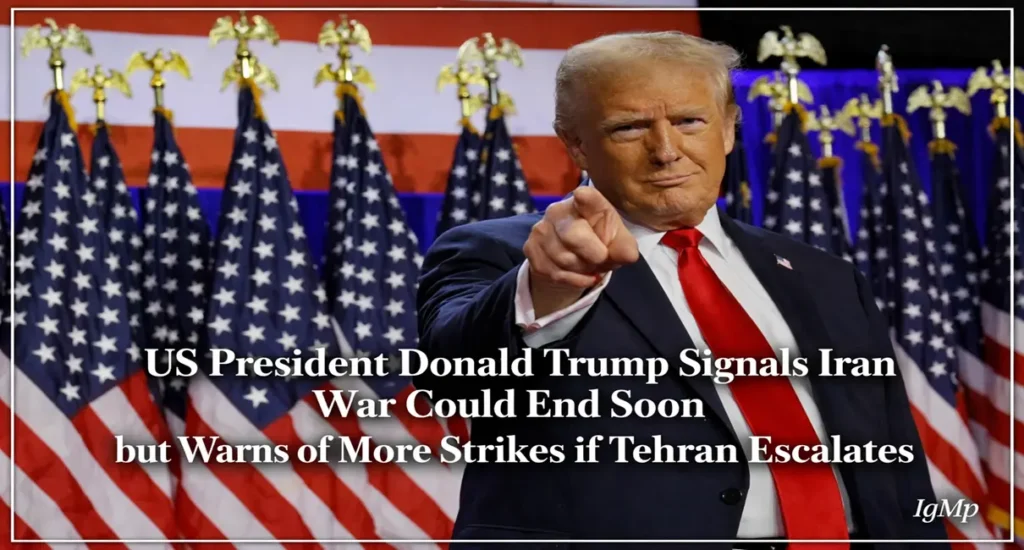
On March 10, 2026, U.S. President Donald Trump said the ongoing war with Iran under Operation Epic Fury could end “very soon,” claiming that most of Tehran’s missile launch infrastructure has already been neutralized. At the same time, Washington has deliberately avoided striking several high-value assets—including Iran’s electrical grid—to maintain leverage if the conflict escalates or if Tehran interferes with global oil shipments through the Strait of Hormuz.
The latest remarks came during a series of interviews and public comments where Trump tried to strike a balance between projecting military success and warning that the United States is prepared for further escalation. While he described the 11-day campaign as a “short-term excursion,” officials inside the United States Department of Defense suggested that operations may continue until the end of March if Iran refuses to halt its missile activities.
The conflict, officially named Operation Epic Fury, has already reshaped the security environment across West Asia. According to U.S. briefings, thousands of targets linked to Iran’s military infrastructure have been hit by precision strikes coordinated with Israel. American officials say the campaign has severely degraded Iran’s missile launch capacity and disrupted command networks connected to the Islamic Revolutionary Guard Corps.
At the same time, Washington has intentionally avoided hitting certain strategic assets that could push the conflict into a broader regional crisis. Trump confirmed that Iran’s electrical grid remains a “reserved target,” meaning it could be struck if Tehran escalates the war or interferes with international shipping lanes.
Several key developments currently define the state of the conflict:
- Status of the war: Trump claims that a large portion of Iran’s missile launchers and military infrastructure have already been destroyed, calling the campaign largely successful.
- Preserved strategic targets: U.S. planners have kept Iran’s national power grid and some command facilities untouched to maintain leverage in negotiations or future operations.
- Energy security concerns: Washington has warned that any attempt by Iran to block tanker traffic through the Strait of Hormuz would trigger retaliation “far beyond anything seen so far.”
- Leadership transition in Tehran: The elevation of Mojtaba Khamenei following the death of Ali Khamenei has added uncertainty to diplomatic calculations. Trump described the appointment as “unacceptable” and a continuation of the same leadership structure that Washington opposes.
The leadership shift in Iran has become one of the most politically sensitive aspects of the crisis. Western analysts believe the transition could either consolidate hardline authority in Tehran or open internal fractures within the political system. Trump has repeatedly suggested that Iran’s leadership must change course if it hopes to end international isolation and military pressure.
Energy markets are also reacting sharply to developments on the battlefield. Oil prices surged toward $120 per barrel in the early days of the conflict amid fears that the Strait of Hormuz—through which a large share of global oil shipments flows—could be disrupted. In an attempt to stabilize markets, the White House temporarily relaxed certain oil sanctions to keep supply moving and prevent a broader economic shock. After Trump’s comments about the war potentially ending soon, crude prices retreated back below the $90 range.
Military data released by U.S. officials offers a snapshot of the campaign’s scale:
| Feature | Current U.S. Status (March 2026) | Strategic Objective |
|---|---|---|
| Air & Sea Operations | Thousands of targets struck; Iranian naval assets heavily damaged | Neutralize IRGC maritime capabilities |
| Oil Market Impact | Prices fluctuating between roughly $87 and $120 | Stabilize markets through controlled escalation |
| Missile Infrastructure | Majority of launch sites reportedly destroyed | Permanently weaken Iran’s ballistic missile threat |
Despite Trump’s suggestion that the conflict could wrap up soon, Pentagon messaging indicates that the campaign may continue if Iran refuses to de-escalate. Officials say the next phase will depend largely on whether Tehran attempts retaliation or disrupts oil shipping routes.
Diplomatic channels remain active behind the scenes. Trump confirmed he recently spoke with Vladimir Putin about the conflicts in both West Asia and Ukraine, describing the conversation as constructive. Russia maintains strategic ties with Iran, meaning Moscow could play a role if negotiations or ceasefire efforts begin.
For now, the world is watching a fragile moment in the crisis. Military pressure, political messaging, energy market stability, and leadership changes in Tehran are all converging at once, making Operation Epic Fury one of the most consequential geopolitical flashpoints of 2026.