

Synopsis
- The Pralay, which was developed by the Defence Research and Development Organisation (DRDO), is a new generation of surface-to-surface systems that was designed to face the type of interception challenges we saw in the 2020 Nagorno-Karabakh war.
Source : IgMp Bulletin

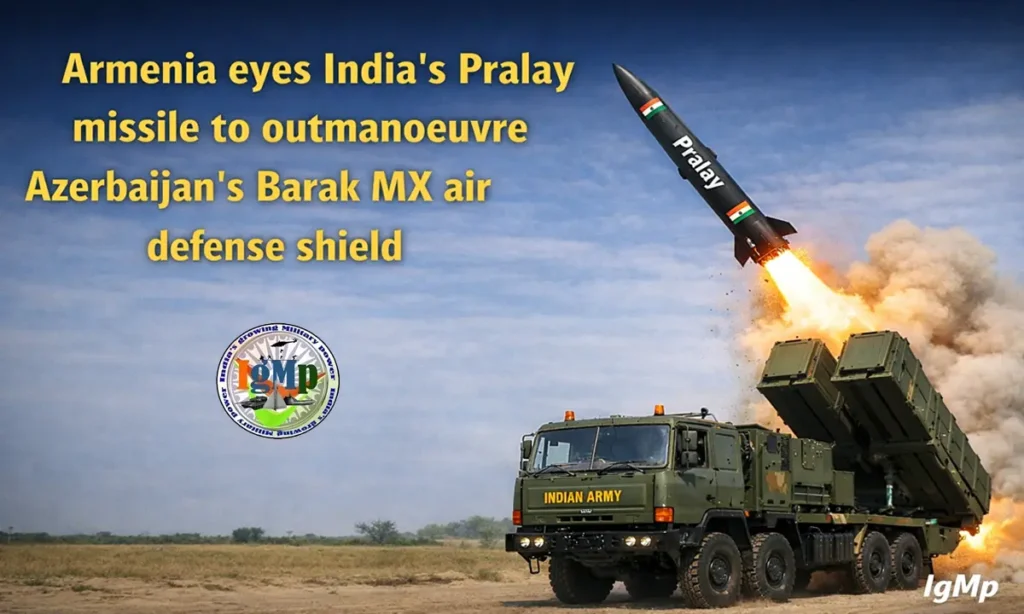
The aftershocks of the 2020 war over Nagorno-Karabakh continue to reshape military planning in the South Caucasus. In case of Armenia, the war was a wake-up call in terms of technology and also a loss of territory. Dealing with an opponent with a superior-equipped Azerbaijani force, with the successful integration of armed drones, precision artillery, and networked air defenses, the dependence of the Yerevan army on older Soviet-era missile systems revealed critical shortcomings.
In the war, there were legacy systems, like Scud-B and Tochka-U ballistic missiles, which were used by the Armenian troops. Other strikes, such as the one that struck the city of Ganja, caused civilian deaths and were internationally scrutinized. More advanced Russian-made Iskander ballistic missiles that had long been considered a strategic asset were later deployed by Armenia as the war took a one-sided turn towards the benefit of Azerbaijan. But these too were said to have been intercepted or even neutralised, the efficiency of the Azerbaijan air defence architecture continuing to increase.
Main architechture of the successful Azerbaijan air defense network is the Barak MX, which is an Israeli-designed weapon manufactured by Israel Aerospace Industries (IAI). The Barak MX is a modular platform with the capability to engage numerous different aerial targets, such as aircraft, drones, and ballistic missiles up to a range of 150 kilometres, using different interceptors. Its proactive radar control, quick turnaround time, and an integrated structure provided Azerbaijan with a formidable protective cover around strategic targets.
Lessons were clear-cut for the defense planners in Armenia. Conventional ballistic missiles generally follow a predictable, high-arching projectile, and therefore, the higher the projectile rises, the more precise the interception point can be calculated by an advanced air defence system. Once incoming missiles can be constantly tracked and their trajectories are predetermined, the degree of danger reduces significantly. Reinforcing that deterrent has become a priority for Yerevan.
This strategic review has made Armenia look at the Pralay tactical short-range ballistic missile of India. The Pralay, which was developed by the Defence Research and Development Organisation (DRDO), is a new generation of surface-to-surface systems that was designed to face the type of interception challenges we saw in the 2020 Nagorno-Karabakh war.
Unlike traditional ballistic missiles, Pralay takes a quasi-ballistic path. It does not fly in a steep, easily shaped, predictable curve, but on a flatter curve, and can execute evasive manoeuvres in its last stage. This manoeuvrability makes the calculations of the defender complex and shortens the reaction time. With a system like Barak MX that would deal with precise tracking and a predictive intercept algorithm, even the slightest variation in trajectories can make interception a lot harder.
Pralay, made in its export form, is capable of meeting the requirements of the Missile Technology Control Regime (MTCR), limiting its range to 290 kilometres and payload to 500 kilograms. Despite these limits, it offers high accuracy and mobility. The missile is launched from road-mobile, canisterised platforms, allowing for rapid deployment and survivability in contested environments.
The interest in Pralay shown by Armenia also indicates a wider change in its defence procurement policy. Over the last few years, defense cooperation between New Delhi and Yerevan has grown. Armenia has also placed significant orders for Pinaka multiple-barrel rocket launchers, Swathi weapon-locating radars, and Akash air defence systems, which are all India-made weapons. These acquisitions are a pointer to a calculated move to diversify beyond overdependence on one supplier and a move to modernise across several fronts.
If the Pralay deal ever happens, Armenia will be the first foreign user of the missile. Such capability would, in strategic terms, act as a counter to comparable long-range precision strike capabilities of Azerbaijan, including Israeli long-range strike systems such as LORA. It is not necessarily about escalation, though restoring balance is the aim. Credibility is important in the deterrence theory: it is necessary to have weapons capable of going through the defences at a reasonable rate to impact the calculations of an adversary.
In case of India, the export of the Pralay missile will fulfill its desire to become a major global defence supplier. By providing systems meeting the requirements of the MTCR to credible defence partners, New Delhi will be able to increase its footprint in the strategic sense without breaching international standards. The effective delivery and integration would also reflect India’s increasing capability in the state of high-level missile technologies, as it would its reputation among the competitive global weapons market.
Almost six years after the guns fell silent in Nagorno-Karabakh, the balance of unprecedented technological arms has shifted in the dispute between Armenia and Azerbaijan. The fact that Pralay is being considered in Armenia highlights how contemporary warfare is transforming procurement decision-making, with manoeuvrability, survivability, and network resilience becoming the priority as opposed to raw firepower. It is in that changing equation that the capability of outmanoeuvring advanced air defences might be at the centre of reestablishing some credible deterrent in the region.


