

Synopsis
- A new phase of strategic deterrence is quietly unfolding in Southeast Asia as the Philippines operationalises its first coastal battery of the BrahMos supersonic cruise missile, while Indonesia moves closer to finalising its own purchase of the system from India.
IgMp Bulletin

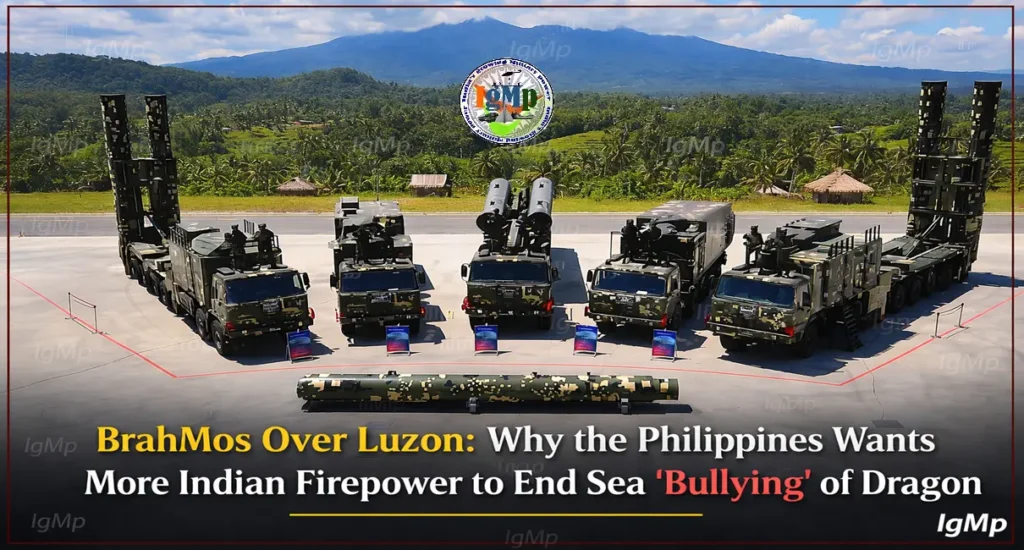
A new phase of strategic deterrence is quietly unfolding in Southeast Asia as the Philippines operationalises its first coastal battery of the BrahMos supersonic cruise missile, while Indonesia moves closer to finalising its own purchase of the system from India. What appears on the surface as a defence procurement is, in reality, reshaping the military balance across the contested waters of the South China Sea [Source: Times Now].
Manila’s first BrahMos battery is expected to be deployed in the northern island of Luzon, a location that directly overlooks the strategically sensitive Scarborough Shoal. For Philippine defence planners, this deployment transforms the missile system into what analysts describe as a “territorial shield.” From Luzon’s coastline, mobile launchers armed with BrahMos missiles can cover large portions of nearby maritime approaches, effectively creating a deterrent against hostile naval movements near contested waters.
The significance of the system lies not only in its range but also in its speed. The missile travels at around Mach 2.8, which dramatically reduces the reaction time available to an adversary’s ship-based defences. In practical terms, once detected, a BrahMos approaching at supersonic speed leaves modern close-in weapon systems only seconds to respond before impact. This “physics of deterrence” is precisely why many naval strategists view the missile as particularly dangerous for surface combatants operating within its strike envelope.
For smaller maritime states with limited naval fleets, the logic is straightforward. A coastal missile battery costing a few hundred million dollars can potentially threaten warships worth billions. In strategic terms, this creates an asymmetric balance where land-based missile units can deny access to larger naval forces. The value-to-kill ratio becomes especially striking when analysts note that a relatively inexpensive coastal defence battery could threaten high-value vessels such as large guided-missile destroyers operating in contested zones.
| Feature | Strategic Impact for ASEAN |
|---|---|
| Response Time | <20 seconds interception window for enemy ship defences |
| Tactical Role | Coastal Denial: prevents blockades of EEZ waters |
| Indonesia Deal | Estimated $200M–$350M for Natuna Islands defence |
| PH Deployment | Luzon / Palawan coverage targeting contested shoals |
| Key Edge | Mobile launchers difficult to detect or pre-emptively strike |
While the Philippines has already taken delivery of the first batches of the system, Indonesia is moving through what defence officials describe as the “final financial synchronisation” stage of negotiations. The deal, estimated at around $350 million, is widely viewed as Jakarta’s response to repeated maritime tensions near the Natuna Islands. If finalised, Indonesia would become the second Southeast Asian nation to deploy BrahMos, extending the missile’s deterrent footprint deeper into the region.
Strategists increasingly see these developments as the beginning of what some analysts call a “BrahMos Triangle.” With both the Philippines and Indonesia moving ahead, and Vietnam maintaining long-standing interest in the system, a network of coastal missile batteries could eventually emerge along key points of the South China Sea. Such deployments would form an Anti-Access/Area-Denial (A2/AD) belt designed to complicate the operational freedom of hostile naval forces across critical sea lanes.
Another factor attracting ASEAN nations to the missile is the resilience of its supply chain. The system is jointly developed by India and Russia, but India now leads the maintenance, repair and overhaul ecosystem for export customers. This arrangement allows New Delhi to replace components with indigenous alternatives where necessary, ensuring that operational support remains insulated from geopolitical sanctions or supply disruptions.
Defence cooperation between India and the Philippines has also expanded beyond missile sales. During bilateral engagements and maritime exercises in recent months, officials from both sides have reportedly discussed deeper operational coordination, including the possibility of sharing maritime surveillance data to support coastal missile targeting. Such collaboration would significantly enhance the effectiveness of land-based anti-ship missiles by improving real-time situational awareness in contested waters.
At the same time, regional interest is also extending toward the next evolution of the system. The proposed BrahMos-NG, a lighter and more compact variant currently under development, is expected to offer greater flexibility for aircraft and naval platforms while maintaining the missile’s hallmark supersonic speed. Several Southeast Asian defence planners are closely watching this program as they consider long-term force modernisation strategies.
For countries navigating an increasingly complex maritime environment, the attraction of BrahMos lies in its strategic clarity. A fast, mobile coastal missile system offers a relatively affordable way to impose significant risk on any naval force operating nearby. As deployments expand and negotiations continue, the missile is gradually becoming one of the defining tools shaping deterrence dynamics across the Indo-Pacific.


