

Synopsis
- , Chief of Staff of the Armed Forces of the Philippines, publicly praised the missile system’s performance, saying Manila remains satisfied with the purchase and is open to expanding defence cooperation with India in the future.
IgMp Bulletin

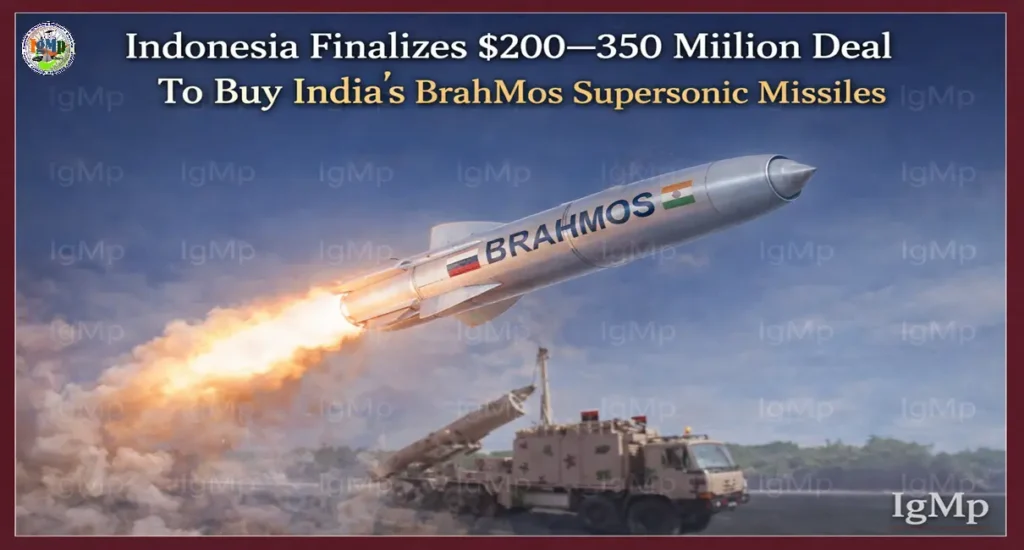
Indonesia has formally confirmed plans to acquire the supersonic BrahMos missile from India, marking a significant step in Jakarta’s effort to strengthen maritime defence across its vast archipelago. The agreement, estimated to be worth between $200 million and $350 million, places Indonesia among a small but growing group of countries adopting one of the world’s fastest operational cruise missile systems [Source: Reuters].
Officials from the Indonesian Ministry of Defence say the procurement is part of a broader strategy to modernise Indonesia’s armed forces and improve maritime deterrence. As the world’s largest archipelagic nation with more than 17,000 islands, Indonesia faces unique challenges in protecting its sea lanes, remote islands and strategic maritime chokepoints.
| Metric | Details (Confirmed March 2026) |
|---|---|
| Contract Status | To be signed formally (End of 2026-Early 2027) |
| Estimated Value | $200 Million – $350 Million |
| Target Deployment | Natuna Islands (Maritime Border Defence) |
| Operational Trigger | Success in Operation Sindoor (May 2025) |
| Manufacturing Hub | BrahMos Aerospace, Lucknow Facility |
The deployment is expected to strengthen security around the Natuna Islands, a strategically important region near contested waters of the South China Sea. Indonesia has increasingly prioritised the defence of this maritime frontier as regional naval activity continues to intensify.
Strategically, the acquisition reflects shifting security dynamics across the Indo-Pacific region. While Indonesia traditionally follows a non-aligned foreign policy, it has quietly expanded defence partnerships with several countries, including India, to diversify military technology and improve deterrence without entering formal alliances.
The BrahMos missile itself has drawn international attention because of its speed and strike flexibility. Developed jointly by India and Russia through the joint venture BrahMos Aerospace, the weapon can travel at nearly Mach 3—almost three times the speed of sound—and hit targets between 300 and 400 kilometres away depending on the variant. Its ability to fly at extremely low altitudes and execute evasive manoeuvres during the final phase of flight makes it particularly challenging for conventional air defence systems to intercept.
An important behind-the-scenes development cleared the way for the Indonesian contract. Because the missile is a joint Indo-Russian project, exports require approval from both partners. Russia reportedly issued a formal No-Objection Certificate in late 2025, removing the final legal barrier and allowing India to proceed with the sale.
Indonesia is not the first Southeast Asian country to adopt the missile. In 2022, the Philippines became the first foreign customer after signing a $375 million agreement with India for coastal defence batteries. The system is now being integrated into the Philippine Marine Corps’ coastal defence strategy amid rising tensions in regional waters.
Also Read: BrahMos Over Luzon: Why the Philippines Wants More Indian Firepower to End Sea ‘Bullying’ of Dragon
At the recent Raisina Dialogue 2026 in New Delhi, Romeo S. Brawner Jr., Chief of Staff of the Armed Forces of the Philippines, publicly praised the missile system’s performance, saying Manila remains satisfied with the purchase and is open to expanding defence cooperation with India in the future.
For India, the expanding interest in BrahMos reflects the country’s growing ambitions as a global defence exporter. New Delhi has spent the past several years investing heavily in domestic military manufacturing while encouraging exports of indigenous systems to trusted partners.
Production capacity has also been ramped up. A major facility in Lucknow, part of India’s defence industrial corridor, is designed to manufacture dozens of BrahMos missiles annually to meet both domestic requirements and rising international demand.
Analysts note that Indonesia’s purchase highlights a broader shift in regional security thinking. Rather than relying solely on large naval fleets, many countries are investing in fast, mobile missile systems capable of denying access to hostile forces. Supersonic coastal defence weapons like BrahMos allow nations with long coastlines to create powerful deterrence at relatively lower cost.
If further export agreements follow, the BrahMos missile could increasingly become a key component of Southeast Asia’s emerging coastal defence architecture, while simultaneously reinforcing India’s role as a major security partner in the Indo-Pacific.


