Synopsis
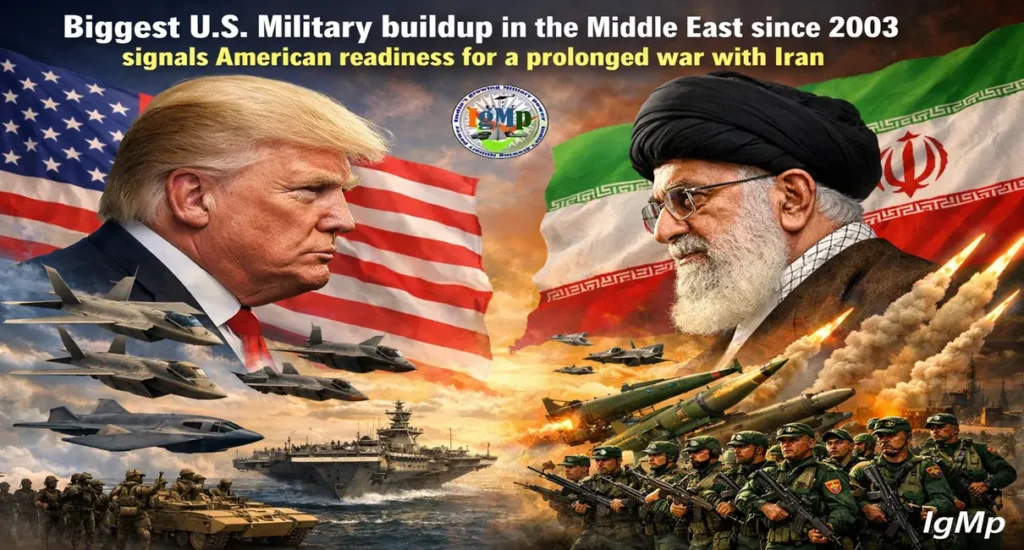
- The United States has quietly assembled its most formidable concentration of military power in the Middle East since the 2003 Iraq invasion, and the scale of the deployment is raising serious questions about whether Washington is preparing not just for a warning strike on Iran, but for a sustained campaign.
Source : IgMp Bulletin

The United States has quietly assembled its most formidable concentration of military power in the Middle East since the 2003 Iraq invasion, and the scale of the deployment is raising serious questions about whether Washington is preparing not just for a warning strike on Iran, but for a sustained campaign.
Two carrier strike groups now anchor the buildup, including the USS Abraham Lincoln and the USS Gerald R. Ford. Each carrier brings a full air wing, guided-missile destroyers, cruisers, and logistical support vessels. Together, they represent a floating air force capable of launching hundreds of sorties per day. In addition, nuclear-powered submarines, littoral combat ships and multiple destroyers have taken positions across the Arabian Sea, the Red Sea and near the Strait of Hormuz — a chokepoint critical to global energy flows.
What makes this deployment different from previous flare-ups is not only the number of ships, but the layered airpower that has accompanied them. Advanced fighters such as the F-22 Raptor and the F-35 Lightning II have reportedly been moved into regional bases alongside F-16s, surveillance aircraft and aerial refueling tankers. Early warning platforms like the Boeing E-3 Sentry are essential in managing complex air operations involving dozens of jets simultaneously. The logistics footprint is equally telling, with waves of cargo aircraft reinforcing regional infrastructure.
Satellite imagery cited by major international outlets shows a surge of activity at Jordan’s Muwaffaq Salti Air Base, where the number of combat aircraft has reportedly tripled compared to routine levels. Hardened shelters, new air-defense systems and increased cargo traffic point to preparations that go beyond symbolic signaling. Military planners appear to be building redundancy into their posture, a hallmark of campaigns designed to last weeks or months rather than hours.
The backdrop to this buildup is a deepening standoff over Iran’s nuclear program, missile capabilities and support for regional proxy groups. Diplomatic channels remain open, but recent deadlines and warnings from Washington have added urgency. Historically, U.S. force surges of this magnitude have preceded either direct military action or a decisive diplomatic breakthrough achieved under intense pressure.
Strategically, the United States now holds a broad spectrum of options. A limited, one-off strike targeting specific facilities would require far fewer assets than are currently deployed. By contrast, a sustained air campaign aimed at degrading air defenses, missile infrastructure and nuclear sites would demand continuous sortie generation, electronic warfare coverage and robust missile defense for regional bases and partners. The present force posture supports the latter scenario.
Notably absent from the region — at least publicly — are long-range stealth bombers like the Northrop B-2 Spirit, which have previously flown Middle East missions from distant bases such as Diego Garcia. Their ability to strike from outside the immediate theater adds another layer of flexibility, reinforcing the idea that Washington is keeping multiple operational pathways open.
Sustaining such a massive deployment, however, comes at high financial and operational cost. Carrier strike groups require constant replenishment, and advanced aircraft demand intensive maintenance cycles. The longer the buildup continues, the greater the pressure on decision-makers to either act or draw down forces.
For regional allies, the surge offers reassurance against potential Iranian retaliation. For Tehran, it presents a stark calculation: negotiate under pressure or risk confrontation with the most concentrated U.S. air and naval power seen in the region in over two decades. Whether this moment becomes a prelude to conflict or a catalyst for diplomacy may depend less on military capability — which is now unmistakably visible — and more on political resolve in the days ahead.