

Synopsis
- Hindustan Aeronautics Limited (HAL) on Monday moved swiftly to counter reports suggesting that a HAL Tejas fighter jet had crashed, stating clearly that the episode in question was a minor technical incident on the ground and not an aircraft crash.
Source : IgMp Bulletin

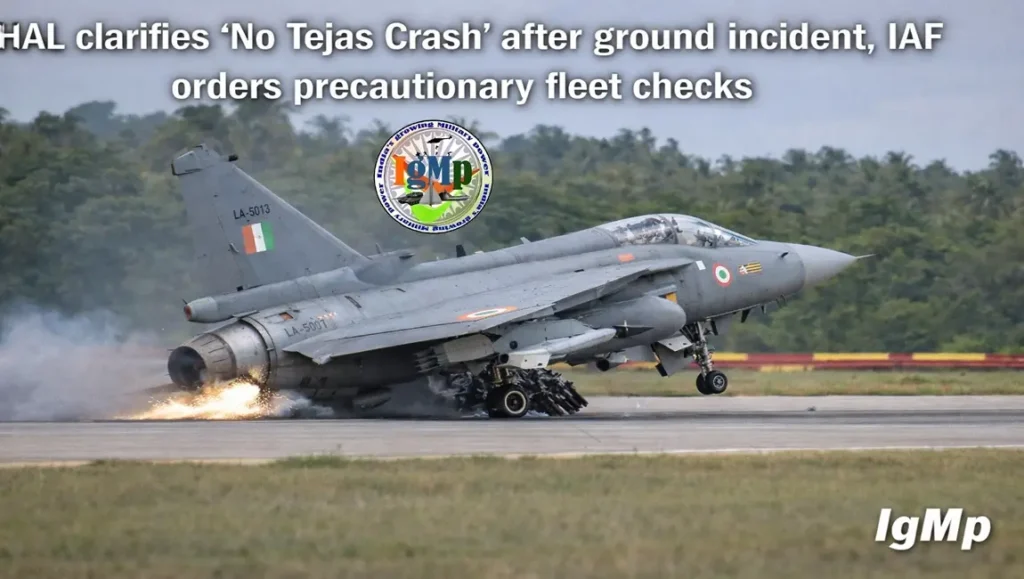
Hindustan Aeronautics Limited (HAL) on Monday moved swiftly to counter reports suggesting that a HAL Tejas fighter jet had crashed, stating clearly that the episode in question was a minor technical incident on the ground and not an aircraft crash. The company said media reports had mischaracterised the situation and emphasised that there was no loss of aircraft in the recent development.
The clarification came after weekend reports claimed that a Tejas jet had overshot the runway at a frontline airbase, allegedly due to a suspected brake malfunction. According to agency inputs, the aircraft had been returning from a routine training sortie when the incident occurred. The pilot reportedly ejected safely, and while the aircraft is believed to have sustained structural damage, HAL underlined that the matter did not amount to a crash.
In its statement, HAL highlighted that the Tejas platform maintains one of the strongest safety records among contemporary fighter aircraft in its class. The company added that the issue is being examined thoroughly under established standard operating procedures and that it is working in close coordination with the Indian Air Force (IAF) to ensure a timely resolution. Such joint reviews are standard in military aviation, where even ground-related technical issues trigger comprehensive inspections.
The IAF has reportedly grounded its fleet of around 30 single-seat Tejas jets as a precautionary measure to carry out detailed technical checks. Defence aviation experts note that temporary groundings are not uncommon after incidents involving landing systems or flight safety components. Modern air forces worldwide adopt this approach to rule out systemic flaws and reinforce confidence in operational fleets. A runway overshoot, especially if linked to braking or hydraulic systems, demands careful mechanical evaluation, even if the aircraft structure remains largely intact.
Investor sentiment, however, reacted quickly. HAL shares fell over three percent in trading following the reports, reflecting how sensitive defence stocks can be to headlines involving safety concerns. Over the past few years, HAL has emerged as a key pillar in India’s defence manufacturing ecosystem, backed by a strong order book that includes 83 Tejas Mk1A fighters and additional contracts across helicopters and trainer aircraft. Any suggestion of instability in its flagship fighter programme tends to draw immediate market attention.
The Tejas programme itself represents decades of indigenous aerospace effort. Designed as a lightweight, single-engine, multi-role fighter, it was developed to replace ageing MiG-21 aircraft and reduce India’s dependence on imported jets. The aircraft is capable of air defence, ground attack and maritime strike roles, equipped with modern avionics, fly-by-wire controls and advanced radar systems. The improved Mk1A variant introduces upgraded sensors, electronic warfare capabilities and maintainability enhancements intended to boost combat readiness.
It is true that the Tejas fleet has experienced accidents in recent years, including a crash near Jaisalmer in 2024 and another incident during an aerial display in Dubai in 2025. Aviation analysts caution, however, that isolated accidents should be viewed in the broader context of overall fleet flying hours and operational intensity. Single-engine fighters across the world, including established Western and Russian platforms, have faced occasional mishaps without undermining long-term programme viability.
What ultimately defines a mature aerospace ecosystem is how it handles such situations. Prompt communication, transparent investigation and swift corrective measures are essential. HAL’s decision to issue a detailed clarification suggests an awareness of the reputational stakes involved, especially as the Tejas is increasingly being positioned for export markets. Countries evaluating new fighter acquisitions closely track safety records, maintenance cycles and manufacturer responsiveness.
For the IAF, the precautionary checks serve as a reaffirmation of safety-first principles rather than an indication of deeper concerns. Military aviation operates on the premise that even minor anomalies warrant rigorous scrutiny. By temporarily pausing operations and reviewing technical data, the force reduces long-term risk and reinforces pilot confidence.
As India continues to expand its indigenous defence manufacturing base, episodes like this highlight both the scrutiny and the responsibility that come with operating advanced combat aircraft. Clear communication from manufacturers and the armed forces remains crucial in separating verified facts from speculation, particularly in a sector as strategically sensitive as military aviation.


