

Synopsis
- Through an AI-enabled Combat Cloud, the aircraft would coordinate loyal-wingman drones like the HAL CATS Warrior and long-range strike platforms such as the DRDO Ghatak UCAV, creating a highly networked and distributed aerial combat system expected to mature around the mid-2040s.

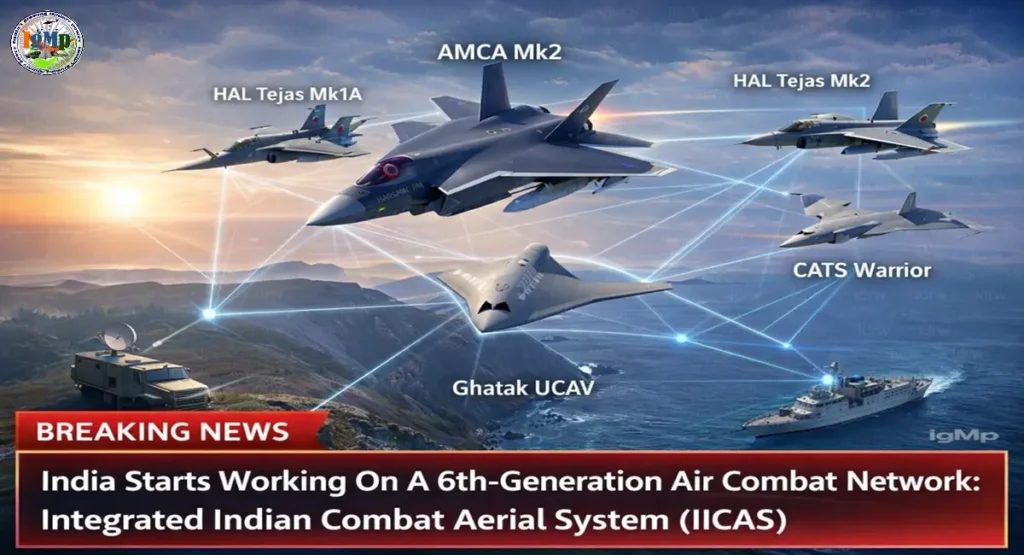
India has started developing the Integrated Indian Combat Aerial System (IICAS), which is a proposed 6th-generation air combat network designed to connect stealth fighters, autonomous drones, and unmanned strike aircraft into a single AI-driven combat network. At the center of this ecosystem is the HAL AMCA Mk2, which acts not only as a fighter jet but also as a battle management platform. Through an AI-enabled Combat Cloud, the aircraft would coordinate loyal-wingman drones like the HAL CATS Warrior and long-range strike platforms such as the DRDO Ghatak UCAV, creating a highly networked and distributed aerial combat system expected to mature around the mid-2040s.
Core Architecture of IICAS
Rather than relying on a single aircraft to perform every mission, the concept behind IICAS is a “system of systems” where multiple platforms operate together as one coordinated force.
Mothership – Mission Control Platform
- The HAL AMCA Mk2 acts as the central command aircraft.
- The pilot’s role expands beyond flying the jet; they function as a battle manager, directing drones and coordinating attacks across the network.
- Its sensors and computing systems process data coming from multiple platforms simultaneously.
Loyal Wingmen – Autonomous Escort Drones
- The HAL CATS Warrior operates alongside the fighter as an intelligent escort.
- These drones can perform reconnaissance, electronic warfare, decoy operations, and additional missile carriage.
- They also extend the sensor range of the mothership, allowing threats to be detected much earlier.
Strategic Strike Platform
- The stealth DRDO Ghatak UCAV is designed as a deep-penetration strike asset.
- Its flying-wing design minimizes radar visibility, enabling it to enter heavily defended airspace.
- Within the IICAS network, it could launch precision strikes while remaining coordinated with the rest of the system.
Connectivity Layer
- A dedicated AI-driven Combat Cloud links all platforms together.
- The network allows real-time exchange of targeting data, threat alerts, and mission updates between aircraft, drones, and ground command centers.
Advanced Technologies
- Directed energy weapons such as airborne combat lasers
- Adaptive electronic camouflage to reduce detection
- Autonomous drone swarms for reconnaissance and decoy missions
The AI Combat Cloud: Distributed Sensor Fusion & Data Links
The most important element of IICAS is the Combat Cloud, a digital backbone that allows every platform to share information instantly. Instead of each aircraft operating independently, the network creates a single integrated battlefield picture.
A key concept within this architecture is Manned-Unmanned Teaming (MUM-T). In this approach, the pilot inside the HAL AMCA Mk2 commands multiple drones simultaneously. The aircraft becomes a flying command center, assigning tasks to drones depending on the mission.
The system relies on software-defined radios (SDR) capable of dynamically switching frequencies to avoid electronic jamming. Combined with satellite communication links, this ensures connectivity even in highly contested environments where traditional radio communication may be disrupted.
Sensor fusion is another critical feature. Radar data from the fighter, infrared sensors from drones, satellite imagery, and intelligence inputs are combined by onboard computing systems. This produces a clearer operational picture, allowing the battle manager to identify threats faster and coordinate strikes more effectively.
6th-Generation Technologies: Directed Energy Weapons & Drone Swarms
As the concept evolves, IICAS is expected to integrate several emerging technologies associated with sixth-generation air combat.
Directed energy weapons could provide aircraft with the ability to neutralize incoming missiles or hostile drones using high-energy laser systems. This would add a new defensive layer without relying solely on traditional interceptors.
Another capability being explored globally is the use of autonomous drone swarms. Instead of deploying a few large drones, the system could launch dozens of smaller, low-cost drones to confuse enemy defenses, gather intelligence, or saturate air defense networks.
Together, these technologies would help create a more flexible and survivable combat ecosystem capable of adapting to complex future battlefields.
Global Context: India’s Indigenous Approach
Around the world, several countries are developing their own sixth-generation fighter programs. One of the most prominent is the Global Combat Air Programme, a collaboration between the United Kingdom, Japan, and Italy. Europe is also pursuing the Future Combat Air System, which aims to combine advanced fighters with networked drones.
In this broader landscape, IICAS represents India’s indigenous path toward next-generation air combat capability. Rather than building a single aircraft to compete with foreign designs, the concept focuses on integrating domestic platforms, drones, and AI networking technologies into a unified combat ecosystem.
Development Outlook
Although the concept remains at an early stage, the broader technologies required for IICAS—stealth fighters, autonomous drones, and networked warfare systems—are gradually advancing. If development progresses steadily, the architecture could begin taking shape alongside the future operational timeline of the HAL AMCA Mk2, potentially reaching maturity by the mid-2040s.
By combining manned fighters, intelligent drones, and AI-driven connectivity, the Integrated Indian Combat Aerial System outlines how air warfare may evolve in the coming decades—where victory depends less on a single aircraft and more on how effectively multiple platforms operate together as one networked force.


