

Synopsis
- On March 14, 2026, the Indian Army’s Gajraj Corps carried out successful live-fire trials of the LCH Prachand in the harsh high-altitude environment of Ladakh, marking a crucial step in the helicopter’s full operational weaponization.

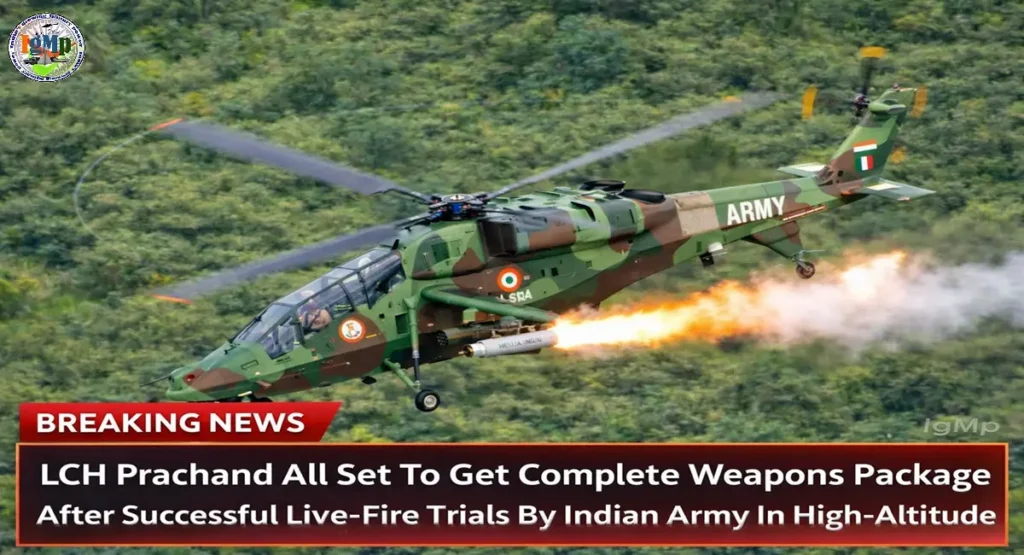
On March 14, 2026, the Indian Army’s Gajraj Corps carried out successful live-fire trials of the LCH Prachand in the harsh high-altitude environment of Ladakh, marking a crucial step in the helicopter’s full operational weaponization. Conducted in one of the world’s most demanding combat theatres, the test demonstrated how India’s indigenous light combat helicopter can deploy advanced missiles and precision weapons while operating in thin air above the Himalayan frontier. For military planners watching tensions along the northern borders, the trials reinforced Prachand’s growing role as a specialized strike platform designed for mountain warfare.
Developed by Hindustan Aeronautics Limited, the LCH Prachand was conceived specifically for the extreme conditions of the Himalayas, where air density, terrain clutter and temperature variations challenge conventional attack helicopters. Unlike heavier platforms that struggle to generate lift at extreme altitude, Prachand was engineered from the outset to operate where few combat helicopters can sustain payload and maneuverability. Its latest Ladakh trials highlight how the aircraft is moving beyond demonstration stages into a combat-ready asset for the Indian Army’s frontline formations.
Key Technical Firepower of LCH Prachand
- HELINA / Dhruvastra ATGM: Third-generation fire-and-forget anti-tank missile
- Missile Range: Up to 7 km
- Guidance: Imaging Infrared (IIR) seeker for lock-on before launch
- Loitering Munitions: Lightweight air-launched “suicide drones” under 45 kg
- Drone Endurance: Around 25–40 minutes for surveillance and precision strike
- Primary Target: Armoured vehicles via vertical top-attack on turret roofs
- Service Ceiling: Approximately 6,500 metres (21,300 ft)
- Maximum Speed: Around 280 km/h
- Operational Capability: One of the few attack helicopters able to take off and land near 5,000 metres with combat payload
Why LCH Prachand Is Called the “Mountain King of Hellfire”
The Prachand’s design reflects a philosophy tailored specifically for the Himalayas rather than conventional low-altitude warfare. Its narrow fuselage and flat-panel tandem cockpit help reduce radar reflections while allowing the helicopter to navigate tight valleys where radar signals often scatter against mountainous terrain. The design also improves agility in narrow mountain passes where larger aircraft struggle to maneuver.
Powering the helicopter are Shakti engines, optimized to maintain thrust in thin high-altitude air. This engine configuration enables Prachand to sustain hover and combat manoeuvres even in environments where heavier helicopters experience rapid power loss. Such performance is particularly critical during anti-armour missions, where helicopters often need to hover behind mountain ridges before briefly exposing themselves to launch missiles.
The HELINA anti-tank missile significantly expands Prachand’s battlefield role. With a fire-and-forget infrared seeker, the missile allows the helicopter to strike armoured vehicles from stand-off distances without prolonged exposure to enemy air defence systems. Combined with potential integration of loitering munitions, the aircraft can also conduct precision strikes on concealed targets, a capability that is increasingly relevant in modern drone-centric warfare.
Can LCH Prachand Outperform Chinese Attack Helicopters in High Altitude?
In the context of Himalayan operations, Prachand’s design provides notable advantages. China’s Z-10 attack helicopter, while powerful at lower altitudes, has historically faced limitations in extremely high terrain due to engine performance constraints. Reports from defence analysts suggest that sustained combat operations above 4,500 metres remain challenging for many conventional attack helicopters.
Prachand, by contrast, was engineered for 5,000-metre-plus operations, allowing it to patrol and strike targets in terrain where other helicopters may struggle to maintain payload capacity. Its lighter overall weight—around 5.8 tonnes—also improves maneuverability in the narrow valleys that dominate the Himalayan landscape.
Another aspect of its advantage lies in anti-armour warfare. By hovering behind ridgelines at altitudes approaching 15,000 feet, Prachand can launch HELINA missiles against enemy armoured columns moving through mountain passes. This tactic allows the helicopter to remain partially concealed while engaging targets from a distance, increasing survivability against ground-based air defences.
The integration of loitering munitions further expands the helicopter’s tactical flexibility. These small aerial weapons can be launched toward suspected enemy positions and remain airborne for extended periods before diving onto targets. In mountainous terrain, where armoured vehicles often rely on overhead protection such as improvised “cope cages,” top-attack munitions provide a method of striking vulnerable sections of a vehicle’s armour.
With the Ladakh trials now demonstrating live-fire capability under real operational conditions, the LCH Prachand appears to be moving steadily toward a larger role in India’s mountain warfare doctrine. For the Indian Army, the helicopter represents more than just a new aircraft—it embodies a combat system tailored to the unique geography of the Himalayas. Defence experts believe that platforms specifically engineered for high-altitude combat will increasingly shape the balance of power along the world’s highest battlefield, where airpower must adapt to thin air, steep terrain and rapidly evolving battlefield technologies.


