

Synopsis
- On March 13, 2026, the Indian Navy commissioned a first-of-its-kind Pneumatic RAM Test Facility at Karwar, marking a major milestone in India’s submarine sustainment capability.

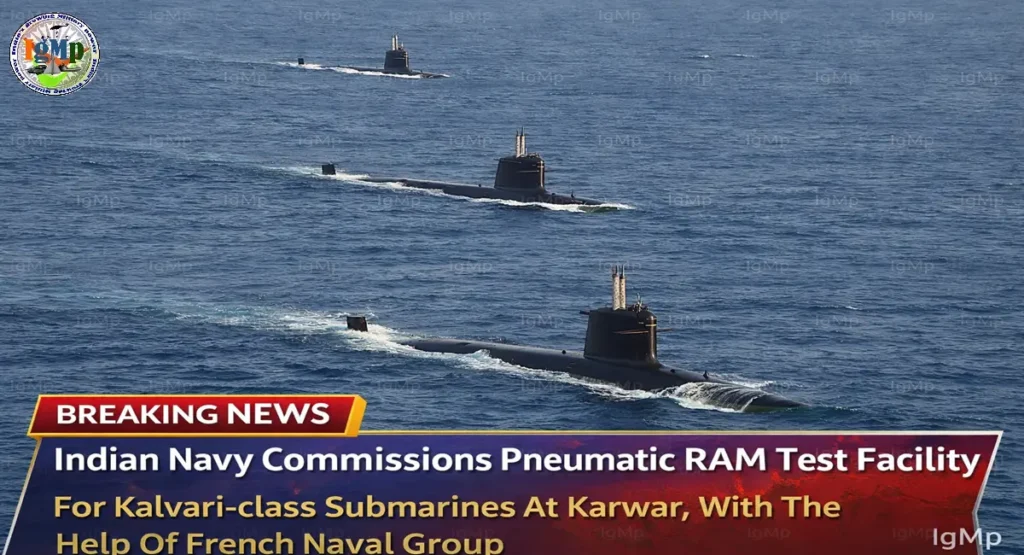
On March 13, 2026, the Indian Navy commissioned a first-of-its-kind Pneumatic RAM Test Facility at Karwar, marking a major milestone in India’s submarine sustainment capability. The specialized Maintenance, Repair and Overhaul (MRO) infrastructure was developed by French company Naval Group’s India subsidiary, Naval Group India, in partnership with Indian MSME SEC Industries Pvt Ltd, and inaugurated by Vice Admiral B. Sivakumar, Chief of Materiel of the Indian Navy. With this development, India now hosts one of only three such facilities in the world capable of servicing these complex submarine components, alongside similar setups in France and Brazil. The move significantly strengthens India’s domestic capability to maintain the Kalvari-class (Scorpene) submarines built under the Project-75 program.
For the Indian Navy, the commissioning of this facility is more than just a technical upgrade. Pneumatic RAM mechanisms are critical to several mechanical operations inside modern submarines, especially systems that must function reliably under extreme underwater pressure. These components require precision testing and servicing through highly specialized infrastructure. Until now, Indian operators had to send such equipment overseas for maintenance, particularly to France, which increased turnaround time and added logistical complexity. The Karwar-based facility changes that dynamic by enabling testing, inspection and overhaul within India itself.
Technical Breakdown – Pneumatic RAM Test Facility
- Function: Tests and services pneumatic actuators that drive critical submarine mechanical systems
- Platform Supported: Kalvari-class (Scorpene) submarines under Project-75
- Capability: High-pressure testing and servicing of submarine pneumatic components
- Regional Significance: First such Scorpene support facility in the Asia-Pacific region
- Operational Impact: Eliminates overseas shipment of components, reducing turnaround time and maintenance costs
The timing of this facility is particularly important for India’s submarine fleet. The Kalvari-class submarines—ranging from INS Kalvari to INS Vagsheer—are gradually maturing into full operational service. As these platforms accumulate years of deployment, the focus naturally shifts from construction to long-term sustainment and mid-life maintenance. Submarine readiness depends heavily on the reliability of onboard mechanical systems, making specialized testing facilities like this mission-critical for maintaining operational availability.
Karwar itself has emerged as a strategic hub for India’s western naval operations. Hosting a technical workshop capable of servicing such advanced components adds another layer of capability to the naval infrastructure located along the Arabian Sea coast. By keeping essential submarine maintenance activities closer to operational bases, the Indian Navy can significantly shorten maintenance cycles and ensure quicker redeployment of underwater assets.
Another important dimension of the project is the collaboration between international technology partners and Indian industry. The facility was developed through cooperation between Naval Group India and SEC Industries Pvt Ltd, an Indian MSME partner. Such partnerships reflect the broader goals of India’s Make in India and Aatmanirbhar Bharat initiatives, which aim to strengthen domestic defence manufacturing while developing technical expertise within the country.
Naval Group has been closely associated with India’s submarine modernization for years. Through its subsidiary Naval Group India, the French defence major has supported indigenisation of equipment for Scorpene submarines and contributed engineering expertise during the development of the Project-75 fleet at Mazagon Dock Shipbuilders Limited. The establishment of the Karwar facility further deepens that cooperation while simultaneously transferring critical maintenance capability to Indian industry.
From a regional perspective, the facility also positions India as an emerging support hub for Scorpene-class submarine maintenance in the wider Asia-Pacific. As more navies adopt advanced submarine platforms, the availability of specialized testing infrastructure in the region could open opportunities for technical cooperation and industrial collaboration.
India’s maritime strategy increasingly emphasizes self-reliance not just in acquiring platforms but also in sustaining them through their operational lifespan. Submarines, perhaps more than any other naval asset, depend on precise engineering support and maintenance ecosystems to remain mission-ready. The new Pneumatic RAM Test Facility at Karwar reflects how India is gradually building that ecosystem at home.
For the Indian Navy, this development means faster maintenance cycles, reduced logistical dependency and greater operational readiness for its underwater fleet. For India’s defence industry, it represents another step toward becoming a technologically capable ecosystem capable of supporting advanced naval platforms throughout their entire lifecycle.


