

Synopsis
- It is a test of whether large-scale defence imports can meaningfully accelerate domestic capability while ensuring the IAF retains a technological edge in an increasingly contested regional airspace.
Source : IgMp Bulletin

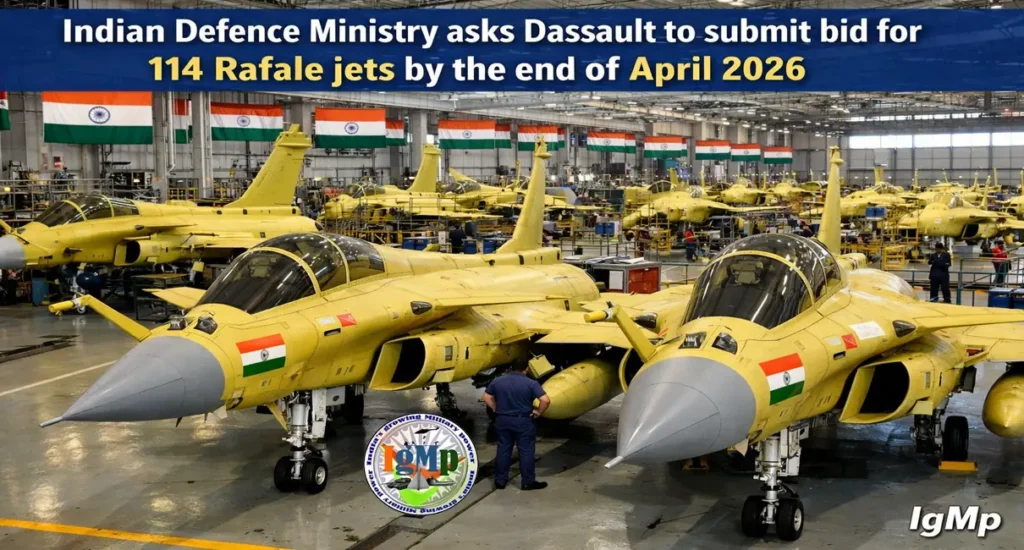
India has formally moved ahead with one of its biggest fighter aircraft procurements in decades, asking Dassault Aviation to submit a comprehensive bid for 114 Rafale jets by the end of April. The project, cleared by the Defence Acquisition Council under Defence Minister Rajnath Singh, is estimated to be worth over ₹2.5 lakh crore, making it a cornerstone of the Indian Air Force’s long-term modernisation plan.
Unlike the earlier 2016 agreement that brought 36 Rafales into service, this proposed deal is structured around a far deeper industrial partnership. At least 96 of the 114 aircraft are expected to be manufactured in India, with New Delhi pushing for 50–60 percent indigenous content. That benchmark reflects the government’s broader objective of strengthening domestic aerospace capability under its self-reliance push.
The Indian Air Force has been clear that this procurement is not just about numbers but about operational readiness. Squadron strength has remained below sanctioned levels for years, and the Rafale’s proven multi-role capability makes it a strong candidate to plug critical gaps in air dominance and strike roles. The twin-engine fighter, already operational in the IAF, offers logistical familiarity and interoperability advantages.
This time, the negotiations will follow a government-to-government route but with greater direct participation from Dassault. The French side is expected to include both company executives and officials from Paris, reflecting the strategic nature of the partnership. French President Emmanuel Macron has publicly stated that France is ready to meet India’s requirements, signalling political backing for the deal.
A key element under discussion is the establishment of a final assembly line in India. The Nagpur-based Dassault Reliance Aerospace Limited facility, now majority-owned by Dassault, is widely seen as a likely hub. If executed as planned, the plant could evolve into a global manufacturing centre catering not only to Indian orders but also to international Rafale customers. Several Indian firms, including Tata and other private-sector suppliers, are expected to play roles in the supply chain, potentially boosting high-end aerospace manufacturing jobs.
After Dassault submits its commercial and technical proposal, a cost negotiation committee comprising representatives from the defence ministry and the IAF will scrutinise the offer. If timelines hold, the contract could be signed by early 2027, with the first batch of fly-away aircraft arriving around 2030.
For India, this deal represents more than a fleet expansion. It is a test of whether large-scale defence imports can meaningfully accelerate domestic capability while ensuring the IAF retains a technological edge in an increasingly contested regional airspace.


