Synopsis
- military has acknowledged the losses and attributed them to friendly fire incidents during a complex and crowded air campaign, Iranian officials have categorically rejected that explanation, claiming their air defence forces were responsible for shooting down the jets.
Source : IgMp Bulletin

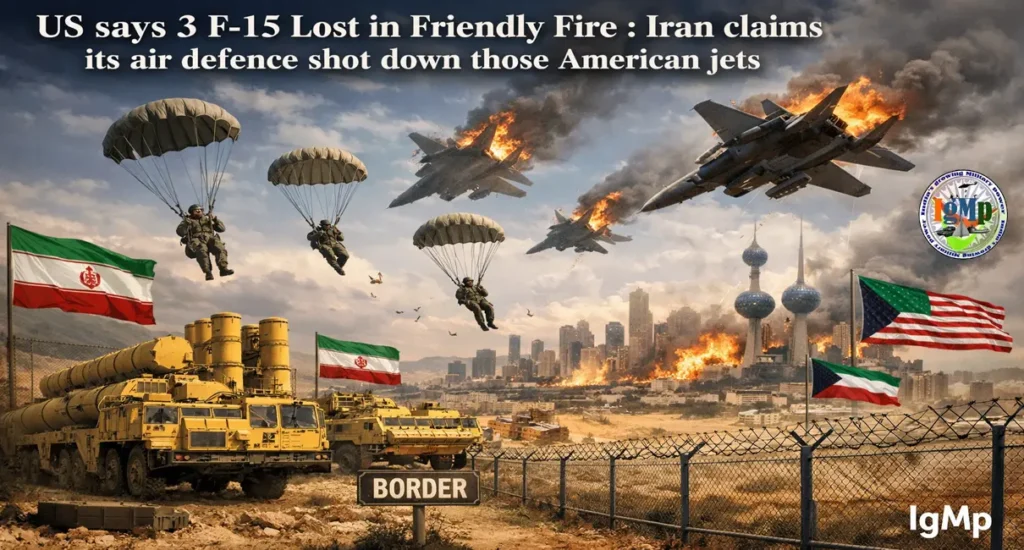
Confusion and competing narratives are shaping the information battlefield after the United States confirmed the loss of three F-15 fighter jets during recent operations linked to the widening Iran crisis. Videos circulating across social media platforms show aircraft plunging from the sky, prompting intense scrutiny from analysts and governments alike. While the U.S. military has acknowledged the losses and attributed them to friendly fire incidents during a complex and crowded air campaign, Iranian officials have categorically rejected that explanation, claiming their air defence forces were responsible for shooting down the jets.
According to a brief statement from the United States military, the incidents occurred during high-tempo operations involving multiple allied aircraft, airborne early warning platforms, and missile defence systems operating simultaneously. Officials stressed that such environments significantly increase the risk of misidentification, particularly when aircraft are operating near the edges of overlapping air defence zones. The U.S. position maintains that internal reviews are underway and that no hostile fire was involved.
Tehran, however, has moved quickly to present a very different account. Senior commanders within Iran’s air defence establishment have publicly claimed that Iranian surface-to-air missile units engaged and destroyed the American fighters as they operated near Iran’s western approaches. Iranian state-linked media has framed the incident as evidence that the country’s integrated air defence network remains effective despite sustained pressure and repeated air operations in the region. These claims, while unverified by independent sources, have resonated domestically and across parts of the region where skepticism toward U.S. statements runs high.
From a technical standpoint, defence analysts note that the geography of the region leaves room for ambiguity. Western Iran lies roughly 200 to 250 kilometers from portions of Kuwaiti airspace, a distance that theoretically falls within the engagement envelope of long-range systems such as the S-300 if deployed forward. Iran has never publicly disclosed the exact locations or readiness status of its high-end air defence assets, which adds another layer of uncertainty to the debate. Kuwait, for its part, has not commented in detail, limiting its response to affirming coordination with partners to ensure the safety of its airspace. Kuwait remains a critical hub for U.S. air operations in the Gulf, making any incident nearby especially sensitive.
What is clear is that the episode highlights the growing complexity of modern air warfare, where dense layers of friendly and hostile systems operate in close proximity. Even the most advanced air forces are not immune to losses caused by miscalculation, compressed decision timelines, or incomplete situational awareness. At the same time, claims of successful engagements by Iranian defences underscore how information warfare now unfolds in parallel with kinetic operations, with each side racing to shape perceptions at home and abroad.
As tensions between Iran and the United States remain elevated, the loss of the three jets—regardless of the cause—carries strategic and political weight. For Washington, it raises questions about coordination and rules of engagement in contested airspace. For Tehran, the narrative of having downed U.S. aircraft serves as a powerful symbol of deterrence and resilience. Until independent verification emerges, the true sequence of events is likely to remain contested, reflecting a broader reality of modern conflict where facts, claims, and counterclaims often collide long before clarity arrives.