

Synopsis
- Facilities such as the aerospace hub in Hyderabad, the assembly infrastructure in Nagpur and the upcoming helicopter Final Assembly Line at Vemagal provide practical blueprints for how a future AMCA assembly line could operate.
IgMp Bulletin

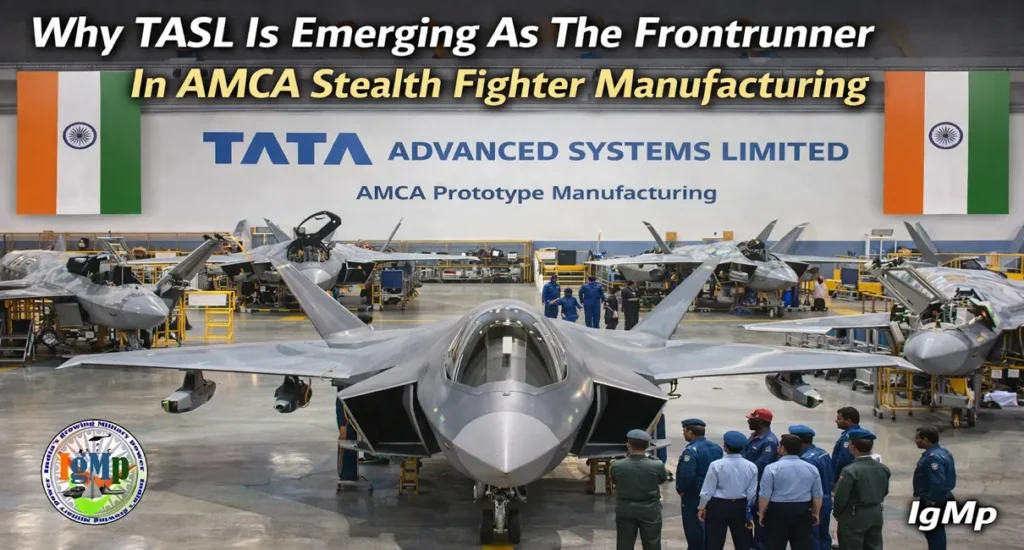
India’s ambitious plan to develop the Advanced Medium Combat Aircraft (AMCA) is not only about building a fifth-generation stealth fighter but also about redefining how the country manufactures complex defence platforms. The Ministry of Defence (India) is preparing a Special Purpose Vehicle (SPV) model for the program where the private sector is expected to hold the majority stake, likely over 50 percent. This structure marks a decisive shift toward appointing an Industrial Lead Partner capable of handling large-scale aerospace manufacturing while working alongside the Aeronautical Development Agency (ADA), which leads the aircraft’s design and development. Within this emerging framework, Tata Advanced Systems Limited (TASL) is increasingly viewed as the most prepared candidate among India’s private aerospace players.
Unlike other contenders that rely on broad consortiums, TASL has built a vertically integrated aerospace ecosystem of its own. Competing groups such as Larsen & Toubro with Bharat Electronics Limited, or Bharat Forge partnering with BEML and Data Patterns, combine heavy engineering, electronics and vehicle manufacturing expertise. TASL’s strength, however, lies in integrated airframe production—an especially critical capability when dealing with stealth aircraft, where the airframe itself forms the primary radar-defeating structure.
A fifth-generation fighter demands extremely precise manufacturing standards. Stealth platforms require advanced carbon-fiber composite structures with “gap and flush” tolerances measured in microns to maintain radar invisibility. Through its long-standing collaborations with global aerospace firms like Lockheed Martin, Boeing and Airbus, TASL already operates at these exacting standards. The company produces empennage assemblies and center wing boxes for the C-130J Super Hercules transport aircraft and advanced structural components for the AH-64 Apache attack helicopter. Perhaps more importantly, its Hyderabad facility manufactures fighter wing structures linked to the F-21 Fighter Aircraft ecosystem—effectively exposing Indian engineers to the manufacturing logic associated with modern fighter jets and low-observable design principles.
Infrastructure also plays a major role in TASL’s positioning for AMCA production. Facilities such as the aerospace hub in Hyderabad, the assembly infrastructure in Nagpur and the upcoming helicopter Final Assembly Line at Vemagal provide practical blueprints for how a future AMCA assembly line could operate. These plants already follow international aerospace certification standards, making them suitable foundations for scaling up to full fighter aircraft production.
A strong industrial supply chain further strengthens the company’s case. TASL has developed a network of more than 2,000 micro, small and medium enterprises across India that supply precision-machined parts, composite materials and avionics components. Such an ecosystem significantly reduces production risk in a project as complex as a stealth fighter, where thousands of specialized components must be delivered with extreme accuracy and reliability.
| Capability Requirement | TASL Readiness (2026) | Strategic Advantage |
|---|---|---|
| Stealth Composites | Experience from fighter wing and C-130 structural assemblies | Demonstrated low-observable manufacturing tolerances |
| System Integration | Airbus aircraft assembly collaborations | Knowledge of full aircraft production workflows |
| Supply Chain | 2,000+ MSME partners across India | Faster scaling and reduced production delays |
| MRO & Sustainment | C-130J maintenance hub under development | Long-term lifecycle support within India |
Challenges remain significant. Manufacturing the AMCA will require mastering stealth coatings, advanced composite airframes and extremely smooth aerodynamic transitions to maintain radar invisibility. Integrating sensors, weapons bays and propulsion systems into a tightly optimized stealth design will test even experienced aerospace manufacturers. Yet these challenges also represent an opportunity to build long-term domestic expertise.
If TASL ultimately becomes the industrial lead for AMCA production, the program could reshape India’s aerospace landscape. A stealth fighter assembled through globally benchmarked manufacturing processes would not only strengthen the Indian Air Force but could also position India to export advanced aircraft to trusted international partners in the future. In that sense, the AMCA program is not just about building a fighter—it is about building a globally competitive aerospace industry.


