Synopsis
- While Israel remains at the center of American military calculations, energy-rich Gulf states are finding themselves on the front line of Iranian missile and drone responses, with limited reassurance that U.
Source : IgMp Bulletin

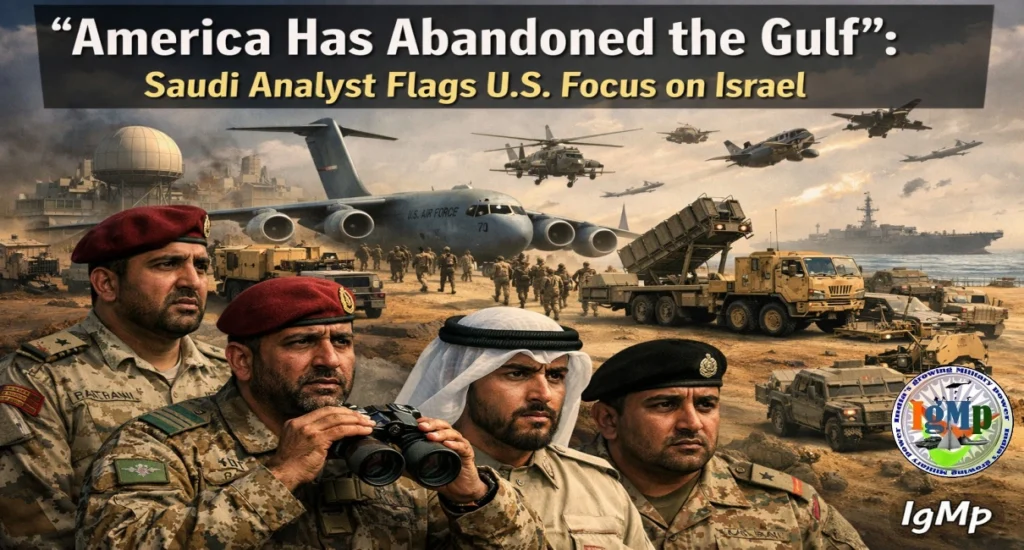
“America Has Abandoned the Gulf”: Saudi Analyst Flags U.S. Focus on Israel
A sharp warning from Saudi political analyst Suleiman Al-Aqili has reignited debate across West Asia about the real priorities of American military power in the region. As the confrontation involving Iran, the United States, and Israel intensifies, Al-Aqili argues that Gulf countries hosting American bases are increasingly exposed, even as U.S. defence systems are heavily oriented toward shielding Israel from retaliation.
Speaking to Al Jazeera, Al-Aqili said that Washington’s strategic focus has narrowed dramatically. In his assessment, the security umbrella long assumed by Gulf monarchies is no longer as dependable as it once appeared. While Israel remains at the center of American military calculations, energy-rich Gulf states are finding themselves on the front line of Iranian missile and drone responses, with limited reassurance that U.S. assets stationed on their soil will be used primarily for their defence.
These concerns have been amplified by the launch of “Operation Epic Fury,” a large-scale American military campaign against Iranian targets. The operation, carried out in coordination with Israel, reportedly struck missile infrastructure, naval facilities, and sensitive locations deep inside Iran. The scale and symbolism of the strikes marked a significant escalation, signalling that Washington was prepared to absorb wider regional consequences in pursuit of deterrence and support for its closest regional ally.
Those consequences are already being felt across the Gulf. Both Qatar and Saudi Arabia have confirmed intercepting Iranian drones aimed at critical infrastructure, including energy facilities and military-linked sites. While no casualties were reported, the incidents underlined how civilian and economic assets have become prime targets in a conflict that shows little regard for national boundaries. Facilities linked to liquefied natural gas production and power generation are not just local assets; they sit at the heart of global energy supply chains.
Al-Aqili’s critique resonates because it taps into a long-simmering unease within Gulf strategic circles. For decades, the presence of U.S. bases was seen as an implicit guarantee that any major attack on host nations would trigger a decisive American response. Today, that assumption appears less certain. The analyst argues that U.S. missile defence deployments, early warning systems, and rapid response assets are being prioritized for Israel, leaving Gulf states to rely more heavily on their own interception capabilities against Iranian drones and missiles.
As a member of the Saudi Association for Political Science and a frequent commentator on regional television networks, Al-Aqili is not an isolated voice. His remarks reflect a broader conversation unfolding in policy circles about strategic autonomy, diversification of security partnerships, and the limits of external guarantees. The current crisis has exposed how quickly regional conflicts can escalate and how unevenly the risks are distributed among U.S. partners.
Beyond immediate security concerns, the stakes are economic and global. Continued attacks on Gulf energy infrastructure could disrupt oil and gas markets, pushing prices higher and affecting economies far beyond the Middle East. The fact that Gulf states are absorbing much of the retaliatory pressure while Israel remains comparatively shielded is fueling political resentment and strategic recalculation.
In this environment, Gulf governments are being forced to ask uncomfortable questions about the balance between hosting foreign forces and ensuring national security. As Iranian retaliation continues and U.S. priorities remain closely tied to Israel’s defence, the sense of vulnerability highlighted by Al-Aqili is likely to shape regional policy debates long after the current phase of the conflict subsides.