

Synopsis
- In March 2026, the Defence Procurement Board (DPB) recommended the procurement of 60 units of the Ghatak UCAV, moving the program to the final stage of approval by the Cabinet Committee on Security (CCS).

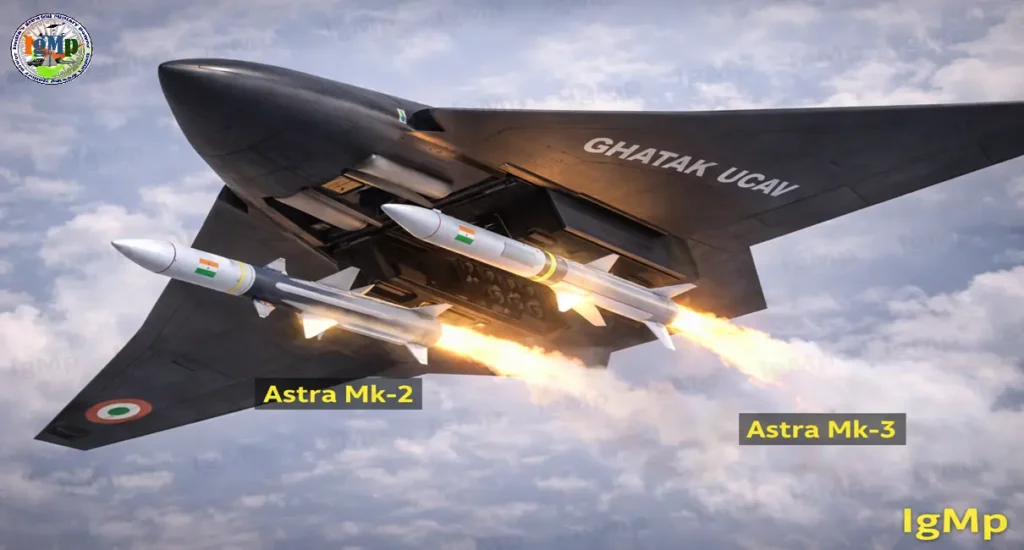
India’s stealth combat drone program has entered a decisive phase. In March 2026, the Defence Procurement Board (DPB) recommended the procurement of 60 units of the Ghatak UCAV, moving the program to the final stage of approval by the Cabinet Committee on Security (CCS). Once cleared, the stealth drone developed by Defence Research and Development Organisation (DRDO) could fundamentally reshape the regional airpower balance across South Asia and the Indo-Pacific.
Unlike traditional combat drones designed mainly for surveillance or limited strike missions, Ghatak is engineered as a stealth penetration platform capable of conducting deep strikes inside heavily defended airspace. Its tailless flying-wing configuration significantly reduces radar visibility, allowing it to bypass advanced surface-to-air missile networks such as China’s HQ-9B surface-to-air missile system and the export-oriented FM-3000 air defense system operated by Pakistan.
Beyond the SWiFT: Why 60 Stealth Units Change Everything
India’s stealth drone program began with the demonstrator known as Stealth Wing Flying Testbed (SWiFT), which validated critical technologies including autonomous flight, stealth shaping, and internal weapon carriage.
The operational platform evolving from that program—the DRDO Ghatak UCAV—is significantly larger and more capable.
Key figures highlight how serious the platform is:
- Maximum Take-Off Weight: ~13 tons (heavier than the HAL Tejas fighter)
- Internal Payload: ~1.5 tons of precision munitions
- Stealth Design: Tailless flying-wing layout optimized for low radar cross-section
- Engine: Dry variant of the GTX-35VS Kaveri producing roughly 49–51 kN thrust
Deploying 60 stealth UCAVs would allow the Indian Air Force to conduct simultaneous deep-strike operations, overwhelming enemy air defense systems through saturation tactics.
This is particularly important in a conflict scenario where manned fighters such as the Sukhoi Su-30MKI must operate at stand-off distances.
Suppression of Enemy Air Defenses (SEAD): Why the HQ-9B Can’t See the Ghatak Coming
Pakistan’s layered air defense network is built around Chinese systems like the HQ-9B surface-to-air missile system and the FM-3000 air defense system.
These systems are optimized to track aircraft with conventional radar signatures—fighters with vertical stabilizers, large intakes, and exposed weapon pylons.
Ghatak changes the equation.
Its stealth geometry and internal weapons bay minimize radar reflections, meaning enemy radar may detect the platform only at extremely short ranges. By the time defensive systems identify the incoming threat, the UCAV may already have launched anti-radiation missiles designed to destroy radar emitters.
This capability allows Ghatak to perform Suppression of Enemy Air Defenses (SEAD) missions traditionally reserved for specialized manned aircraft.
Autonomous Lethality: AI-Driven Operations in GPS-Denied Combat
A major advantage of the platform is its autonomy.
The Ghatak UCAV integrates:
- AI-driven waypoint navigation
- Autonomous take-off and landing
- Mission planning with adaptive rerouting
This allows the aircraft to operate even in GPS-denied battlefields, a scenario expected in conflicts with technologically advanced adversaries like China.
Crucially, the drone will rely on India’s indigenous satellite navigation system, NavIC, making it less vulnerable to foreign signal disruption or electronic warfare.

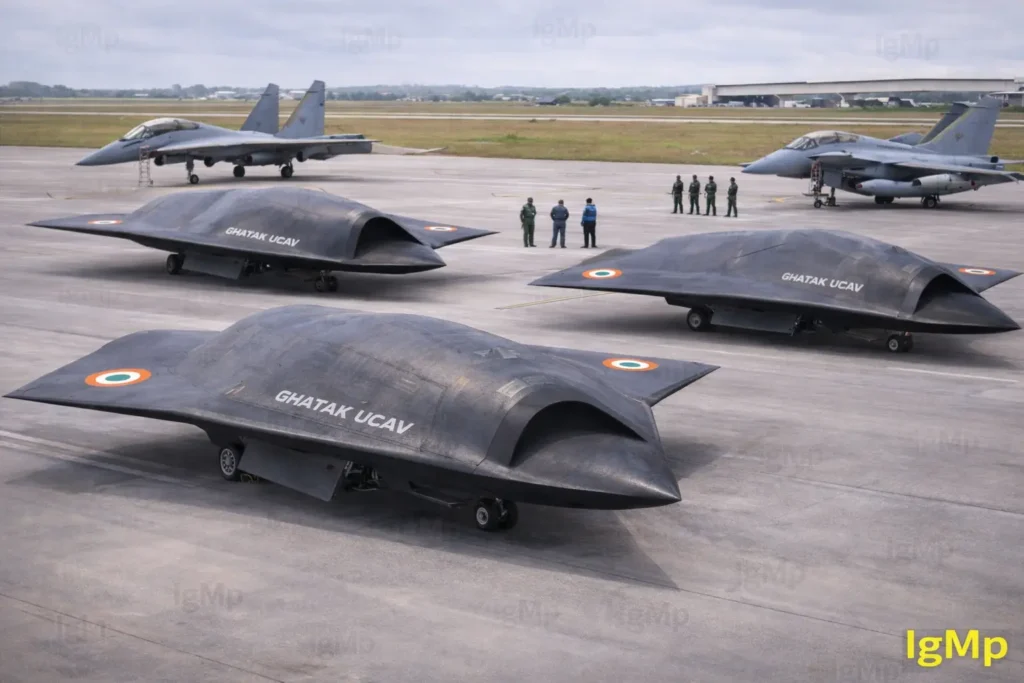
Internal Weapons Bay: Silent Strike Capability
The platform’s internal weapons bay ensures that the aircraft remains stealthy until the moment of attack.
Expected payload options include:
- Long-range air-to-air missiles such as the Astra Mk3 missile
- Anti-radiation missiles for SEAD missions
- Precision-guided glide bombs for deep strikes
Because the weapons are stored internally rather than on external pylons, the UCAV maintains a low radar signature throughout the mission.
India’s Asymmetric Counter to China’s Stealth Fighters
China fields advanced stealth fighters like the Chengdu J-20, while India’s indigenous fifth-generation fighter, the Advanced Medium Combat Aircraft (AMCA), is still under development.
Ghatak offers a powerful interim solution.
In a future combat network, the stealth drone could act as a forward stealth scout, detecting hostile aircraft and transmitting targeting data to Indian fighters such as the Sukhoi Su-30MKI. Those aircraft could then launch long-range missiles like the Astra Mk3 missile from safe distances.
This “sensor-shooter separation” model is becoming a defining feature of modern air warfare.
Comparison: Ghatak vs Rival Stealth UCAVs
| Feature | Ghatak UCAV | GJ-11 Sharp Sword | Anka-3 |
|---|---|---|---|
| Country | India | China | Turkey |
| Design | Flying-wing stealth UCAV | Flying-wing stealth UCAV | Jet stealth UCAV |
| MTOW | ~13 tons | ~10 tons | ~7 tons |
| Payload | ~1.5 tons internal | ~2 tons | ~1.2 tons |
| Engine | Dry Kaveri | Turbofan | AI-322F |
| Primary Role | SEAD / deep strike | Strategic strike | Strike & ISR |
The table shows that Ghatak falls into the heavy stealth UCAV class, giving India a platform capable of sustained deep-penetration operations.
The Strategic Impact
If the CCS approves the procurement plan, the Indian Air Force will soon field one of the largest stealth drone fleets in Asia.
This changes several strategic dynamics:
- Pakistan’s radar-based air defense network becomes vulnerable to stealth penetration
- China faces a new reconnaissance and targeting threat along the Himalayan frontier
- India gains an interim stealth strike capability before the AMCA fighter enters service
In essence, the Ghatak UCAV is not merely another drone program—it represents India’s transition into AI-enabled stealth warfare, where unmanned platforms can silently penetrate defended airspace and dismantle enemy defenses before the first manned aircraft even enters the battlefield.


