

Synopsis
- With recent breakthroughs in weight reduction, advanced manufacturing, and afterburner technology, the upgraded “Super Kaveri” or Kaveri Derivative Engine (KDE) is moving closer to becoming a viable powerplant for future Indian combat platforms such as the HAL Tejas Mk1A ecosystem and the stealth Ghatak UCAV.
IgMp Bulletin

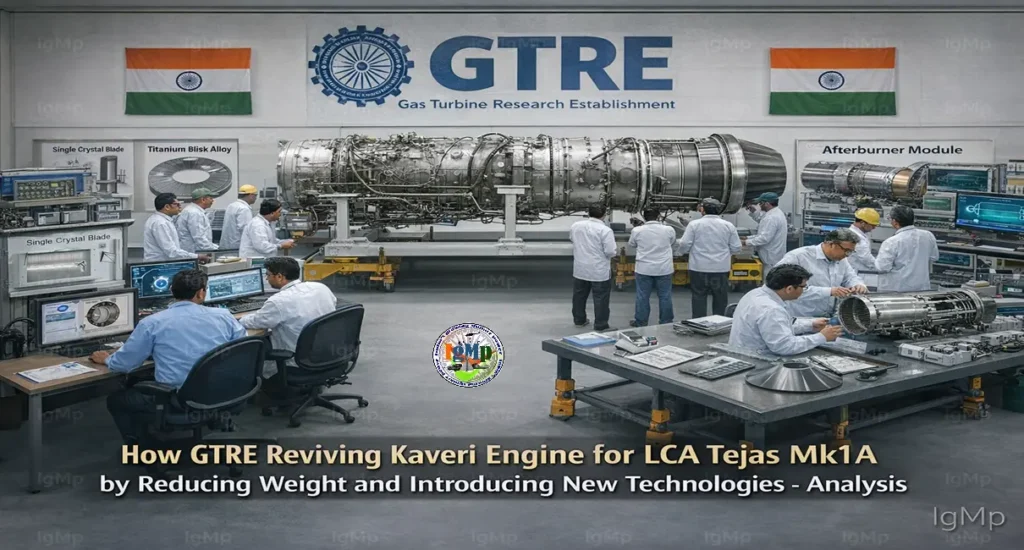
India’s indigenous jet engine effort has entered a decisive phase in 2026. For decades, the Kaveri engine program was discussed mainly in terms of development hurdles, but the focus has now shifted toward a technological transformation led by the Gas Turbine Research Establishment. With recent breakthroughs in weight reduction, advanced manufacturing, and afterburner technology, the upgraded “Super Kaveri” or Kaveri Derivative Engine (KDE) is moving closer to becoming a viable powerplant for future Indian combat platforms such as the HAL Tejas Mk1A ecosystem and the stealth Ghatak UCAV.
A major turning point came on February 16, 2026, when the engine successfully demonstrated full afterburner capability during a test witnessed by Rajnath Singh. The milestone confirmed that India’s indigenous turbofan has matured significantly beyond its earlier prototype stages. Today, the focus inside India’s propulsion community is not whether the Kaveri works, but how quickly the next-generation variant can be optimized for operational deployment.
One of the most striking engineering achievements is the dramatic reduction in engine weight. The original Kaveri engine design weighed about 1,235 kilograms, which affected thrust-to-weight ratios and integration with lightweight fighter aircraft. Through modular redesign and advanced materials, engineers have already brought the dry engine weight down to roughly 1,100 kilograms. The next milestone—targeting a sub-1,000 kilogram configuration—is being pursued through additive manufacturing and composite structures.
Recent prototypes are using 3D-printed superalloy components and polymer matrix composites (PMC) in non-critical structural areas such as the bypass duct. In one instance, a single redesigned component saved about six kilograms, highlighting how incremental material changes across the engine can collectively deliver major weight reductions.
| Feature | Original Kaveri (GTX-35VS) | Super Kaveri / KDE (2026) |
|---|---|---|
| Dry Weight | 1,235 kg | ~1,100 kg (Targeting <1000 kg) |
| Compressor Tech | Conventional Discs | Integrated BLISKs (9-Stages) |
| Thrust (Dry) | 42 kN | 49-52 kN |
| Thrust (Wet) | 70–72 kN | 81–83 kN |
| Material Innovation | Directional Solidification | Single Crystal (CMSX-4) + PMC |
Another major upgrade is the use of integrated BLISK compressors combined with boltless turbine blade arrangements. Traditional engines use bolts or mechanical attachments to secure blades to turbine discs, creating small structural weak points known as stress risers. GTRE’s boltless design eliminates these holes entirely, allowing the turbine to rotate at higher speeds while reducing structural mass. This innovation improves both reliability and thrust-to-weight ratio.
The compressor itself has evolved into a nine-stage BLISK configuration. Because the blades and discs are machined from a single piece, the assembly contains fewer parts, lower aerodynamic leakage, and reduced mechanical losses. The design also simplifies maintenance and improves airflow efficiency across the compressor stages.
Another critical improvement involves turbine materials. Engineers are now using second-generation single-crystal blades based on CMSX-4 superalloys. These blades tolerate higher temperatures and mechanical stress, enabling a turbine entry temperature of around 1500°C—about 50 degrees higher than earlier Kaveri configurations. That increase allows the engine to generate more thrust without adding extra structural mass.
The afterburner system has also undergone a significant redesign. Developed with collaboration from BrahMos Aerospace, the new weight-optimized afterburner pushes wet thrust into the 81–83 kilonewton range. This performance bracket places the upgraded engine closer to modern fighter propulsion standards and strengthens its suitability for unmanned combat platforms and specialized aircraft variants.
Also Read: GTRE Kaveri Engine Afterburner Test Success: 81-83 kN Thrust Achieved in Presence of Rajnath Singh
Much of the rapid improvement has been enabled by digital engineering tools. GTRE has adopted digital twin modeling combined with fused deposition modeling (FDM) prototypes, allowing engineers to simulate stress loads, airflow behavior, and thermal expansion before manufacturing real hardware. This virtual prototyping environment has reportedly reduced development cycles by more than 80 percent, allowing weight optimization to occur in simulation rather than through costly physical iterations.
The impact of these upgrades extends beyond the engine itself. India’s stealth Ghatak UCAV program has a critical certification timeline approaching March 31, 2026. The aircraft’s 13-ton design depends heavily on a lightweight turbofan capable of delivering long-range deep-penetration missions. Achieving a sub-1-ton engine configuration dramatically improves the drone’s endurance and operational radius.
Equally important is the shift from laboratory prototypes to industrial production. Godrej Aerospace is already delivering production-standard D2 and D3 variants of the engine, signaling the transition from research to manufacturing readiness. This industrial participation marks a major milestone for India’s indigenous propulsion ecosystem.
Jet engines remain among the most complex machines ever built, combining extreme materials science with precision engineering. The Kaveri program’s transformation—from a heavy experimental engine to a lighter, more powerful propulsion system—illustrates how incremental advances in manufacturing, materials, and digital design can reshape an entire aerospace program. As India pushes toward self-reliance in fighter propulsion, the Super Kaveri may soon stand as one of the country’s most significant technological achievements in modern aviation.


