

Synopsis
- The company, incubated at Indian Institute of Technology Delhi, recently carried out a full test run of its sub-kilonewton micro-turbojet engine, achieving a continuous 45-minute operation under simulated high-altitude conditions—an important benchmark for propulsion systems in this class.
IgMp Bulletin

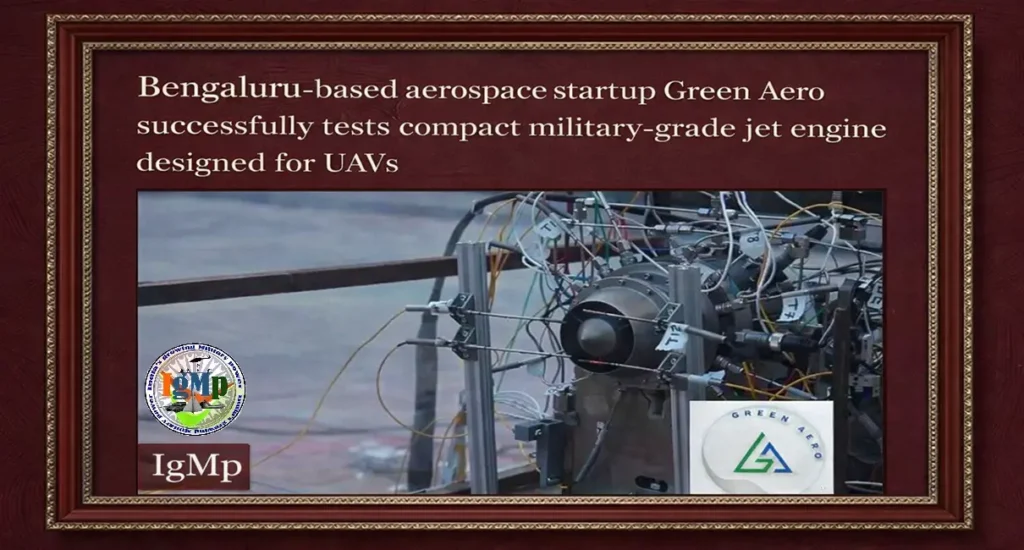
India’s emerging defence-tech ecosystem has taken a notable step forward after Bengaluru-based aerospace startup Green Aero successfully tested a compact military-grade jet engine designed for unmanned systems. The company, incubated at Indian Institute of Technology Delhi, recently carried out a full test run of its sub-kilonewton micro-turbojet engine, achieving a continuous 45-minute operation under simulated high-altitude conditions—an important benchmark for propulsion systems in this class.
For micro-turbojets used in drones and loitering munitions, endurance is as crucial as thrust. Maintaining stable combustion, turbine temperatures, and consistent airflow over long runs is a complex engineering challenge. Engineers involved in the test confirmed that the engine sustained steady thrust levels across different operating regimes without hotspots or structural anomalies, indicating a mature design approaching operational readiness.
The “Diesel-Jet” Innovation
One of the most striking features of the new engine is its ability to run on both aviation turbine fuel and diesel. This dual-fuel capability aligns with what military planners often call the “Single Fuel Policy,” a logistics principle where the same fuel used for tanks, trucks, and generators can also power unmanned aircraft.
In remote or forward operating environments—such as mountainous border zones or expeditionary deployments—supplying specialised aviation fuel can be difficult. Diesel, however, is widely available across military supply chains. A drone powered by a diesel-compatible jet engine can therefore operate with far simpler logistics.
Technically, this is not a trivial achievement. Diesel is a “middle distillate” similar to kerosene but denser and with different viscosity and combustion characteristics. Running diesel in a turbojet often risks carbon buildup, known as “coking,” which can damage combustion chambers and turbines. Green Aero’s engine reportedly handles these differences without performance loss, making it unusually flexible compared with most micro-turbojets in its class.
Surviving the High-Altitude Challenge
The propulsion unit produces more than 200 newtons of thrust, placing it in the sub-kilonewton category typically used in tactical UAVs, high-speed target drones, and loitering weapons. During testing, engineers simulated thin-air conditions similar to high-altitude flight, ensuring the engine can operate effectively in environments where oxygen levels and air density are significantly lower.
Green Aero’s design process relied heavily on computational fluid dynamics modelling and rapid prototyping. Using additive manufacturing techniques, engineers were able to produce highly precise turbine components and integrate internal cooling channels directly into metal parts—something extremely difficult with conventional casting methods at such a small scale. This approach allowed the team to accelerate development while improving the engine’s power-to-weight ratio.
Quick Specs
| Feature | Specification |
|---|---|
| Thrust Class | Sub-kilonewton (>200N) |
| Fuel Type | Multi-fuel (Jet A-1, Diesel) |
| Design Cycle | ~18 Months (CFD & Digital Simulation) |
| Primary Use | Loitering munitions, target drones |
Bridging India’s Propulsion Gap
The successful test also highlights a long-standing challenge in India’s defence aviation sector: the propulsion gap in unmanned platforms. While India has developed several indigenous drone airframes, including projects such as the DRDO Tapas UAV, propulsion systems have often been sourced from foreign manufacturers.
One widely used benchmark in this segment is the Czech-made PBS TJ100 turbojet engine, a compact jet engine that powers numerous UAV platforms worldwide. However, systems like the TJ100 typically rely on aviation fuel such as Jet A-1. By contrast, Green Aero’s fuel-agnostic design could offer a distinct advantage in expeditionary warfare scenarios where high-grade aviation fuel may not be readily available.
Defence analysts believe such engines could power next-generation loitering munitions and fast-reaction attack drones similar to the ALS‑50 loitering munition developed in India. Jet-powered drones travel significantly faster than propeller-driven versions, reducing the reaction time available to enemy air defences and increasing mission effectiveness.
Beyond tactical drones, micro-turbojets are also used in target aircraft that simulate enemy threats during missile tests, supporting trials for systems like the Akash‑NG air defence missile system.
The breakthrough reinforces Bengaluru’s position as one of India’s most dynamic aerospace innovation hubs, supported by institutions such as the Indian Institute of Science and major manufacturers like Hindustan Aeronautics Limited.
For India’s defence sector, the development also reflects a broader shift. While government laboratories such as the Gas Turbine Research Establishment have long worked on large fighter-class engines under programmes like the Kaveri project, startups are increasingly tackling the small-engine segment that powers modern drone warfare.
In many ways, this emerging ecosystem represents the private sector’s answer to the propulsion challenge—filling a critical gap in India’s defence supply chain and strengthening the technological backbone of future unmanned combat systems.


