

Synopsis
- The reported plan to integrate a hypersonic SLCM with a strike range of up to 2,500 kilometers marks a potential doctrinal shift.
Source : IgMp Bulletin

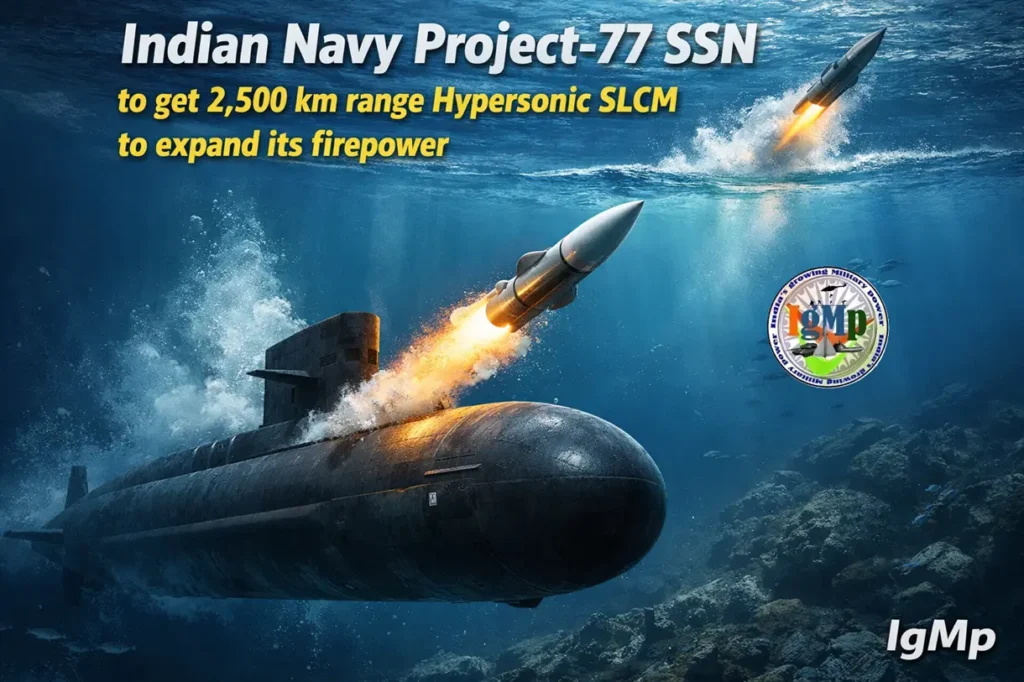
Project-77 SSN: India’s Silent Sentinel in the Indian Ocean
India’s undersea warfare capability is poised for a significant leap forward as Project-77 nuclear-powered attack submarines (SSNs) move closer to realization. Designed as stealthy, long-endurance platforms, these submarines are expected to combine advanced propulsion, reduced acoustic signatures, and potentially a 2,500-kilometer hypersonic submarine-launched cruise missile (SLCM). Together, these elements could reshape India’s maritime posture in the Indo-Pacific over the next two decades.
Project-77 represents one of the most ambitious indigenous naval programs undertaken by the Indian Navy. With an estimated project cost of around ₹1.2 lakh crore, the program aims to field nuclear-powered attack submarines capable of sustained high-speed underwater operations, independent deployments, and multi-domain strike missions.
The Indian Ministry of Defence has emphasised the Navy’s indigenisation progress under the Aatmanirbhar Bharat policy as part of its broader modernisation plan, with ongoing submarine programmes highlighted within this vision [Source: PIB]. The Ministry of Defence’s 2025 year-end review notes that approximately 75% of the capital modernisation budget is being allocated toward domestically sourced equipment, reinforcing the Aatmanirbhar Bharat approach [Source: PIB]. According to the Indian Navy’s official vision statement, maximising self-reliance and capability modernisation through indigenous design and construction forms a core strategic priority [Source: Indian Navy].
Unlike ballistic missile submarines designed primarily for nuclear deterrence, SSNs are offensive platforms. Their mission set includes anti-submarine warfare, anti-ship strikes, intelligence gathering, escort operations, and land-attack roles. The addition of hypersonic cruise missile capability would significantly expand their strategic relevance.
The Hypersonic Edge: Why a 2,500 km SLCM Matters
The reported plan to integrate a hypersonic SLCM with a strike range of up to 2,500 kilometers marks a potential doctrinal shift. Traditional cruise missiles fly at subsonic or supersonic speeds. Hypersonic weapons, by contrast, travel at speeds exceeding Mach 5 while remaining within the atmosphere and retaining maneuverability.
From a tactical perspective, speed dramatically reduces an adversary’s reaction window. Modern naval air-defense systems, including layered interceptor networks deployed by major naval powers, rely heavily on detection-to-intercept timelines. A hypersonic missile compresses that cycle significantly. While no defense system is truly obsolete, higher speeds and maneuverability complicate interception efforts and demand more advanced countermeasures.
This leads to what strategists often describe as a “no-escape zone.” If launched from a concealed SSN operating hundreds of kilometers offshore, a hypersonic SLCM could place high-value maritime or coastal assets under sustained risk without exposing the submarine to counter-detection.
Equally important is the concept of strategic reach. A Project-77 submarine positioned in the Bay of Bengal could theoretically cover large parts of the eastern Indian Ocean without venturing into contested waters. This approach aligns with a maritime “bastion strategy,” where submarines operate under the protective umbrella of friendly air and naval assets while maintaining long-range strike capability.
The missile development effort is expected to draw upon decades of expertise from the Defence Research and Development Organisation and BrahMos Aerospace. India’s cruise missile ecosystem has steadily matured, with increasing indigenous content and advances in propulsion, materials, and guidance systems.
Engineering the Beast: From 83MW to 190MW Indigenous Reactors
One of the most consequential technological upgrades under Project-77 lies in its power plant. India’s earlier nuclear submarine platform utilized an 83 MW pressurised water reactor. Project-77 is expected to feature a far more powerful 190 MW reactor developed by the Bhabha Atomic Research Centre.
The jump in reactor output is not merely numerical. More power translates directly into operational advantages.
First, it enables sustained underwater speeds above 30 knots. Speed in submarine warfare is not just about chasing targets; it is about repositioning rapidly, evading threats, and maintaining tactical unpredictability.
Second, higher power availability supports advanced onboard systems. Modern SSNs rely on sophisticated sonar arrays, signal processing units, electronic warfare suites, and secure communications. These systems require consistent energy supply without compromising propulsion efficiency.
Third, increased power reserves provide headroom for future upgrades. As naval warfare evolves, submarines may integrate high-energy sensors, improved data fusion capabilities, and possibly directed-energy defensive systems. Designing Project-77 with a higher power baseline ensures technological relevance for decades.
Finally, reactor improvements often accompany acoustic refinements. Reports suggest that Project-77 may incorporate pump-jet propulsion instead of traditional propellers. Pump-jets are generally quieter, reducing cavitation noise and enhancing stealth — a decisive factor in contested maritime environments.
Comparative Analysis: Project-77 vs. Regional Adversaries
Project-77 vs. Type 093 (Shang-class): Shifting the Undersea Balance
| Feature | Project-77 SSN (India) | Type 093B/093G (China) |
|---|---|---|
| Primary Armament | 2,500 km Hypersonic SLCM (proposed) | YJ-18 / CJ-10 Cruise Missiles |
| Propulsion | Indigenous 190 MW PWR | High-pressure PWR |
| Acoustic Signature | Advanced pump-jet (anticipated) | 7-bladed propeller |
| Operational Philosophy | Deep-sea interdiction, bastion denial | Carrier strike group support |
China’s Type 093 submarine fleet enjoys numerical strength. However, undersea warfare is not purely a numbers game. Acoustic superiority — the ability to remain undetected while detecting others — is often the defining advantage.
If Project-77 achieves meaningful noise reduction through pump-jet propulsion and hull optimization, it could prioritize stealth over fleet size. Silent operation would allow Indian SSNs to position themselves near critical choke points such as the Malacca Strait and monitor vessel movements discreetly.
This reflects a strategic design philosophy: instead of matching hull-for-hull, focus on survivability, precision strike reach, and denial capability.
Strategic Analysis: Redefining India’s “Area Denial” Doctrine
Project-77 SSNs equipped with long-range hypersonic SLCMs would expand India’s maritime toolkit beyond conventional sea control. The combination of nuclear propulsion, stealth, and extended strike range creates a layered deterrence framework.
In practical terms, such submarines could:
- Conduct anti-ship and anti-submarine missions
- Support carrier battle groups
- Perform deep land-attack operations
- Maintain surveillance across key sea lanes
- Contribute to sea denial strategies
Sea denial differs from sea control. It focuses not on dominating an entire maritime zone, but on preventing adversaries from operating freely within it. Long-range submarine-launched hypersonic weapons amplify this effect by holding high-value targets at risk without visible escalation.
Importantly, this capability also enhances strategic stability. Submarines are inherently survivable platforms. Their concealed nature makes them credible deterrent assets, reducing incentives for preemptive action while maintaining defensive readiness.
As Indo-Pacific naval competition intensifies, undersea capabilities are likely to define the balance of power more than surface fleets alone. Project-77 reflects India’s recognition of that reality.
If executed successfully, these submarines will not simply add numbers to the fleet. They will redefine how India projects power, secures sea lanes, and safeguards maritime interests across a rapidly evolving strategic landscape.


