

Synopsis
- In this context, the Su-57 is being evaluated not just as a fighter jet but as a weapons platform capable of deploying some of the most advanced air-launched munitions currently available.

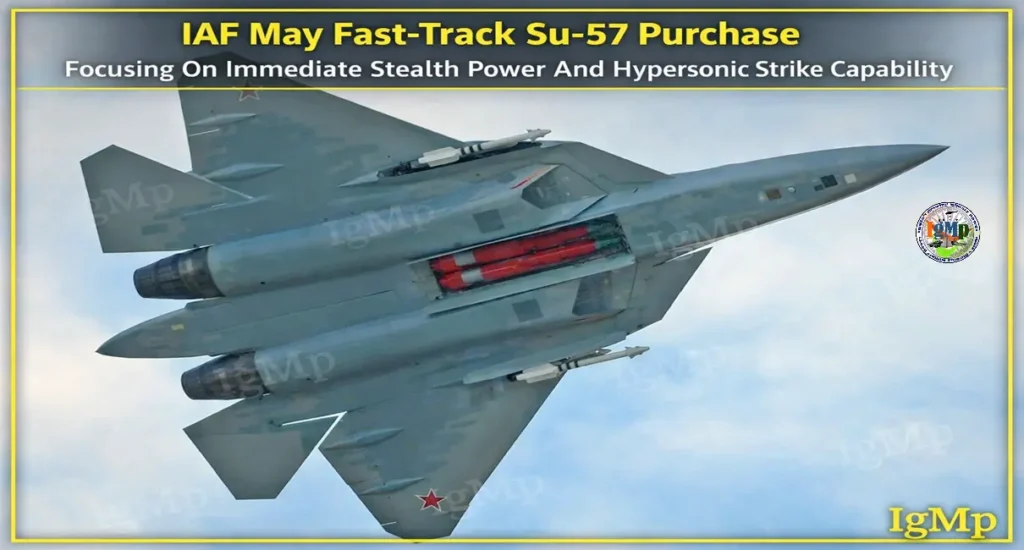
India’s evolving plans to acquire the Sukhoi Su-57 stealth fighter are increasingly being shaped by urgency rather than long-term industrial ambitions. As of March 2026, defence discussions have shifted away from a complex local manufacturing program toward a rapid “off-the-shelf” procurement of roughly 40 to 60 aircraft for the Indian Air Force. The idea behind this strategy is straightforward: close the emerging stealth capability gap in the region as quickly as possible while India’s indigenous fifth-generation aircraft projects mature later in the decade.
The new approach prioritizes speed of induction and operational readiness over domestic assembly. Analysts note that establishing a licensed production line would likely delay deliveries until the early 2030s. In contrast, a direct flyaway purchase could allow the first aircraft to begin arriving as early as 2027–2028, giving India an operational stealth squadron several years earlier. Within military planning circles, this timing advantage is sometimes summarized with a simple phrase: in modern air combat, time can be as decisive as technology.
The urgency partly stems from the growing presence of stealth fighters in the region, particularly the deployment of China’s Chengdu J-20. Indian strategists increasingly view a limited but capable stealth fleet as necessary to maintain balance along critical theatres such as the Himalayas and the wider Indo-Pacific. In this context, the Su-57 is being evaluated not just as a fighter jet but as a weapons platform capable of deploying some of the most advanced air-launched munitions currently available.
Su-57 Internal Weapons Bays and Hypersonic Strike Capability With Kh-47M2 Kinzhal missile (Mini Variant)
Unlike many Western stealth aircraft, the Su-57 features unusually large internal weapon bays designed to accommodate a diverse mix of missiles and strike systems while preserving low radar visibility. Russia has reportedly offered the aircraft to India with what officials describe as a “sovereign weapons bundle,” giving the Indian Air Force access to a broad range of internal munitions without restrictive integration policies.
| Weapon System | Operational Role | Strategic Advantage |
|---|---|---|
| Kh-47M2 Kinzhal (Mini Variant) | Hypersonic Strike | Near-instant destruction of hardened targets |
| R-37M missile | A2A Interception (400 km) | Outranges most current BVR missiles in the region |
| Kh-69 cruise missile | Precision Stealth Strike | Internal carriage for “First Day” operations |
| R-77M missile | Medium-Range A2A | Compact fins for high internal bay density |

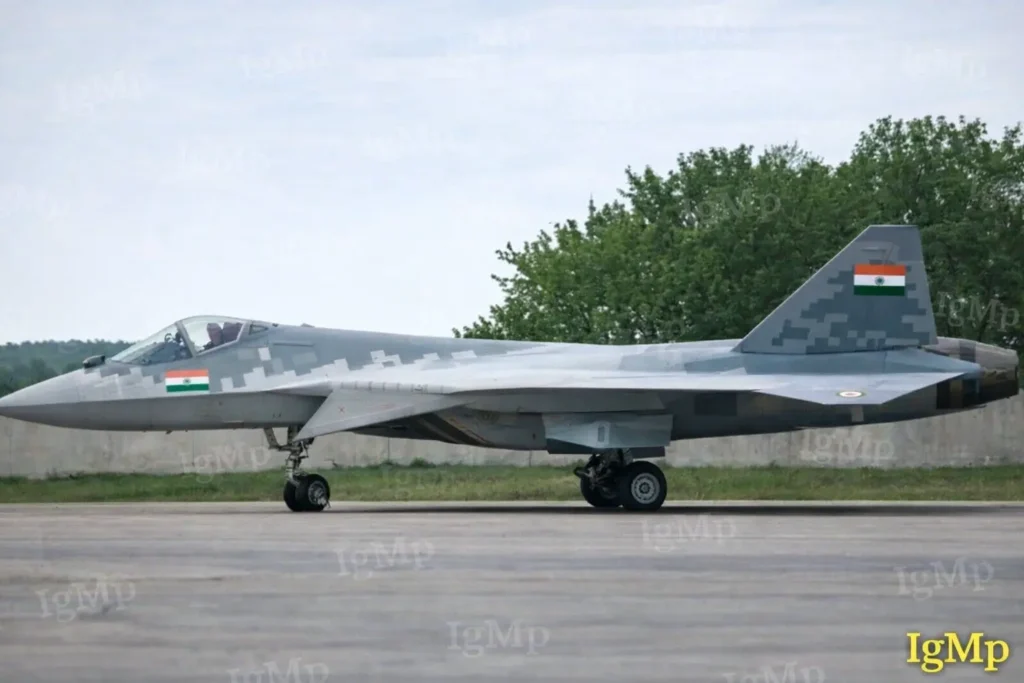
A centerpiece of this weapons package is the potential integration of a smaller air-launched ballistic missile derived from the hypersonic Kh-47M2 Kinzhal system. Often referred to informally as a “Mini-Kinzhal,” this concept involves adapting the high-speed strike missile for internal carriage within the Su-57’s weapon bays. Unlike the larger version currently deployed from interceptors such as the Mikoyan MiG-31, the scaled variant is intended to preserve the stealth profile of the aircraft while still delivering hypersonic performance.
If integrated, this weapon would effectively turn the Su-57 into a stealth-enabled hypersonic strike platform. The missile’s speed—potentially exceeding Mach 8 or higher—would allow it to reach targets extremely quickly, leaving very little time for interception by conventional air defense systems. For military planners, this combination of stealth delivery and hypersonic velocity could create what some analysts describe as a “hypersonic stealth sniper,” capable of neutralizing hardened command centers, strategic infrastructure or time-sensitive targets deep inside contested territory.
R-37M and Astra Missiles: Hybrid Lethality for the IAF
Another key component of the Su-57’s potential arsenal is the very-long-range R-37M missile. Originally developed for interceptor aircraft such as the Mikoyan MiG-31, the missile has gained attention for its extremely long engagement envelope, often estimated at several hundred kilometers. In operational terms, such a weapon allows fighters to threaten high-value airborne assets—airborne early warning aircraft, refueling tankers or electronic warfare platforms—from distances far beyond the reach of most escort fighters.
At the same time, Indian planners are reportedly exploring a hybrid weapons architecture rather than relying exclusively on imported missiles. The indigenous Astra missile family is expected to remain central to India’s long-range air-to-air doctrine. Future variants like Astra Mk3 aim to reach ranges approaching 350 kilometers, creating the possibility of a mixed arsenal where Russian airframes launch both domestic and foreign missiles depending on mission requirements.
Su-57 Logistics Advantage and Interim Stealth Bridge Strategy
Another practical factor driving the off-the-shelf model is logistics. The Indian Air Force already operates a large fleet of Sukhoi Su-30MKI fighters. Many of the maintenance skills, ground equipment and operational practices developed for that fleet could potentially support the transition to the Su-57 more quickly than introducing an entirely unfamiliar aircraft ecosystem.
The Su-57’s internal bay design also enables stealth-compatible precision strike missions. Weapons such as the Kh-69 cruise missile are specifically shaped to fit inside the aircraft without increasing radar visibility. This allows the aircraft to conduct deep-penetration missions on the first day of a conflict, targeting critical infrastructure or air-defense networks before adversaries fully react.
For India’s broader defence planning, the potential Su-57 purchase is not necessarily meant to replace indigenous development programs. The country’s long-term stealth ambitions still revolve around the Advanced Medium Combat Aircraft project, which is expected to mature during the 2030s. Until that aircraft enters service, the Su-57 could function as an interim stealth bridge—providing operational experience, deterrence and technological exposure.
Viewed through this lens, the emerging procurement strategy is less about building a new production ecosystem and more about securing immediate operational capability. By potentially acquiring dozens of ready-to-fly stealth fighters equipped with advanced weapons—including the hypersonic Mini-Kinzhal concept—the Indian Air Force could quickly establish a credible fifth-generation strike capability while maintaining strategic flexibility for the future.


