

Synopsis
- India’s long-delayed Project 75 India (P-75I) submarine programme has taken a decisive step forward, with the Indian Navy and Germany’s Thyssenkrupp Marine Systems (TKMS) concluding cost negotiations for what is expected to be one of the world’s largest conventional submarine contracts.
Source : IgMp Bulletin

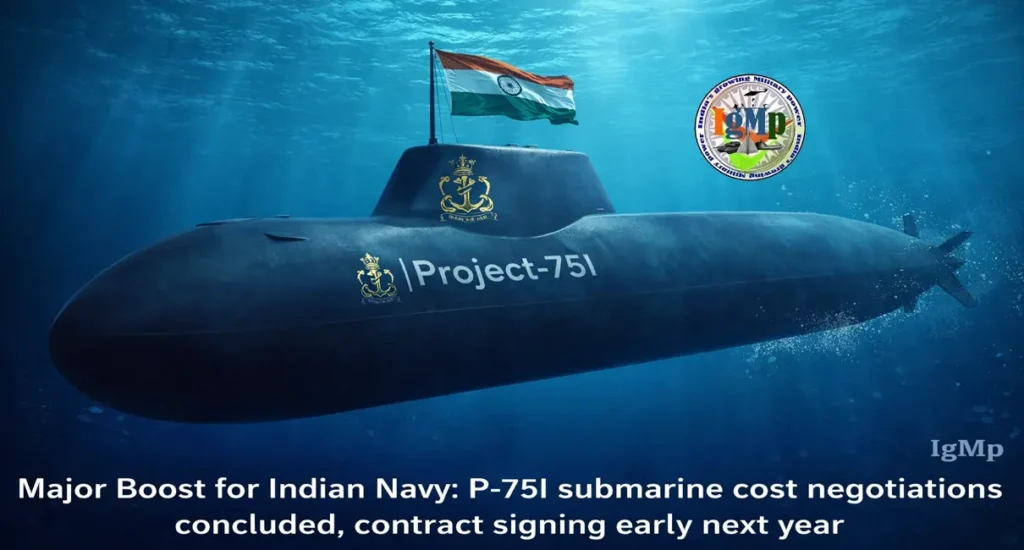
India’s long-delayed Project 75 India (P-75I) submarine programme has taken a decisive step forward, with the Indian Navy and Germany’s Thyssenkrupp Marine Systems (TKMS) concluding cost negotiations for what is expected to be one of the world’s largest conventional submarine contracts. Estimated at around $9 billion for six advanced diesel-electric submarines equipped with Air Independent Propulsion (AIP), the deal reflects both India’s maritime urgency and its push for deep technology transfer.
While final contractual signatures are still subject to financial clearances and approval by India’s Cabinet Committee on Security, defence officials indicate that the complex pricing discussions have now been settled. The agreement will see the submarines constructed in India by Mazagon Dock Shipbuilders Limited under a strategic partnership model designed to expand domestic shipbuilding capabilities.
Unlike several global submarine procurements that focus purely on acquisition, P-75I is structured around indigenous manufacturing and ecosystem development. The first submarine is expected to be delivered seven years after contract signing, with an initial indigenous content target of around 45 percent. That figure is planned to rise to approximately 60 percent over the course of the programme, creating long-term industrial depth in complex systems integration, hull fabrication, combat systems and propulsion modules.
The high cost has drawn comparisons internationally. Canada, for instance, is pursuing a separate conventional submarine programme in which TKMS is also a bidder. However, India’s contract differs fundamentally because it mandates extensive technology transfer and local production. Building the submarines domestically—rather than importing them fully assembled—naturally raises upfront expenditure but strengthens sovereign capability over time.
For the Indian Navy, timing is critical. India currently operates 16 conventional submarines, many of which are approaching the end of their operational life. These include boats from the Kilo and Shishumar classes, alongside the more modern Kalvari-class submarines built under the earlier Project 75. The addition of six P-75I boats will bridge capability gaps as older vessels are phased out and will complement the ongoing induction of the Kalvari-class fleet.
Strategically, the new submarines are expected to feature advanced stealth characteristics, improved endurance through AIP technology, and modern combat management systems suited for blue-water operations. As Chinese submarine deployments in the Indian Ocean Region increase, New Delhi has prioritised undersea deterrence as a core pillar of maritime security. The P-75I programme fits into a broader roadmap that includes future indigenous Project-76 conventional submarines and nuclear-powered platforms under development.
By the mid-2030s, India aims to operate a significantly expanded submarine arm, combining conventional and nuclear assets for layered deterrence. The Arihant-class ballistic missile submarines already provide a sea-based nuclear deterrent, while future nuclear attack submarines are planned to enhance sea denial and carrier battle group protection. In that architecture, P-75I boats will serve as versatile, stealthy workhorses for intelligence gathering, anti-shipping missions and choke-point control across critical sea lanes from the Strait of Hormuz to Southeast Asia.
For Germany, securing the Indian contract reinforces TKMS’s standing in the competitive global submarine export market. For India, the partnership strengthens defence-industrial ties with Europe at a time of shifting geopolitical alignments. The emphasis on local construction aligns with New Delhi’s long-term objective of self-reliance in defence manufacturing, reducing dependence on single-source suppliers while upgrading technological sophistication.
If approvals proceed as expected, steel cutting at the Mumbai yard could begin soon after signing. Given the seven-year delivery timeline for the first vessel, the coming decade will be pivotal. Beyond the headline figure, P-75I represents something more consequential: a strategic bet on building not just submarines, but a resilient domestic undersea industrial base capable of sustaining India’s maritime ambitions well into the 2040s.


[…] submarines were commissioned between 2017 and 2025 under the Project 75 India (Project-75I) submarine program, forming the backbone of India’s conventional submarine arm. While the vessels […]