

Synopsis
- According to details released by IG Defence, Project KAL is being designed with an estimated operational range of up to 1,000 kilometres and an endurance window of three to five hours, allowing it to reach deep into contested airspace before engaging targets.
IgMp Bulletin

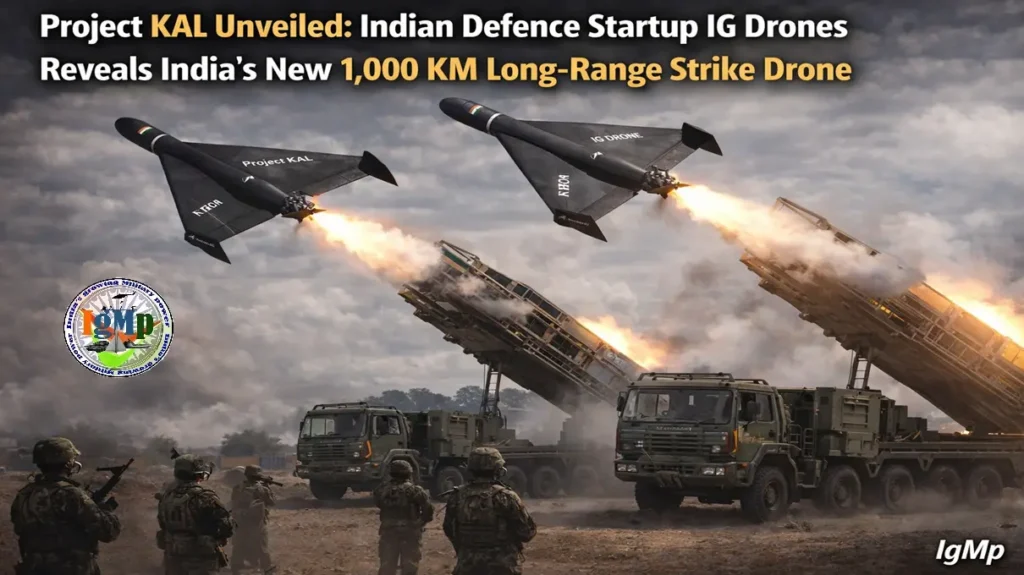
India’s rapidly evolving unmanned warfare ecosystem may soon see the arrival of a new deep-strike capability after IG Defence revealed the early concept of Project KAL, a long-range unmanned strike drone designed to operate far beyond the frontline. The platform, currently in early development, aims to strengthen India’s domestic capabilities in long-range combat drones at a time when autonomous systems are transforming modern military strategy [Source: The Economic Times].
Recent conflicts across the Middle East and Eastern Europe have demonstrated how long-range one-way attack drones can influence the balance of power on the battlefield. Platforms such as Iran’s Shahed-136 have drawn global attention for their ability to travel hundreds or even thousands of kilometres while carrying explosive payloads capable of striking infrastructure, radar installations and logistical facilities. Their relatively low production cost compared with advanced interceptor missiles has also forced many militaries to rethink how air defence networks should respond to large numbers of incoming drones.
According to details released by IG Defence, Project KAL is being designed with an estimated operational range of up to 1,000 kilometres and an endurance window of three to five hours, allowing it to reach deep into contested airspace before engaging targets. The concept focuses on creating a long-range unmanned strike platform capable of locating high-value military assets and delivering a precision strike without exposing manned aircraft to enemy air defence systems.
Breaking Down the 1,000 KM Range: The Strategic Necessity of Project KAL
A drone capable of striking targets at distances approaching 1,000 kilometres represents a significant addition to India’s unmanned capabilities. Long-range drones allow military planners to conduct deep-strike operations against radar networks, air defence sites, logistics depots and command centres without risking expensive fighter aircraft or pilots.
In operational terms, such systems can be used as the first wave of an attack designed to degrade enemy defences. Once radar systems or surface-to-air missile sites are neutralised, conventional aircraft or cruise missiles can enter the contested area with reduced risk. This doctrine is widely associated with anti-access/area-denial (A2/AD) strategies, where layered air defence systems are targeted before the main strike force arrives.
Technical Specifications: Piston Power vs. Turbojet Endurance
To understand where Project KAL fits within the broader drone ecosystem, it helps to compare it with other well-known strike drones currently in service around the world.
Strategic Strike Drones: Project KAL vs Global Benchmarks
| Feature | Project KAL (IG Drones) | Shahed-136 (Iran) | Sheshnaag-150 (India) |
|---|---|---|---|
| Operational Range | ~1,000 km | 2,000–2,500 km | 1,000-1,500 km |
| Endurance | 3–5 hours | 6–8 hours | ~5 hour |
| Payload Capacity | High-explosive / anti-radar | ~50 kg | ~5 hours |
| Primary Launch Method | Catapult / rocket assist | RATO / truck-launched | Launcher / truck-launched |
| Strategic Tier | Long-range strategic | Long-range strategic | Long-range strategic |
Achieving a 1,000-kilometre operational range requires careful engineering trade-offs involving propulsion efficiency, payload capacity and aerodynamic design. Most drones in this category rely on small piston engines, similar to those used in light aircraft or commercial unmanned platforms. Engines derived from systems such as Rotax-type powerplants are particularly attractive because they are fuel-efficient, relatively inexpensive and easy to maintain.
Compared with compact turbojet engines, piston propulsion offers longer endurance at lower cost, making it ideal for one-way attack drones (OWA) that are intended to travel long distances before striking a target. For militaries planning to deploy these drones in large numbers, affordability becomes as important as performance.
Navigation in Contested Airspace: Overcoming GPS Jamming
Operating over long distances also introduces significant navigation challenges. Modern battlefields are heavily contested electronic environments where satellite navigation signals can be jammed or manipulated. A drone travelling hundreds of kilometres cannot rely solely on GPS or other global navigation satellite systems.
To maintain accuracy during long-range missions, platforms like Project KAL would likely require inertial navigation systems (INS) combined with terrain-mapping or optical navigation technologies. These systems allow the drone to calculate its position independently by measuring movement and comparing terrain imagery with pre-loaded maps. Such redundancy ensures the drone remains on course even if satellite signals become unreliable.
The Economic Logic: Forcing the Adversary into an Interceptor Deficit
One of the key reasons long-range strike drones have become strategically important is their economic advantage. Many advanced surface-to-air interceptor missiles cost hundreds of thousands or even millions of dollars per shot. In contrast, loitering munitions and strike drones can often be produced at a fraction of that cost.
This imbalance creates what defence analysts describe as an “interceptor deficit.” When dozens of low-cost drones approach simultaneously, defenders must either expend expensive missiles to stop them or risk allowing some to penetrate the defence network. Even a small number of successful hits on radar stations or logistics facilities can produce disproportionate operational effects.
Startup Synergy: How Indian Defence Startups like IG Drones and NewSpace Research Technologies Are Disrupting the Traditional Defence Ecosystem
India’s defence innovation landscape is increasingly being shaped by agile private startups that are moving faster than traditional development cycles. Companies such as IG Drones and NewSpace Research & Technologies are becoming prominent examples of how the country’s defence ecosystem is evolving beyond state-led laboratories and large public-sector programmes.
IG Drones has gained attention for its work in autonomous aerial platforms and AI-driven drone solutions. With Project KAL, the company is exploring the development of a long-range strike drone capable of operating deep inside contested environments. Drawing from its expertise in autonomous navigation and aerial mapping, the startup is attempting to translate commercial drone technology into a military-grade platform that combines long endurance, low operational cost, and the ability to deliver precision strikes on critical targets such as radar stations, logistics hubs, or command facilities.
A parallel story is unfolding with NewSpace Research & Technologies, another Indian startup that has rapidly emerged as a serious player in the unmanned combat systems space. The company drew significant attention with the development of the Sheshnaag-150 long-range strike drone, which reportedly offers deep-strike capabilities comparable to emerging long-range loitering munitions worldwide. Designed for extended range missions and high-precision targeting, the Sheshnaag-150 represents a new class of indigenous strike drones that can be deployed in large numbers to saturate adversary air defences while keeping costs manageable.
Together, the work of IG Drones and NewSpace Research highlights a broader shift in India’s defence innovation model. Instead of relying solely on large, multi-year programmes led by state laboratories such as Defence Research and Development Organisation, the ecosystem is gradually opening space for startups that can prototype, iterate, and field new technologies at a faster pace. These companies often operate at the intersection of artificial intelligence, autonomous systems, and advanced manufacturing, allowing them to bring commercial-sector innovation into military applications.
The Future of India’s Unmanned Deep-Strike Capability
If successfully developed, a drone with a 1,000-kilometre strike radius could expand India’s operational options across a wide range of potential scenarios. Such systems could conduct reconnaissance, suppress air defence nodes or carry out precision strikes without risking frontline aircraft such as the Dassault Rafale or Sukhoi Su‑30MKI.
Project KAL could also play a role in drone swarm tactics, where multiple unmanned systems approach a target area simultaneously to overwhelm defences. In such a strategy, several low-cost drones may be launched first to trigger enemy air defence responses, forcing the opponent to expend interceptor missiles before a second wave of precision weapons or cruise missiles arrives.
As warfare continues to evolve toward greater automation and network-centric operations, long-range unmanned strike platforms are increasingly becoming a critical part of modern military doctrine. India’s growing ecosystem of defence startups, research institutions and industrial partners suggests that the country is positioning itself to remain an active participant in this global transformation of air power.


