

Synopsis
- The key step in this transition is the official activation of the Littoral Combatant Command on July 1, 2026, a dedicated command structure expected to be led by a two-star vice admiral.

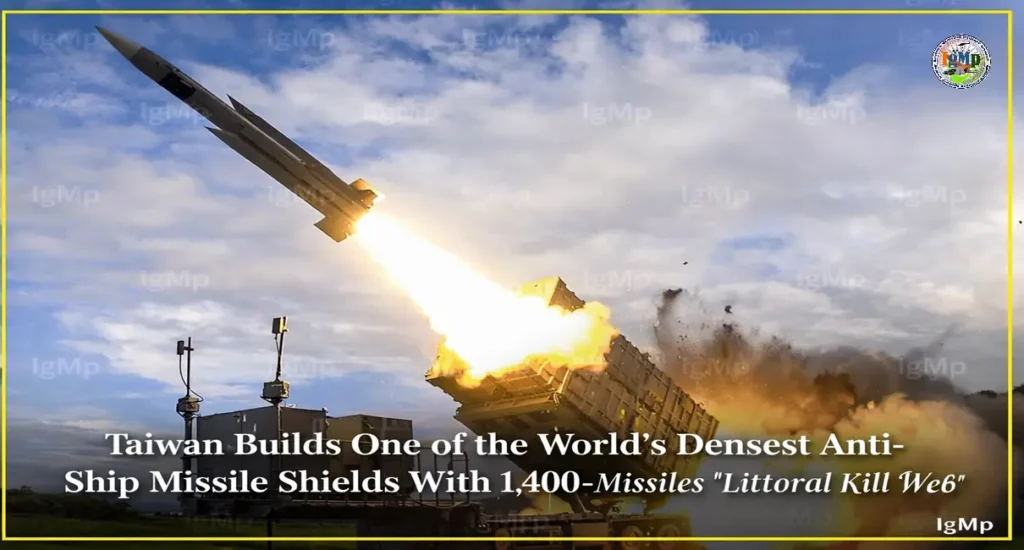
Taiwan’s Sea-Air Combat Power Improvement Plan has entered its peak production phase, placing the island on track to field more than 1,400 anti-ship missiles by December. A major operational shift is also underway. On July 1, 2026, Taiwan is scheduled to activate a new Littoral Combatant Command that will unify domestically built Hsiung Feng III supersonic missiles with US-supplied Harpoon Block II systems. The result will be a tightly integrated maritime denial network designed to protect Taiwan’s surrounding waters through layered missile strikes, upgraded ECCM-capable guidance systems, and integration with unmanned platforms.
July 2026: The Launch of Taiwan’s Littoral Combatant Command
Taiwan’s defense posture is moving beyond scattered coastal missile batteries toward a more coordinated maritime denial architecture. The key step in this transition is the official activation of the Littoral Combatant Command on July 1, 2026, a dedicated command structure expected to be led by a two-star vice admiral.
The new command will unify existing coastal missile brigades with newly arriving US-supplied Harpoon units under a single operational framework. Instead of independent launch batteries responding individually to threats, the Littoral Combatant Command will manage a coordinated strike network covering Taiwan’s surrounding sea lanes.
Military planners increasingly describe this system as a “littoral kill web,” where missile forces, radar stations, drones, and reconnaissance assets share a common operational picture. The objective is to enable faster targeting decisions and synchronized missile launches capable of overwhelming hostile naval formations approaching the island.
Taiwan’s 2026 Missile Production Engine
A central driver of this strategy is Taiwan’s expanding domestic missile production. The National Chung-Shan Institute of Science and Technology (NCSIST) has ramped up manufacturing capacity under the Sea-Air Combat Power Improvement Plan.
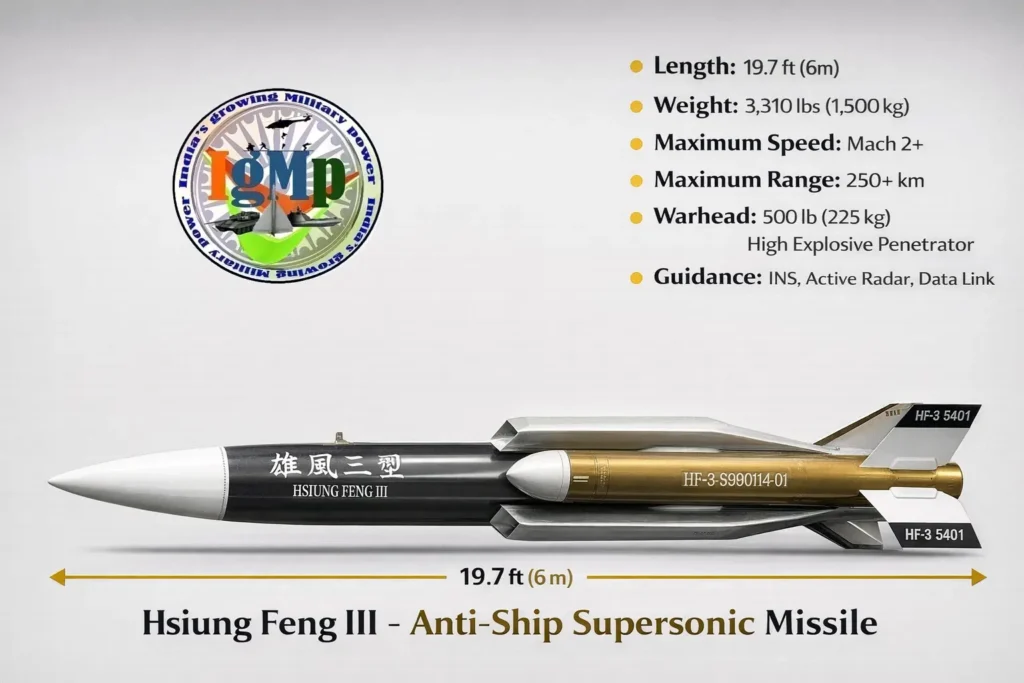
Current 2026 production estimates indicate that roughly 70 units per year of the supersonic Hsiung Feng III family are being produced, including the extended-range version believed to reach close to 400 kilometers. At the same time, production lines generate around 131 units annually of the subsonic Hsiung Feng II and Hsiung Sheng cruise missiles.
When these indigenous systems are combined with deliveries of American Harpoon Block II coastal defense missiles, Taiwan’s total anti-ship missile inventory is expected to exceed 1,400 units by the end of 2026. This scale of coastal firepower would give the island one of the highest densities of anti-ship missiles anywhere in the world.

Taiwan’s 2026 Coastal Strike Architecture
| System | Role in “Porcupine” Doctrine | Status (March 2026) |
|---|---|---|
| Hsiung Feng III | Mach 3 “Carrier Killer” | Mass production ending Dec 2026 |
| Harpoon Block II | Mobile Saturation Strike | First 32 systems / 128 missiles arriving |
| HF-2E (Land Attack) | Strategic Deep Strike | Rare sightings confirmed in March drills |
| Littoral Combatant Command | Unified Kill-Web C2 | Operational Activation: July 1, 2026 |
The 2026 Technology Edge: ECCM Guidance and Electronic Warfare Resilience
Beyond the raw missile numbers, Taiwan’s defense planners are prioritizing survivability in an increasingly contested electronic environment. A major upgrade underway in 2026 involves new domestically developed guidance chipsets integrated into the latest missile batches.
These chips are designed with advanced Electronic Counter-Countermeasure (ECCM) capabilities. In simple terms, they allow the missile’s navigation and targeting systems to resist jamming, spoofing signals, or electronic decoys that might attempt to mislead them during flight.
This capability has become increasingly important as modern naval forces experiment with signal-spoofing drones and electronic warfare platforms designed to disrupt incoming missile attacks. Taiwan’s upgrades aim to ensure that even under heavy electronic interference, its missiles can still identify and track intended maritime targets.
High-Low Saturation Attacks: The Logic Behind 1,400 Missiles
The significance of Taiwan’s growing missile arsenal lies in how those weapons are intended to be used. Defense planners rely on a concept known as high-low saturation to penetrate advanced naval air defenses.
In this approach, subsonic missiles such as the Harpoon Block II and Hsiung Feng II approach targets at low altitude in waves. These missiles force enemy warships to engage with interceptors and close-in weapon systems, quickly consuming defensive ammunition and attention.
Once the defensive envelope is occupied, faster weapons like the Mach-3 Hsiung Feng III enter the attack sequence. Because of their speed, the reaction window for defensive systems can drop to well under 15 seconds, significantly increasing the chance of a successful strike.
Equally important is the concept of distributed lethality. Most of Taiwan’s missile launchers are truck-mounted and highly mobile, allowing them to disperse across the island’s mountainous terrain. Even if radar sites or command nodes are targeted, the launch platforms can remain hidden and operational, preserving the overall strike capability.
Beyond Missiles: Unmanned Systems Expanding the “Denied Zone”
The Littoral Combatant Command will not rely solely on missile forces. Taiwan is also integrating unmanned platforms into its maritime denial strategy. The Kuai Chi unmanned surface vehicles and Chien Hsiang loitering attack drones are expected to support surveillance, targeting, and decoy missions along the coastline.
By combining drones, surface vehicles, and land-based missile units within a unified command network, Taiwan is gradually building a multi-domain defensive shield designed to complicate any hostile naval approach.
From a strategic perspective, the emerging architecture signals a deeper shift in Taiwan’s military planning. Rather than attempting to match larger navies ship-for-ship, the island is investing in survivable, mobile firepower capable of denying access to surrounding waters. If the Littoral Combatant Command reaches full operational capability as planned in 2026, Taiwan’s evolving “littoral kill web” could become one of the most sophisticated coastal defense systems in the Indo-Pacific.


