

Synopsis
IgMp Bulletin

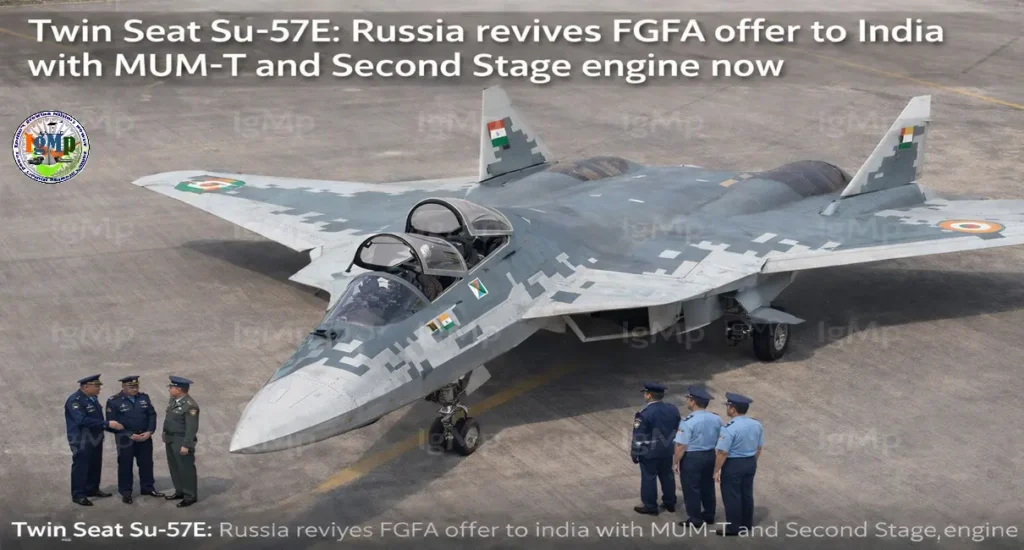
Synopsis: In March 2026, Russia revived discussions around a possible fifth-generation fighter partnership with India by presenting a specialized twin-seat export version of the Sukhoi Su-57 stealth fighter. The new proposal, informally described as the Su-57E twin-seat variant, was pitched as a “drone command fighter” capable of managing unmanned combat systems during battle. The offer reportedly includes the advanced AL-51F1 Stage-2 engine and an unprecedented level of technology access, positioning the aircraft as a strategic complement—or backup—to India’s indigenous stealth fighter effort under the Advanced Medium Combat Aircraft (AMCA) programme.
Russia’s renewed pitch surfaced during defence engagements at Wings India 2026, where representatives from Rosoboronexport and United Aircraft Corporation reportedly briefed senior officials from the Indian Air Force. The discussions signaled Moscow’s attempt to revive momentum after India exited the earlier Fifth Generation Fighter Aircraft (FGFA) programme in 2018, when concerns about cost, performance and limited technology transfer stalled the project.
| Feature | Original FGFA (2018) | 2026 Su-57E Proposal |
|---|---|---|
| Engine | AL-41F1 (Stage-1) | AL-51F1 Stage-2 supercruise engine |
| Cockpit | Single-seat focus | Twin-seat “drone command” variant |
| Tech Access | Limited technology transfer | Full source-code access & joint production |
| Drone Support | No dedicated MUM-T role | Okhotnik / CATS drone integration |
One of the biggest technical changes in the new pitch revolves around propulsion. The aircraft being offered now incorporates the Izdeliye-30 engine, officially known as the AL-51F1 turbofan. Defence analysts say this engine is critical because it resolves one of India’s original concerns about the early Su-57 prototypes. With thrust estimated at roughly 17.5 tons, the Stage-2 engine allows the fighter to achieve sustained supercruise—flying at supersonic speeds without afterburners—while improving fuel efficiency and overall stealth performance.
But the real centerpiece of the proposal is the aircraft’s two-seat configuration. Russia is positioning the rear cockpit not as a training seat but as a battlefield command station designed for Manned-Unmanned Teaming. In this concept, the pilot focuses on air combat and navigation while a mission operator manages drones, electronic warfare tools and network-centric targeting systems.

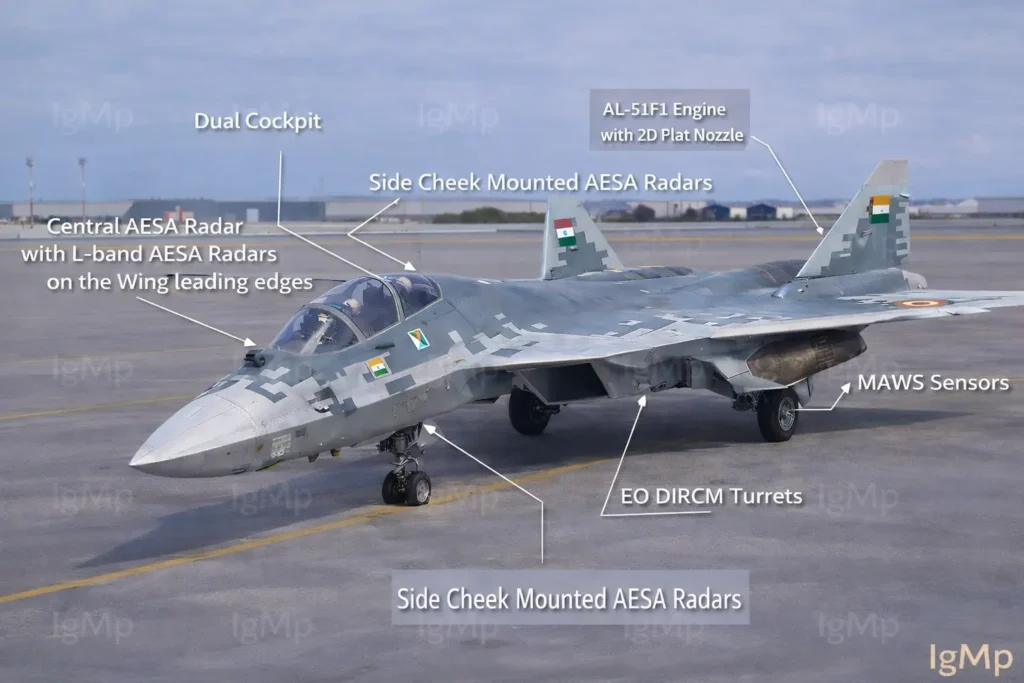
The aircraft is expected to work closely with the heavy stealth drone known as the S-70 Okhotnik, which has already been tested in cooperative missions with the Su-57. Russian planners say a similar approach could allow India to control future domestic drones, potentially including platforms linked to the HAL CATS Warrior programme. If integrated successfully, the rear cockpit operator could coordinate multiple unmanned wingmen in real time, turning the fighter into a mobile command hub capable of directing drone swarms across contested airspace.
This “loyal wingman controller” concept reflects a broader shift in air combat thinking. Instead of relying solely on manned fighters, future operations are increasingly expected to involve networks of crewed aircraft and autonomous systems sharing targeting data, reconnaissance feeds and electronic warfare capabilities.
Russia is also sweetening the deal with a major industrial incentive. According to defence industry discussions surrounding the 2026 pitch, Moscow is offering a much deeper level of technology transfer than before, including potential access to software architecture and source codes. That level of openness would be significant because it would allow India to integrate indigenous weapons, sensors and mission systems without relying on foreign vendors.
From a strategic standpoint, the Su-57E is being framed less as a replacement and more as insurance for India’s long-term fighter modernization plan. The AMCA project remains the centerpiece of India’s ambition to build a fully indigenous stealth aircraft, but it is expected to enter service only in the early 2030s. A ready-to-produce stealth fighter with shared logistics could therefore act as a bridging capability if development timelines stretch.
Another factor working in Russia’s favor is operational familiarity. The Su-57 shares design lineage and certain maintenance concepts with India’s large fleet of Sukhoi Su-30MKI fighters, which form the backbone of the Indian Air Force. Defence experts often point out that common training frameworks, ground equipment and technical knowledge could make integration faster than adopting an entirely new Western platform.
Updated assessments of the aircraft’s stealth profile also suggest improvements compared with earlier prototypes. Analysts estimate the fighter’s radar cross-section in certain combat configurations could fall within the 0.1–0.5 square meter range, placing it broadly within the envelope expected of fifth-generation combat aircraft during specific mission profiles.
Whether India seriously considers the proposal remains uncertain. The country is simultaneously evaluating options for its multirole fighter acquisition and investing heavily in indigenous aerospace development. Still, the timing of Russia’s offer in 2026 shows how global defence partnerships are evolving, especially as stealth aircraft and drone integration become central to the next era of air warfare. ✈️


