

Synopsis
- The description implied accuracy over random firing, and this has come in line with the points made by Cooper that the task was not based on closing in on a specific target, but rather on broad-area strikes.
Source : IgMp Bulletin

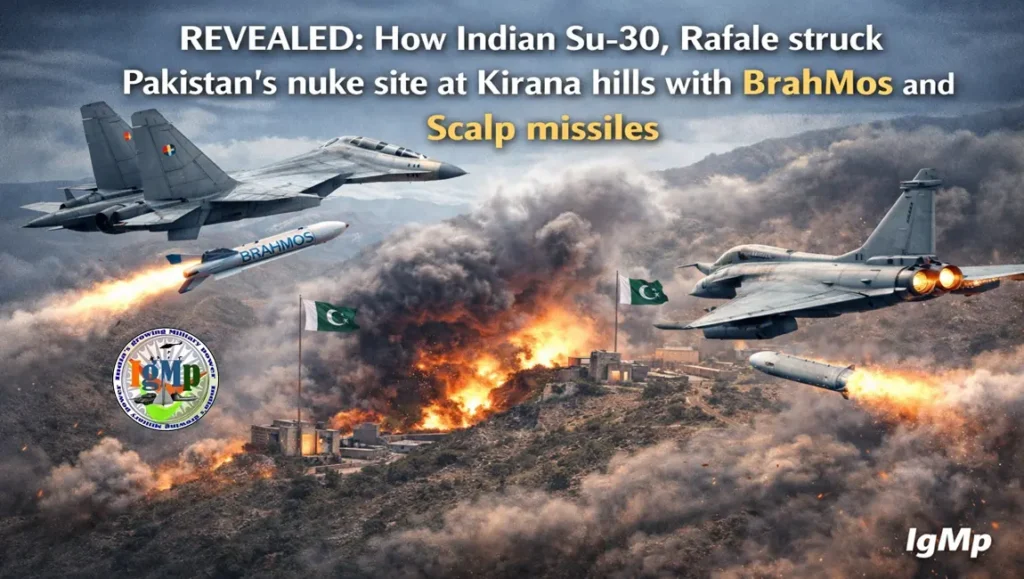
During the stressful weeks that followed the deadly Pahalgam terror attack, news broke on the internet that the Indian Air Force carried out an undercover operation that allegedly pushed the boundaries of conventional strikes. The offensive, dubbed by several defense observers as ‘Operation Sindoor’, had an alleged one-point precision airstrike on the Kirana Hills in Pakistan, which has traditionally been regarded as an important military infrastructure location. Although the attack on the site has never officially been admitted by New Delhi, aviation historian and warfare analyst Tom Cooper wrote openly about the strike, claiming it was a calculated demonstration of power that signified the increasing military sophistication of India.
Kirana Hills region has long been traditionally a strategically important area in the defense positioning of Pakistan. The region is very likely to harbor hardened base structures and support systems associated with the nuclear program of the country. The rugged terrain has, over the decades, been linked with nuclear-related activity; tests and storage networks. That is why any reported attack on such a place would not only be an operation that is tactical in nature but also a strong message symbolically.
Cooper, in his analysis, has come up with the planned nature of the so-called Indian air strike. He explained that the start of the operation involved paralyzing radar equipment in and around the hills, which incapacitated Pakistan’s ability to monitor and retaliate against the threats coming their way. It was upon overpowering the warning systems that the intruding aircraft were said to hit access portals of underground storage corridors and other important infrastructure. The chain, based on the analysis outlined by the analyst, shows a calculated move towards cutting escalation risk and optimizing strategic impact.
Video posted on Pakistani social media after the event showed tracks of missiles flying through the air, with the final result being a column of smoke that rose above radar stations. Although the use of such videos could only be checked independently, their distribution created speculation that something meaningful had occurred. The description implied accuracy over random firing, and this has come in line with the points made by Cooper that the task was not based on closing in on a specific target, but rather on broad-area strikes.
The equipment and weaponry of the said mission could indicate the capabilities that India has in public domain. Analysts cited the use of Su-30MKI fighter jets that fired BrahMos and Rampage missiles, Jaguar aircraft that dropped more precision-guided missiles, and Rafale jets that fired Scalp cruise missiles. The integration of platforms meant that there was coordination among units of various squadrons and types of weapons. The history of each missile system is tailored to certain specific roles, whether as a high-speed penetration, a deep strike, or as a feature of a layered attack approach.
Cooper made it clear that such a mission did not need any secret technology to carry out. Rather, he reasoned, the power of the action was in planning, integration, and timing. The integrated airdefense and Air command network of India would have played a critical role in the coordination with the offensive fighter aircraft formation, and at the same time maintaining defensive preparedness. The procedures of airspace deconflicting, electronic warfare, and missile guidance concurrently require both advanced systems and training. In case the strike is carried out according to the described scenario, it would be an indication of a high measure of operational maturity.
The political aspect of the episode is also important. India has even markedly rejected it, denying any attacks on nuclear-related places in Pakistan. Cooper was not shy to challenge this denial, indicating that the evidence available did not make the claim very easy to rule out. The hot-blooded nature of the debate is typified by his statement that rejecting the strike was comparable to stating that the sun sets not in the east. Strategic ambiguity serves the purpose for governments. By neither confirming nor fully detailing operations, officials might have attempted a balance between local expectations and global diplomacy.
Strikes on nuclear facilities carry a significant global response. In contrast to the traditional bases of armies and navies, these locations are deeply interlinked with national deterrence postures. It can be read between the lines that to target them or even targeting smaller systems like radars or access tunnels is a message about capability rather than intent. In this respect, Operation Sindoor, as outlined by Cooper, would be an effort to demonstrate reach without crossing into full-scale escalation.
Militarily, it is a textbook strategy to disable radar installations initially on high-risk missions. Any air defense network is based on early warning systems. The attackers do this by degrading them to limit the time during which they can be intercepted, and also make it hard for the defender to detect them. The emphasis on temporary disruption of the whole complex instead of destruction would be proposed through following up on the precision strikes on the key access points, but not on the whole complex. Such a difference is important in instances where signaling and deterrence are combined with each other.
The wider picture is the modernization of the Indian Air Force and the large inventory of missiles in the last 10 years. Advanced platforms and long-range precision weapons have increased the nation’s ability to launch stand-off strikes. These capabilities eliminate unnecessary crossing of aircraft deep into the hostile airspace, which prevents risks to the pilots and does not limit the efficiency. The reported usage of cruise missiles and high-speed systems would be in line with this doctrinal change.
Simultaneously, it is through open-source intelligence and social media that the episode brings out the contribution to narrative-making. Back in the past decades, the information regarding cross-border operations typically appeared gradually and in small amounts. Nowadays, footage on smartphones and posts on the Internet can become viral in a few minutes. This makes formal communication both difficult and contributes to opposing interpretations. Analysts, such as Cooper, base their research on such content in addition to historical experiences and military experiences to build evaluations that occasionally contradict the official views.
The supposed attack on Kirana Hills is one action in a series of calculated actions that do not lead to a long-term war. Both India and Pakistan have shown the capability in recent years to perform limited operations while managing the escalation. The balance is delicate. Any step that is viewed as a direct threat to nuclear property may become an international issue. However, the very act of showing capability can serve the same purpose as deterrence, as it sends the message of determination and technological advancements.
Operation Sindoor, which Cooper depicted, was not about showmanship and was rather about accuracy. It depended on the already existing fleet of fighters, long-range missiles, and combined planning instead of dramatic new weapons. This focus on integration as opposed to novelty shows a maturing military strategy. The workings of various components together, such as aircraft, sensors, missiles, and command networks, with strict timelines, is commonly the concern of modern warfare.
It is not clear whether the future disclosures will shed more light on the extent to which what happened at Kirana Hills then. To protect the information of a nation, governments often hide certain operational information. The most evident thing is that the discussion about Operation Sindoor highlights how the dynamics of South Asian security are shifting. Both accuracy in striking and air defence networks, combined with a continuous flow of information, are transforming the manner in which military strength is shown and felt. Even a strike, which we are not officially recognizing, in that environment can also get the message across, which will be heard far away than the battlefield.


