

Synopsis
- India’s artillery modernization is entering a decisive phase as the **Indian Army moves forward with trials for more than 400 Mounted Gun Systems (MGS), a critical requirement aimed at transforming how artillery operates on modern battlefields.
IgMp Bulletin

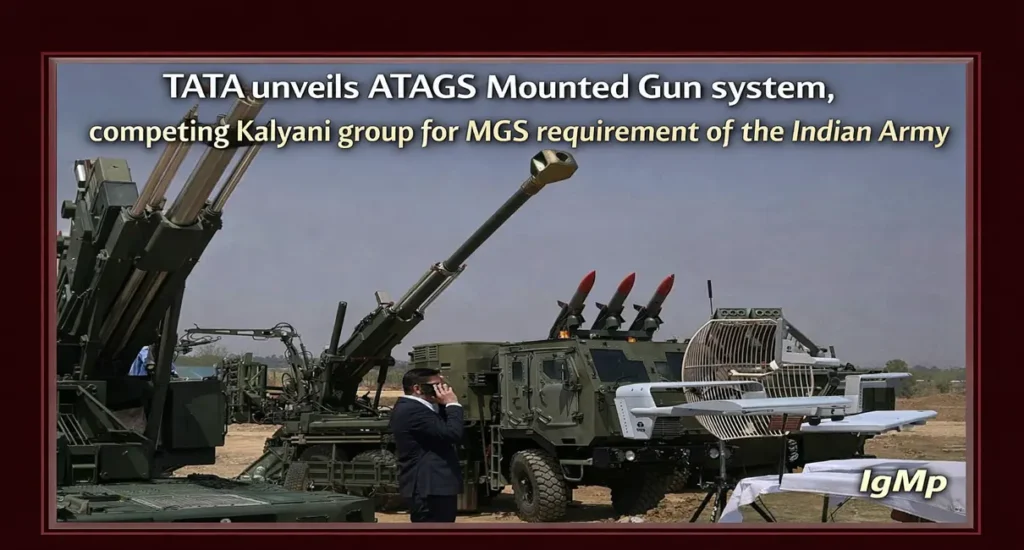
India’s artillery modernisation is entering a new phase as Tata Advanced Systems Limited (TASL) positions its truck-mounted version of the Advanced Towed Artillery Gun System (ATAGS) as a next-generation battlefield solution for the Indian Army. The system, recently highlighted by TASL during a defence industry showcase in Karnataka, reflects a wider shift in global warfare where mobility and rapid redeployment have become as critical as firepower itself.
Modern battlefields increasingly rely on drones, surveillance satellites and networked counter-battery radars that can detect the source of artillery fire within seconds. In such an environment, traditional towed guns risk becoming vulnerable once they reveal their firing position. Defence planners therefore see mounted artillery—often described as “shoot-and-scoot” systems—as essential for survival and operational effectiveness. TASL’s mounted ATAGS aims to address this requirement by integrating the powerful 155mm gun onto a high-mobility military truck platform, enabling faster relocation after firing.
India’s artillery modernization is entering a decisive phase as the **Indian Army moves forward with trials for more than 400 Mounted Gun Systems (MGS), a critical requirement aimed at transforming how artillery operates on modern battlefields. The program is separate from the 307 towed guns already ordered under the Advanced Towed Artillery Gun System (ATAGS) contract and forms part of a larger long-term plan to induct over 800 modern artillery platforms.
The urgency behind the MGS program reflects lessons from contemporary conflicts where drones, counter-battery radars and satellite surveillance can locate artillery positions within minutes. In such conditions, traditional towed guns—once the backbone of field artillery—can become vulnerable if they remain stationary for too long. Mounted “shoot-and-scoot” systems allow crews to fire rapid bursts and relocate immediately, significantly improving survivability.
India’s private and public defence manufacturers have responded with four distinct indigenous designs, each optimized for different operational scenarios ranging from Himalayan warfare to high-mobility desert operations. Notably, companies that collaborate on one project are also competing fiercely for this next major contract. For example, Tata Advanced Systems Limited and Kalyani Strategic Systems Limited jointly produce the towed ATAGS guns ordered in 2025, yet they are direct rivals in the mounted artillery competition.
The competing systems demonstrate how India’s defence ecosystem has evolved. Most platforms now claim more than 80–85 percent indigenous components, a significant leap compared with earlier decades when artillery modernization relied heavily on imports following the era of the **Bofors FH‑77B howitzer.
Below is a snapshot of the four indigenous contenders currently competing in trials.
Technical Comparison: India’s 155mm/52 Calibre MGS Contenders
| System & Entity | Platform & Mobility | Max Range (Std/Adv) | Firing Rate (Burst/Intense) | Key Strategic Advantage |
| DRDO – BEML MGS | BEML 8×8 HMV (Tatra Chassis); 85 km/h road speed. | 45 km / 48 km (Up to 75 km+ with Ramjet) | 3 rounds in 30s (Burst); 15 rounds in 3m (Intense). | Heavy-Duty Survivability: Features a blast-resistant armored cabin and a 24-round automated magazine for prolonged high-intensity combat. |
| Bharat Forge (Kalyani) MArG | 4×4 High Mobility Vehicle; Ultra-light (approx. 24 tons). | 41 km / 45 km | 3 rounds in 30s; 10 rounds per minute. | Expeditionary Warfare: World’s only 52-cal on a 4×4; Chinook-portable, making it the primary choice for rapid deployment in high-altitude LAC sectors. |
| TASL (Tata) ATAGS-MGS | Tata 8×8 / 6×6 HMV; 85 km/h speed; 600 km range. | 48 km (Confirmed in Pokhran/Balasore) | 5 rounds in 60s (Burst); 60 rounds in 60m (Sustained). | System Reliability: Utilizes an all-electric drive for gun-laying (no hydraulics) and a fully integrated indigenous truck platform for streamlined logistics. |
| L&T – AWEIL (Dhanush MGS) | 8×8 Kolos/Tatra Chassis; Proven off-road stability. | 38 km / 42 km | 3 rounds in 30s; 12 rounds in 3 min. | Proven Pedigree: Combines L&T’s K9 Vajra-T integration expertise with the upgraded Dhanush (Bofors) system, ensuring high mechanical reliability. |
Among these, the Bharat Forge MArG system stands out for its unusually light 4×4 configuration. Weighing around 24 tons, it is one of the few 155mm artillery systems that can be transported by Boeing CH‑47 Chinook helicopters. This capability is particularly relevant for high-altitude sectors along the **Line of Actual Control where road infrastructure and bridge capacity often restrict the deployment of heavier artillery.
The TASL-developed ATAGS-MGS, meanwhile, takes a more balanced approach by mounting the gun on a 6×6 high-mobility truck designed to align with the Army’s existing logistics ecosystem. Defence analysts note that this compatibility with the Army’s standard diesel-based “single fuel” policy could simplify maintenance and reduce long-term operating costs.
Another factor shaping the future of these systems is emerging ammunition technology. Researchers at Indian Institute of Technology Madras recently demonstrated a ramjet-assisted artillery shell that could dramatically extend the range of 155mm guns. If operationalized, such rounds could potentially push the reach of India’s new artillery systems toward the 75–80 km mark, a range that would rival or exceed many of today’s leading global artillery platforms.
Cost also plays a major role in the program. Indigenous mounted guns are estimated to cost roughly ₹15–20 crore per unit—significantly less than imported systems such as the CAESAR self-propelled howitzer or ATMOS 2000 artillery system, which can cost nearly double depending on configuration. This price advantage, combined with growing domestic expertise in electronics, mobility platforms and fire-control systems, highlights how India’s defence industry is moving steadily toward self-reliance.
With trials underway and the Army aiming for induction before the end of the decade, the competition among these four systems may ultimately define the future structure of India’s field artillery—one increasingly built around mobility, automation and long-range precision firepower.


