Synopsis
- The strike, acknowledged during a Pentagon briefing under the campaign banner Operation Epic Fury, marks the first time since World War II (WWII) in 1945 that a U.
IgMp Bulletin

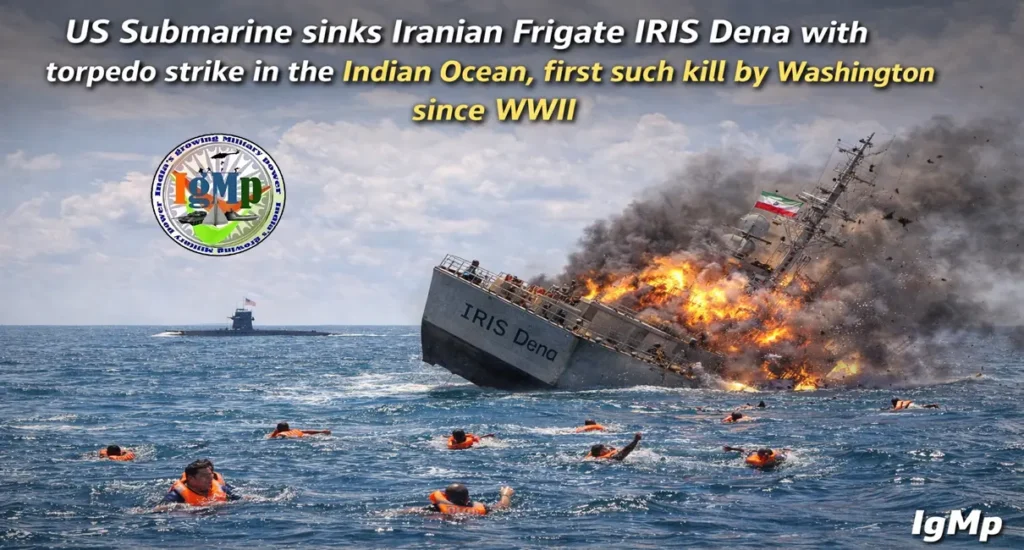
The United States has confirmed that a U.S. Navy fast-attack submarine sank the Iranian frigate IRIS Dena with a single Mk-48 torpedo roughly 40 nautical miles south of Galle, Sri Lanka, outside territorial waters but within Sri Lanka’s Exclusive Economic Zone (EEZ). The strike, acknowledged during a Pentagon briefing under the campaign banner Operation Epic Fury, marks the first time since World War II (WWII) in 1945 that a U.S. submarine has destroyed an enemy warship with a torpedo in combat [Source: Military Times].
Defense Secretary Pete Hegseth stated that the objective of Operation Epic Fury is to render the Iranian Navy “combat ineffective” in theater. Chairman of the Joint Chiefs of Staff Gen. Dan Caine confirmed that a single heavyweight Mk-48 ADCAP torpedo achieved the kill. The identity of the submarine—believed to be from either the Virginia- or Los Angeles-class—was not disclosed for operational security reasons.
IRIS Dena, a Moudge-class frigate of the Islamic Republic of Iran Navy, had reportedly been returning from the MILAN 2026 naval exercise hosted by the Indian Navy when it was engaged. The fact that the ship had recently participated in a multinational exercise in the Bay of Bengal adds diplomatic sensitivity to the episode. Its sinking so soon after regional engagement underscores how rapidly Indo-Pacific stability can shift from cooperation to confrontation.
According to Sri Lankan officials, approximately 180 crew members were aboard the frigate at the time of the strike. Thirty-two sailors were rescued by the Sri Lankan Navy, while around 148 are missing or presumed dead. Search and recovery operations were launched from Galle as debris and survivors were located in the surrounding waters.
Comparison: IRIS Dena vs. U.S. Fast-Attack Submarine
| Feature | IRIS Dena (Moudge-class Frigate) | U.S. Fast-Attack Submarine (Virginia/Los Angeles class) |
|---|---|---|
| Primary Role | Surface Combatant / Power Projection | Stealth Undersea Warfare |
| Displacement | ~1,500 tons | 6,000 – 7,800 tons |
| Armament | Qader Anti-ship Missiles, 76mm Gun | Mk-48 ADCAP Torpedoes, Tomahawk Missiles |
| Stealth Level | Conventional Radar Signature | Extreme Acoustic Quieting (Nuclear Propulsion) |
| Vulnerability | High (without ASW cover in open water) | Low (undetected until weapon launch) |
The table highlights the asymmetry at play. A surface combatant like IRIS Dena, though armed with anti-ship missiles and naval guns, is inherently vulnerable when operating without robust anti-submarine warfare (ASW) protection. A nuclear-powered fast-attack submarine, by contrast, combines endurance, stealth and heavyweight torpedoes capable of catastrophic damage.
The “Quiet Death”: Technical Breakdown of the Submarine Strike
The Mk-48 torpedo is designed not merely to punch a hole in a ship’s hull but to break its backbone. Modern heavyweight torpedoes often detonate beneath a vessel’s keel rather than on direct impact. The explosion creates a massive gas bubble under the hull, lifting the ship violently before the bubble collapses. The resulting structural stress can snap the keel, effectively breaking the ship in two.
This “keel-breaking” effect explains how a single torpedo can send even large warships to the bottom within minutes. The U.S. Navy has continuously upgraded the Mk-48 for improved guidance, countermeasure resistance and deep-water performance. Its effectiveness in this strike underscores the continued relevance of Cold War-era undersea doctrine in modern conflict.
Historically, submarine torpedo kills have been rare in the post-World War II era. The most notable modern example remains the sinking of the Argentine cruiser ARA General Belgrano by a British submarine during the 1982 Falklands War. For the United States, however, this engagement represents the first confirmed combat torpedo sinking of an enemy warship since the end of World War II.
Humanitarian Crisis: Search and Rescue Operations off Galle
The humanitarian dimension has quickly become central. Sri Lankan naval authorities launched rescue operations within hours of the strike. Survivors were transported to shore for medical treatment, while search teams continued to scan debris fields. The location—outside territorial waters but within Sri Lanka’s EEZ—placed Colombo in a delicate position, balancing humanitarian responsibility with geopolitical neutrality.
Families of Iranian sailors now face uncertainty, and international maritime observers are closely monitoring the rescue efforts. Maritime law permits freedom of navigation in EEZ waters, but military engagements in such zones inevitably raise diplomatic questions.
Strategic Impact: Neutralizing Iran’s Blue-Water Aspirations
IRIS Dena was part of Iran’s effort to demonstrate extended naval reach beyond the Persian Gulf. The Moudge-class frigates, though modest in size compared to Western destroyers, symbolize Tehran’s ambition to operate as a blue-water navy. The loss of one such vessel not only reduces material capability but also strikes at symbolic projection.
Under Operation Epic Fury, U.S. officials claim more than 20 Iranian naval vessels have been destroyed in recent operations, alongside extensive strikes on related infrastructure. The stated objective—to render Iran’s naval forces combat ineffective in theater—suggests a campaign aimed at degrading sustained maritime presence rather than isolated retaliation.
Geopolitical Fallout: Why the Indian Ocean is the New Frontline
The Indian Ocean is no longer a peripheral theater. It is a central artery for global trade and energy flows, bordered by emerging and established powers alike. The presence of Iranian warships, U.S. carrier groups and regional navies has turned it into a complex chessboard.
The fact that IRIS Dena had recently participated in MILAN 2026, an Indian-hosted multinational exercise, complicates perceptions. While exercises are routine diplomatic engagements, the rapid transition from cooperative port visits to combat loss highlights the volatility of maritime geopolitics.
Submarine warfare, often invisible and silent, has now delivered one of the most visible statements of power projection in recent memory. The U.S. Navy’s ability to deploy, detect and strike in distant waters reinforces the strategic weight of undersea dominance. At the same time, the event raises pressing questions about escalation dynamics, regional stability and the future posture of naval forces in the Indo-Pacific.
As search operations continue off Galle and diplomatic channels remain active, the sinking of IRIS Dena stands as a stark reminder that beneath the calm surface of the Indian Ocean, strategic competition runs deep.