

Synopsis
- A key technological milestone in the 2026 system is the integration of the Hawkeye AI-powered multi-sensor optical platform, which significantly expands the drone detection envelope for small naval craft.
IgMp Bulletin

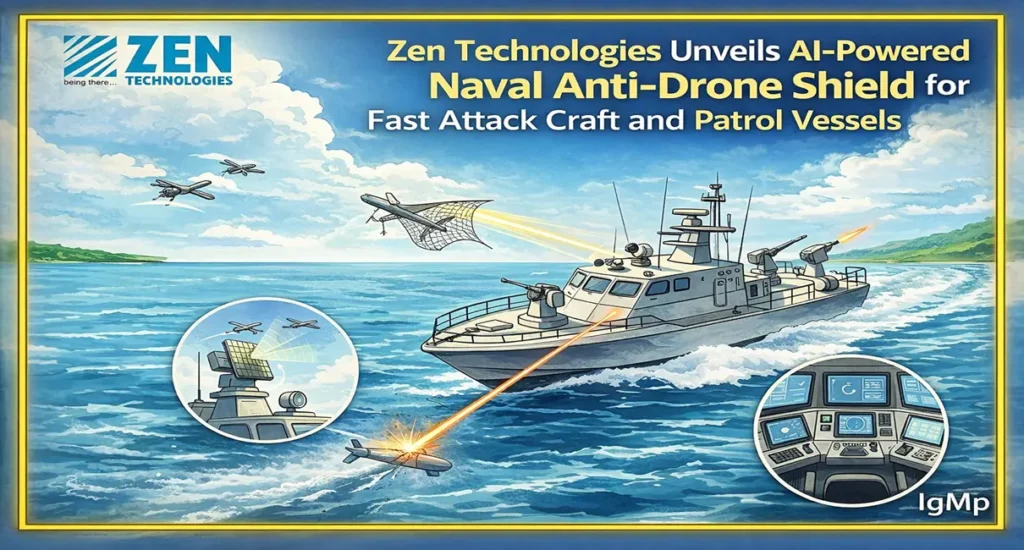
The rapid rise of drone warfare has pushed navies around the world to rethink how small vessels defend themselves in contested waters. In March 2026, Hyderabad-based Zen Technologies unveiled its new Naval Anti-Drone System, marking a strategic shift from land-focused counter-UAS solutions toward maritime-specific defence technology. While the company’s earlier counter-drone platforms were designed to protect ground forces—including deployments during operations such as Op Sindoor—the newly introduced naval variant has been engineered specifically for the demanding environment of fast attack craft and patrol vessels operating in high-speed maritime conditions.
Unlike land-based counter-drone systems that operate from relatively stable platforms, naval vessels face constant vibration, rolling seas, and rapid maneuvering. Zen’s Naval Anti-Drone System has therefore been optimized for compact integration and lightweight deployment so that smaller boats can maintain speed while remaining protected. The architecture follows a layered defensive approach based on three operational stages: detect, disrupt, and destroy. This layered protection allows patrol vessels to identify and neutralize aerial threats long before they reach dangerous proximity.
A key technological milestone in the 2026 system is the integration of the Hawkeye AI-powered multi-sensor optical platform, which significantly expands the drone detection envelope for small naval craft. Earlier counter-drone systems typically offered detection ranges of around six to eight kilometres. With Hawkeye’s advanced sensor fusion capability combining electro-optical imaging, infrared cameras, and RF detection, Zen claims the new maritime system can identify aerial threats at distances of up to 15 kilometres. For fast attack craft operating independently at sea, this extended detection range provides crucial reaction time against fast-moving unmanned aircraft.
Artificial intelligence plays a central role in interpreting the vast amount of sensor data collected by the system. Using deep-learning algorithms and advanced video analytics, the platform compares detected objects against a large onboard threat library containing hundreds of thousands of drone signatures. This automated classification process enables the system to distinguish hostile UAVs from birds, civilian drones, or maritime clutter. The ability to quickly filter out false targets reduces operator workload and ensures faster response during high-pressure situations.
| Layer | Technology Component | Operational Capability |
|---|---|---|
| Detection | 3D X-Band Radar + Hawkeye Optical Sensor | Up to 15 km drone detection range, including autonomous drones |
| Identification | AI Deep Learning & Video Analysis | Distinguishes drones from birds or maritime clutter |
| Soft-Kill | Multi-Band RF Jammer + GNSS Spoofing | Breaks operator links and manipulates navigation signals |
| Hard-Kill | Barbarik-URCWS / Net-Capture System | Physical destruction or safe drone capture |
Once a drone threat is confirmed, the system can deploy a range of electronic countermeasures. Multi-band radio-frequency jammers disrupt communication links between the drone and its operator, while GNSS spoofing techniques manipulate satellite navigation signals to misdirect the aircraft. In some cases, these electronic interventions can safely force hostile drones to land away from the vessel rather than destroying them mid-air, reducing risk to nearby ships or infrastructure.
If electronic disruption fails or the drone continues approaching aggressively, the Naval Anti-Drone System activates its hard-kill capability. This includes the integration of the lightweight Barbarik-URCWS, a remote-controlled weapon station developed by Zen Technologies. Designed to be extremely light for maritime platforms, the Barbarik-URCWS enables small patrol boats to deliver a kinetic response without compromising speed, balance, or maneuverability. Mounted on a stabilized platform, it allows operators to accurately engage drones using machine-gun fire even while the vessel is moving at high speed. The system can also deploy net-based capture mechanisms designed to physically trap drones, allowing them to be recovered intact for investigation.
Stabilization is another critical feature of the naval platform. The sensors and weapons are mounted on systems equipped with fiber optic gyro stabilization, ensuring that tracking and engagement remain accurate even when the vessel is pitching or maneuvering in rough seas. This “shoot-on-the-move” capability is essential for fast attack craft that cannot afford to slow down while defending themselves.
Zen Technologies has also introduced a training ecosystem to support deployment of the system. Alongside the Naval Anti-Drone System, the company launched India’s first AI-enabled Fast Attack Craft simulator, allowing naval crews to train in immersive 360-degree virtual environments. In these simulated maritime scenarios, operators can practise detecting and intercepting drone threats before deploying the real system at sea, creating what Zen describes as a “training-to-combat” operational pipeline.
The system’s development comes at a time when drone threats are increasing across critical maritime routes. Recent incidents in strategic waterways such as the Red Sea and the Strait of Hormuz have demonstrated how low-cost drones can threaten naval patrol vessels and commercial shipping alike. For navies operating across the Indo-Pacific region, compact counter-drone solutions capable of protecting smaller vessels are rapidly becoming a strategic necessity.
By combining AI-driven detection, electronic disruption, and lightweight kinetic interception in a single integrated platform, Zen Technologies’ Naval Anti-Drone System highlights the growing role of indigenous defence technologies in countering emerging asymmetric threats at sea. The system not only strengthens protection for patrol vessels and fast attack craft but also positions India’s defence industry within a rapidly expanding global market for maritime counter-drone solutions.


