

Synopsis
- The platform is emerging as a potential challenger to established systems such as the Heron Mk II UAV and the Hermes 900 UAV, particularly as India prepares for a high-value procurement program for 87 MALE drones.
IgMp Bulletin

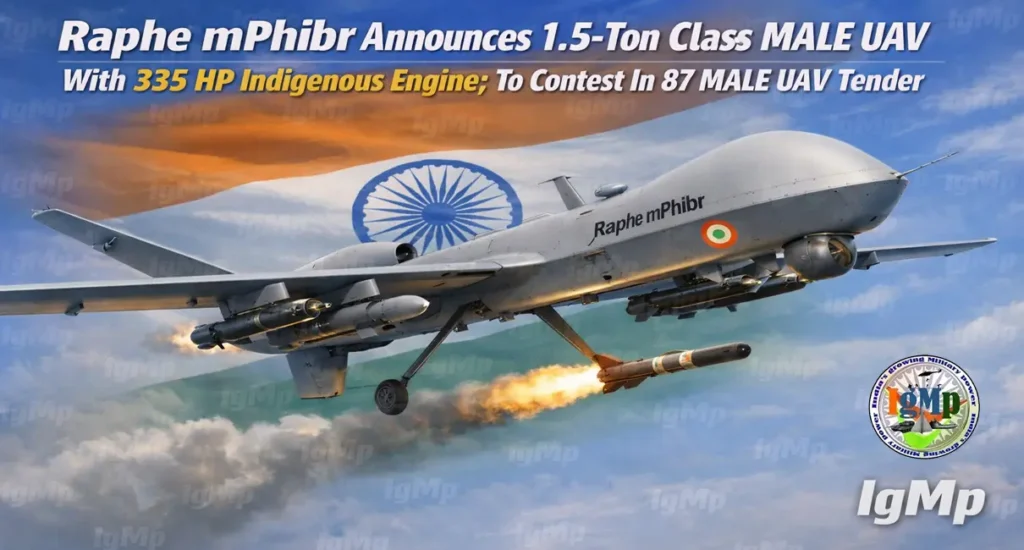
India’s Medium-Altitude Long-Endurance (MALE) drone market is entering a decisive phase as domestic defence startup Raphe mPhibr has developed a new 1.5-ton class MALE UAV powered by a 250 kW (335 hp) indigenous engine. The platform is emerging as a potential challenger to established systems such as the Heron Mk II UAV and the Hermes 900 UAV, particularly as India prepares for a high-value procurement program for 87 MALE drones.
What makes the aircraft noteworthy is the engine powering it. The 250 kW propulsion system—equivalent to about 335 horsepower—is believed to be the first indigenous UAV engine developed in India within this power bracket. For years, the country’s drone programs have struggled with propulsion limitations that affect payload capacity and high-altitude performance. That challenge has often forced reliance on imported engines such as the Rotax series used by several international platforms. By designing the engine in-house, Raphe mPhibr is attempting to solve what many analysts consider the “missing link” in India’s MALE UAV ecosystem.
The power output is significant because platforms in the 1.5-ton Maximum Take-Off Weight category require strong power-to-weight ratios to sustain long endurance missions, especially in demanding environments like the Himalayas. High-altitude operations reduce engine efficiency due to thinner air, meaning propulsion capacity becomes critical for maintaining endurance and payload flexibility.
| Feature | Raphe mPhibr MALE UAV | Heron Mk II (Benchmark) |
|---|---|---|
| Weight Class | ~1.5 Tonnes | ~1.6 Tonnes |
| Engine | 335 hp (Indigenous) | ~135–150 hp Rotax |
| Wingspan | 15 Metres | 16 Metres |
| Endurance | 30+ Hours (Projected) | Up to 45 Hours |
| Indigenous Content | ~85–90% | <50% (License Built) |
The platform’s 15-meter wingspan places it squarely within the MALE category used for long-range intelligence, surveillance and reconnaissance missions. Systems in this class are designed for stand-off surveillance and deep-look ISR, meaning they can monitor targets hundreds of kilometres away without entering hostile airspace. According to early specifications shared within the defence ecosystem, the drone is expected to achieve endurance beyond 30 hours, a key threshold that distinguishes tactical UAVs from true MALE systems.
Beyond raw performance, the aircraft’s design philosophy focuses heavily on vertical integration. Raphe mPhibr reportedly manufactures many of its own carbon-fiber composite structures and advanced flight control systems. This internal manufacturing capability reduces dependency on external suppliers and may lower the cost per airframe. In defence tenders, where lifecycle cost and production scalability matter as much as performance, such efficiencies can significantly influence procurement decisions.
The strategic opportunity lies in India’s upcoming requirement for 87 MALE drones, one of the most closely watched UAV tenders in the country. The project is expected to be structured under the government’s indigenous development frameworks such as the Make-I or Make-II categories, which reward platforms with higher domestic content. A drone powered by a locally developed engine could gain a regulatory advantage because propulsion systems are considered a critical technology in defence manufacturing.
Connectivity will also be a key factor in determining operational value. For long-range missions, a MALE UAV requires Beyond-Line-of-Sight (BLOS) communication, typically achieved through satellite links. Integration of SATCOM allows operators to control the aircraft hundreds or even thousands of kilometres away from ground stations, enabling persistent surveillance over maritime zones, mountainous borders and deep-interior strategic areas.
Another area where the 335 hp engine may offer long-term advantages is payload capacity. Larger MALE drones often include multiple payload bays and hardpoints under their wings. While the Raphe platform is primarily positioned as an ISR drone, the available power margin could theoretically support future weaponisation, such as carrying precision-guided munitions, lightweight laser-guided bombs or anti-tank guided missiles. Such flexibility is increasingly common in modern MALE platforms used worldwide.
The broader significance of the project lies in what it represents for India’s defence manufacturing landscape. Indigenous propulsion, locally produced composite airframes and advanced avionics together suggest that the country’s private aerospace sector is moving beyond small tactical drones toward more strategic unmanned systems.
If the platform successfully demonstrates endurance, reliability and secure satellite connectivity, it could reshape competition in India’s MALE UAV market and provide the armed forces with a domestically controlled alternative to foreign surveillance drones. For defence planners seeking technological sovereignty and supply-chain resilience, that shift could prove just as important as the drone itself.


