

Synopsis
- While India’s future Advanced Medium Combat Aircraft (AMCA) will ultimately provide a manned fifth-generation fighter capability, its operational timeline in the early 2030s leaves a capability gap in the near term.
IgMp Bulletin

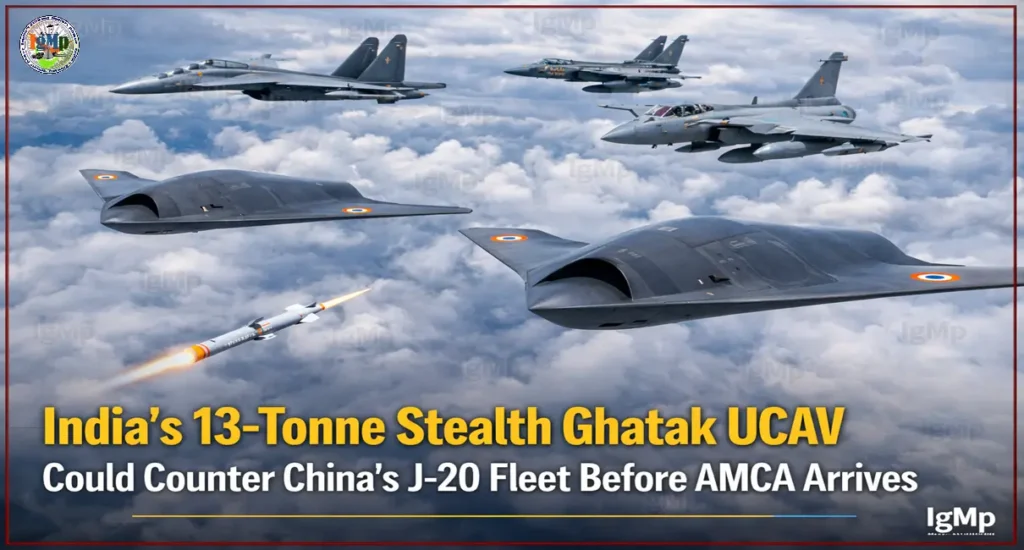
India is accelerating the development of its stealth unmanned combat aerial vehicle (UCAV) program, known as Ghatak UCAV, as a strategic counter to China’s rapidly expanding stealth fighter fleet. While India’s future Advanced Medium Combat Aircraft (AMCA) will ultimately provide a manned fifth-generation fighter capability, its operational timeline in the early 2030s leaves a capability gap in the near term.
To address this gap, India has developed a 13-tonne class stealth UCAV platform called Aura, the full-scale aircraft under the Ghatak program. Designed with a flying-wing configuration and powered by a 48 kN Dry Kaveri engine, the aircraft could serve as India’s first operational stealth combat drone.
More importantly, analysts increasingly view the system not just as a strike drone—but as an asymmetric stealth interceptor asset capable of complicating China’s air superiority strategy.
The Stop-Gap Stealth Timeline
India’s long-term answer to stealth air dominance is the AMCA fighter program. However, the development cycle for a manned fifth-generation aircraft is lengthy and costly.
The Ghatak program offers a faster alternative.
The Aura UCAV is expected to begin high-speed taxi trials by late 2026, placing it significantly ahead of AMCA in terms of operational readiness. This timeline means India could deploy a stealth platform capable of penetrating contested airspace years before its manned stealth fighter becomes operational.
By fielding unmanned stealth assets first, India can partially bridge the stealth capability gap with China in the late 2020s.
Countering the J-20: The RCS Advantage
China’s Chengdu J‑20 has become the backbone of the People’s Liberation Army Air Force stealth fleet, with estimates suggesting more than 300 aircraft already deployed.
However, stealth aircraft design involves trade-offs.
The J-20 uses a canard-delta configuration with large canted vertical stabilizers. While this provides aerodynamic benefits, those vertical surfaces increase radar reflection angles under certain conditions.
By contrast, India’s Aura UCAV adopts a tailless flying-wing design, eliminating vertical fins entirely.
This design dramatically reduces radar cross-section from multiple angles, enabling the UCAV to operate as a “stealth scout.”
In this role, the drone could detect hostile aircraft using onboard sensors and relay targeting data through secure Oura data-links to Indian fighters such as the Sukhoi Su‑30MKI.
The result is a networked combat architecture where the stealth drone sees the enemy first—allowing conventional fighters to engage from advantageous positions.
Internal Weapons Bay and Air-to-Air Capability
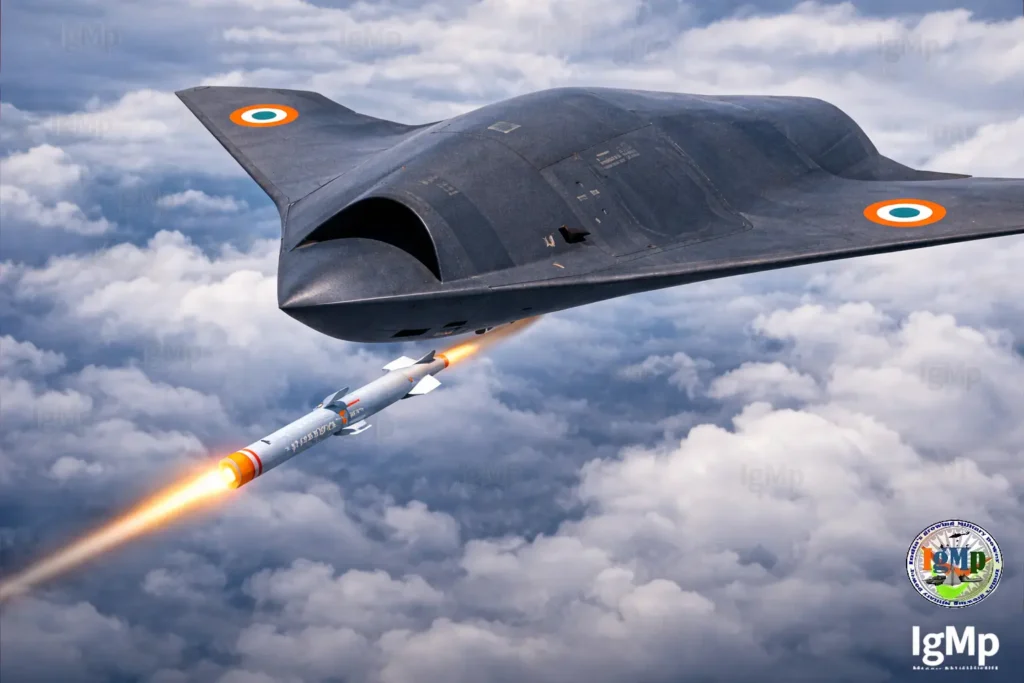
Unlike many strike drones designed purely for ground attack, the Aura UCAV is being designed with an internal weapons bay (IWB) sized to carry stealth-compatible payloads.
Current planning suggests the bay could accommodate:
- Two 500 kg Smart Anti‑Airfield Weapon for runway denial missions
- Astra Mk1 or Astra Mk2 missiles for beyond-visual-range combat
The ability to carry air-to-air missiles transforms the UCAV from a strike platform into a stealth defensive layer.
Instead of directly replacing fighters, the drone could act as a forward sensor and missile truck, engaging enemy aircraft or guiding friendly fighters toward targets.

Technical Interceptor Comparison
| Feature | Ghatak UCAV (The Shield) | Chengdu J-20 (The Threat) |
|---|---|---|
| Configuration | Tailless Flying Wing (Super-Stealth) | Canard-Delta (Partial Stealth) |
| Engine | 48 kN Dry Kaveri (Lower IR Signature) | WS-15 (Higher Heat Signature) |
| Role | Deep Strike / Stealth Scout | Air Superiority Fighter |
| Risk Factor | Unmanned – High-risk missions possible | Manned – Pilot loss risk |
The unmanned nature of Ghatak means it can perform high-risk penetration missions without endangering pilots.
The Stealth Mass Strategy
Against China’s numerical superiority in stealth fighters, India cannot realistically match the J-20 fleet airframe-for-airframe using expensive manned jets.
Instead, the Ghatak program introduces a different strategic logic.
A fleet of 60–80 stealth UCAVs could generate what analysts call “stealth mass.”
By operating in coordinated swarms or distributed patrol networks, these drones could:
- Saturate enemy radar coverage
- Extend sensor reach for Indian fighters
- Conduct deep strike missions against high-value targets
Because unmanned aircraft eliminate life-support systems and pilot training costs, they can be produced at roughly one-quarter the cost of a manned stealth fighter.
This makes them an economically viable way to complicate Chinese air dominance planning.
A Bridge to India’s Fifth-Generation Future
While the HAL AMCA remains India’s long-term stealth solution, the Ghatak program represents a crucial transitional capability.
If development milestones proceed as planned, the Aura UCAV could become operational well before AMCA enters serial production.
In doing so, it would provide India with something it currently lacks: an indigenous stealth combat platform capable of operating deep inside contested airspace.
And in the increasingly complex aerial balance across the Indo-Pacific, that capability could prove decisive.


