

Synopsis
- India will be well able to rotate deployments and see that there will be a survivable tier of its nuclear triad in action as its three Arihant-class SSBN submarine fleet will give it the advantage of patrolling throughout the year despite maintenance and repairs at the same time.
Source : IgMp Bulletin

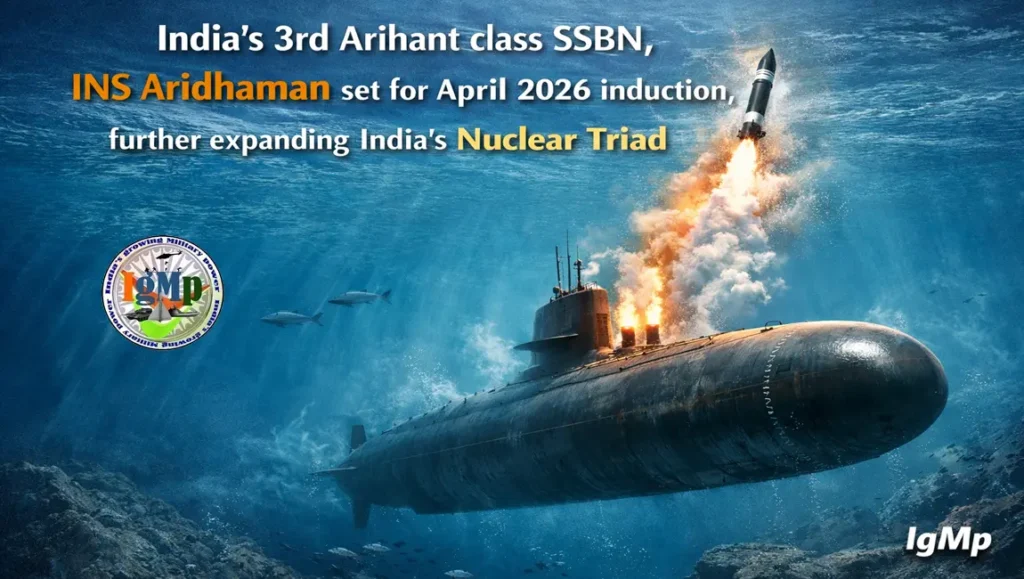
In a major milestone in its strategic defence journey, India is preparing to launch the much-anticipated third indigenous Arihant class nuclear-powered ballistic missile submarine (SSBN), INS Aridhaman, around April-May 2026. The submarine, designated as S4 in the Arihant class SSBN, is expected to significantly enhance India’s sea-based nuclear deterrent posture and move the country closer to sustained, round-the-clock underwater patrol capability. As regional security dynamics continue to evolve, this development adds weight to India’s long-term effort to maintain a credible and survivable nuclear triad.
INS Aridhaman is constructed under the highly confidential ‘Advanced Technology Vessel’ (ATV) program in the Ship Building Centre in Visakhapatnam. The ATV project, which originated decades ago, is treated as one of the most complicated defense projects in the history of the country. It entailed the development of small-scale nuclear reactors, highly advanced metallurgy, silencing techniques, and weapons integrated underwater. The successful completion of INS Aridhaman’s sea trials is an indication of the extent to which the indigenous submarine program of India has matured.
Senior naval officers have stated that the submarine is in its final sea trial phase and is set to commence in April-May 2026. In December last year, Indian Navy Chief Admiral D K Tripathi came out publicly to confirm the timeline, stating the induction as a turning point in the underwater Indian strategic forces. With the operational service, INS Aridhaman will join its predecessor sister boats, INS Arihant and INS Arighat, to form a three-boat Arihant-class SSBN fleet under the Strategic Forces Command (SFC).
INS Aridhaman weighs around 7,000 tons, thereby being larger than its predecessors. INS Arihant and INS Arighat both have a tonnage close to 6,000 tonnes, but the extended hull of INS Aridhaman to accommodate more submarine-launched ballistic missiles (SLBM) can be coupled with a possible increased range. The additional space enables the flexibility to adjust its own payload and make future upgrades. The increased displacement is not just a question of size but also an issue of capability, especially in regard to range and firepower.
INS Aridhaman will be armed with K-15 Sagarika and K4 submarine-launched ballistic missiles (SLBM). The K-15, which has a range of approximately 750-1,500 kilometers, provides the country with tactical capability with targets that are closer; the K4 SLBM has a range of 3,500 kilometers, extending India’s reach. The increased range of the K4 SLBM greatly expands the strategic envelope, giving freedom to our naval ships to patrol at safer locations in the Indian Ocean than the coastline of the possible adversary and still keep the target within its reach. Such flexibility is the main focus of such a concept as survivable second-strike capability.
The philosophy of these developments is Continuous At-Sea Deterrence, which is commonly known as CASD. The principle is simple yet challenging in practice; one nuclear-capable long-range ballistic missile submarine must be patrolling at least 365 days a year. The realization of CASD needs numerous vessels, efficient personnel, and the consistency of assembly services and safety command-and-control channels. India will be well able to rotate deployments and see that there will be a survivable tier of its nuclear triad in action as its three Arihant-class SSBN submarine fleet will give it the advantage of patrolling throughout the year despite maintenance and repairs at the same time.
The Indian nuclear doctrine puts a focus on no-first-use and guaranteed retaliation. Sea-based resources are critical in that context. Land-based missiles and air-launched weapons are susceptible to a first strike, but a submerged ballistic missile submarine is much more difficult to detect and counter. The fact that India has in place the INS Aridhaman SSBN, which works in deep water, enhances the plausibility of its deterrent weapon, as any enemy who would consider any form of first strike would have to factor in a guaranteed counterattack.
The situation involving the induction of INS Aridhaman also coincides with the intensifying competition in the region being underwater. Pakistan is also progressing on its purchase of Hangor-class submarines with China, as a multi-billion-dollar agreement that was signed in 2015. These electrically propelled diesel-electric boats are designed to improve the endurance and stealth of the Pakistan Navy in the Arabian Sea. The Hangor-class submarines are to be built with the help of Chinese technology in Karachi Shipyard and are likely to present new dimensions to the maritime posture of Pakistan.
The further complication of the strategic picture is the increasing naval presence of the Chinese within the Indo-Pacific region. The frequency of the usage of the People’s Liberation Army Navy (PLA-N) in the Indian Ocean Region has risen, and Beijing is still modernizing its own fleet of submarines. Within this context, the move of India to speed up the process of operationalizing its indigenous SSBN fleet is part of an overall approach to ensuring the protection of key maritime routes and the maintenance of balance in disputable waters.
In addition to its ballistic missile submarines, India is developing other underwater capabilities so as to develop a balanced force. The Indian Navy is also in the process of leasing one more nuclear-powered attack submarine, an Akula-class SSN, commonly known as Chakra III, which is likely to be delivered in the year 2027 or 2028. Attack submarines are not as armed as SSBNs are since they are used as conventional strike platforms as well as anti-submarine warfare and escort missions. This set of platforms creates a strategic and tactical depth.
India is also trying to complete Project-75(I), a program to construct six hi-tech diesel-electric submarines, having air-independent propulsion (AIP). These vessels are set to improve the conventional deterrence and increase blue-water operational capabilities as well. Along with the Arihant-class SSBNs, S5 class SSBN and future nuclear-powered attack submarines under Project P-75 Alpha, India is planning to deploy a layered submarine fleet that is capable of meeting the various mission needs.
The facility on which this increasing fleet is built is also important. Rambilli on the eastern coast is being fortified as a forward operating base to deal with nuclear-powered submarines and the related logistics. Secure missile handling facilities, specialized maintenance docks, and robust communication networks are needed. Integration of satellite navigation and surveillance systems also boosts patrol coordination and precision of target selection.
The induction of INS Aridhaman is also symbolic. It signals the result of decades of indigenous research and development, and shows the world that India can design, construct, and operate complex strategic platforms with very little foreign support. To a country that has long suffered under regimes of technology denial, the ability to develop nuclear submarines on its own is a powerful statement of capability.
A further development in the Arihant class SSBN with a bigger successor commonly known as S4* or S4-star is set to be able to carry even longer range missiles like the K5 SLBM possibly even reaching into intercontinental ranges. Such a development would further cement the nuclear triad that India has developed on the seas and would fit its philosophy of credible minimum deterrence.
The fact that INS Aridhaman is set to come into service in 2026 does not just increase the number of hulls in the fleet. It increases the strategic depth of India, its survivability, and fortifies the foundation of India’s nuclear triad deterrence. The silent patrols of the submarines through the sea depths will act as a consistent reminder of India’s determination to have a credible and resilient deterrent in an ever-changing global geopolitics filled with alliances and escalating competition at sea.


