

Synopsis
- The debate over India’s defence capabilities has often revolved around a familiar criticism—that the country can design advanced weapons but lacks the industrial scale needed to sustain a prolonged conflict with a peer adversary.
IgMp Bulletin

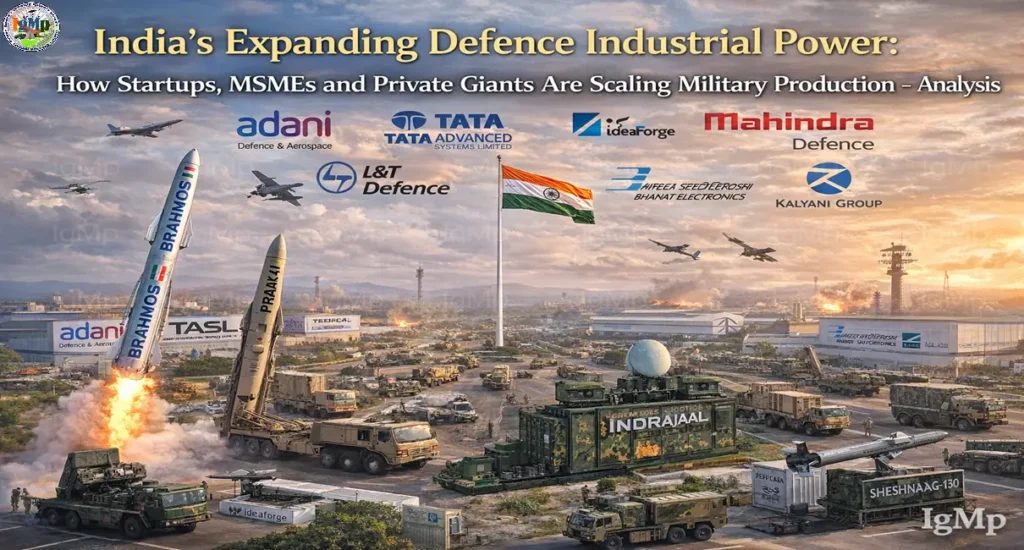
The debate over India’s defence capabilities has often revolved around a familiar criticism—that the country can design advanced weapons but lacks the industrial scale needed to sustain a prolonged conflict with a peer adversary. However, developments following Operation Sindoor in May 2025 suggest that this narrative is increasingly outdated.
What emerged from that operation was not merely a demonstration of precision strike capabilities. It highlighted the growing depth of India’s Expanding Defence Industrial Power—an industrial network that now connects large private corporations, fast-growing defence startups, and more than 16,000 micro, small and medium enterprises (MSMEs). By early 2026, analysts tracking procurement and production trends say India is transitioning from limited prototype production toward large-scale military manufacturing.
The Rise of India’s Distributed Defence Industrial Ecosystem
India’s defence production structure is built around a multi-layered industrial framework. Large companies such as Adani Defence & Aerospace, Tata Advanced Systems Limited (TASL), Larsen and Toubro Defence (L&T) and Mahindra Defence Systems serve as the primary integrators, producing complex platforms ranging from missile launchers and armored vehicles to aerospace systems.
Behind these major manufacturers is a vast network of MSMEs supplying electronics, sensors, materials and precision components. This distributed supply chain has become one of the defining characteristics of India’s emerging military-industrial complex.
Why MSMEs Are the Backbone of India’s Defence Manufacturing
Unlike centralized defence production systems seen in some countries, India’s model relies heavily on thousands of specialized smaller firms. These companies manufacture key subsystems—from radar modules and circuit boards to propulsion components used in missiles and drones.
This decentralised manufacturing approach offers strategic advantages. By spreading production across multiple regions and suppliers, the system becomes more resilient to disruption. It also allows rapid scaling if demand increases during periods of crisis.
The Drone Sector: A Rapidly Expanding Capability
One of the clearest examples of India’s industrial shift is the rapid growth of its domestic drone sector. A decade ago, India relied largely on imported unmanned aerial systems. Today, domestic firms have significantly expanded local production.
Companies such as ideaForge Technology, Garuda Aerospace and NewSpace Research and Technologies are now manufacturing surveillance drones, tactical UAVs and loitering munitions for military use. These systems are increasingly designed for swarm deployment, allowing large numbers of drones to operate simultaneously during reconnaissance or combat missions.
Countering Drone Warfare with Indigenous Technology
India’s defence ecosystem is also investing heavily in counter-drone technology. The AI-enabled defence network Indrajaal, developed by Grene Robotics, provides autonomous air defence coverage capable of detecting and neutralizing hostile drones across wide areas.
Meanwhile, Zen Technologies has secured major contracts to deliver anti-drone systems capable of jamming or disabling incoming UAVs. These technologies are increasingly viewed as essential in modern warfare, where drone swarms have become a central battlefield threat.
Scaling Missile Production for Layered Defence
Missile manufacturing represents another critical pillar of India’s growing defence industry. The indigenous Akash surface-to-air missile program has expanded significantly, with production handled by Bharat Dynamics Limited and supported by a network of domestic suppliers.
Newer variants such as Akash-NG and Akash Prime are designed to enhance interception range and response times, creating a layered air defence shield capable of protecting both strategic installations and frontline formations.
Project Kusha and the Next Generation of Air Defence
India is also working on advanced long-range interception systems through Project Kusha, an ambitious initiative led by the Defence Research and Development Organisation. The system aims to strengthen India’s ability to detect and intercept high-speed aerial threats at extended distances.
The project illustrates a broader shift in India’s defence production strategy—combining indigenous research with scalable industrial manufacturing involving both public and private sector partners.
Expanding Strike Capabilities with Missiles and Rocket Artillery
India has also strengthened its strike capabilities through the expansion of domestically produced missile systems. The quasi-ballistic Pralay missile is designed for precision strikes against high-value targets, while the supersonic BrahMos missile remains one of the fastest operational cruise missiles currently deployed.
Production capacity for BrahMos has grown significantly at the defence manufacturing hub in Lucknow, which forms part of the broader Uttar Pradesh Defence Industrial Corridor.
Pinaka Rocket System and Industrial-Scale Firepower
India’s rocket artillery capability has also evolved with the development of the Pinaka multi-barrel rocket launcher system. Built with contributions from companies including Larsen & Toubro, Tata Defence & Aerospace and Economic Explosives Limited, the system has become a cornerstone of long-range battlefield firepower.
The latest guided variants extend the system’s range beyond 100 kilometres and allow high-precision strikes. A single regiment can saturate a large battlefield area in seconds, providing heavy fire support during high-intensity combat operations.
Innovation Speed: Startups Driving Rapid Adaptation
Another major strength of India’s evolving defence ecosystem is the role played by technology startups. These companies are increasingly using advanced digital engineering tools—such as simulation environments and AI-driven design platforms—to accelerate weapons development.
In modern warfare, the ability to rapidly upgrade sensors, guidance systems and electronic warfare equipment is crucial. Startups working with larger defence integrators are helping shorten development cycles from years to months, enabling faster adaptation to emerging threats.
The Strategic Shift Toward Indigenous Defence Production
Policy reforms have also played a major role in reshaping India’s defence sector. Government initiatives aimed at increasing domestic procurement have significantly boosted local manufacturing.
Official data indicates that roughly 65 percent of India’s defence procurement now comes from domestic sources, a sharp increase compared with earlier decades when imports dominated the country’s military inventory.
This policy shift has encouraged private companies and startups to invest heavily in defence technologies, while also expanding opportunities for MSMEs across the supply chain.
A Changing Balance in Industrial Military Capability
For defence strategists studying the Indo-Pacific security environment, industrial capacity is just as important as technological sophistication. Military power in prolonged conflicts often depends on the ability to manufacture and replenish equipment quickly.
India’s defence ecosystem is gradually evolving into such a system—one capable not only of designing advanced weapons but also producing them at scale.
While China still maintains one of the world’s largest defence industries, India’s growing industrial network suggests the country is steadily strengthening its ability to sustain military operations over the long term.
What is emerging is not just a series of individual weapons programs but a broader transformation of the defence industrial base—one built on collaboration between major corporations, innovative startups and thousands of specialized manufacturers spread across the country.


