

Synopsis
- The longest-range interceptor, often referred to as the M3, is expected to stretch engagement distances to nearly 400 kilometres, pushing Indian air defence into a category traditionally dominated by a small number of foreign systems (Source.
Source : IgMp Bulletin

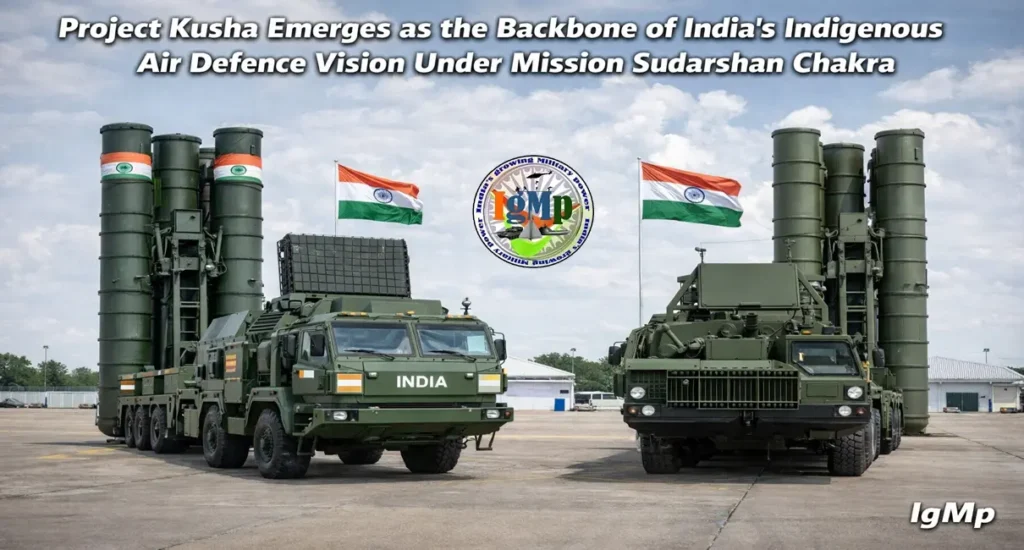
India’s air defence thinking has quietly but decisively shifted over the past few years, and by early 2026 that change has become visible in the way Project Kusha is being positioned within national planning circles. Once discussed largely as a future indigenous alternative to imported long-range air defence systems, the programme has now moved closer to the centre of India’s operational doctrine. Under the ambitious Sudarshan Chakra National Air Defence coverage mission, India is accelerating the development of its indigenous long-range air defence system, Project Kusha. The program’s strategic importance was recently highlighted during Defence Minister Rajnath Singh’s February 2026 visit to Bharat Electronics Limited (BEL) Bengaluru, where it was showcased alongside other tier-1 national projects like the AMCA and Tejas Mk2 (Source: PIB).
The Extended Range Surface-to-Air Missile (ER-SAM) programme has crossed an important psychological threshold. Early developmental uncertainty has given way to structured testing and system-level validation, with the focus shifting from individual missile shots to how the entire architecture works together. The successful evaluation of the M1 interceptor in controlled trials has reinforced confidence within the ecosystem led by the Defence Research and Development Organisation (DRDO). Official assessments suggest that while the interceptor is still evolving toward its full operational configuration, the core propulsion and guidance stages have met initial benchmarks. This phased approach reflects a mature understanding that in contemporary air defence, integration matters as much as raw missile performance.
The Core Philosophy: Common Airframe Logic
One of the defining aspects of Project Kusha is its common airframe philosophy, which departs from the traditional practice of developing multiple unrelated missile families for different engagement envelopes. Instead, a baseline interceptor design is scaled through the use of progressively larger booster stages, allowing a single battery to field multiple engagement ranges without duplicating infrastructure. This design logic supports flexibility at the unit level while simplifying logistics, training and long-term sustainment. In practical terms, it enables a single deployed system to counter everything from low-flying cruise missiles to distant, high-value airborne assets.
Three-Layered Interceptor Architecture
The three-layer structure emerging from this philosophy is particularly relevant to India’s threat environment. The shorter-range layer, represented by the M1, is tuned for agile targets such as fighters, unmanned systems and cruise missiles operating within roughly 150 kilometres. The intermediate layer extends reach to around 250 kilometres, introducing more sophisticated mid-course guidance and networking to address stealth aircraft and high-speed intruders. The longest-range interceptor, often referred to as the M3, is expected to stretch engagement distances to nearly 400 kilometres, pushing Indian air defence into a category traditionally dominated by a small number of foreign systems (Source: Business Line, Defence Stories). More importantly, this layer is intended to hold at risk high-value enablers such as airborne early warning platforms and aerial refuellers, assets that modern air forces rely on to project power.
What stands out in open-source assessments is the emphasis on keeping these interceptors lighter and more agile than many legacy long-range missiles. Reducing mass is not simply an engineering preference; it directly translates into faster acceleration, higher end-game maneuverability and better performance against targets that are designed to evade interception through sharp, high-speed turns. This focus suggests that Project Kusha is being tailored for an environment where adversaries are expected to exploit speed, electronic warfare and low observability rather than relying on predictable flight profiles.
Technical Edge: GaN Radars and Hybrid Seekers
Sensors and networking form the second pillar of the programme. Project Kusha is closely tied to indigenous active electronically scanned array radars operating across L-band and S-band frequencies, built around gallium nitride technology. GaN-based radars offer higher power efficiency and improved sensitivity, which are critical when attempting to detect low radar cross-section targets at long distances. The choice of multiple bands is equally significant, as it complicates an adversary’s stealth optimisation strategy and improves detection reliability against a wider range of targets, from conventional aircraft to small drones.
At the missile level, the adoption of hybrid seekers combining radio-frequency and imaging infrared guidance reflects a clear recognition of modern countermeasure environments. Relying on a single sensor type has become increasingly risky as electronic attack capabilities proliferate. A dual-mode seeker provides resilience, allowing the interceptor to shift guidance logic if radar tracking is degraded, while still maintaining accuracy in the terminal phase. This approach aligns with global trends toward multi-spectral engagement but gains added value from being fully under domestic control.
Perhaps the most consequential aspect of Project Kusha is how it fits into India’s broader command-and-control framework. Rather than operating as a standalone system, it is designed to plug seamlessly into the Integrated Air Command and Control System, enabling real-time data sharing across services and domains. This networked architecture allows Kusha batteries to receive targeting data from distant sensors, including airborne platforms, without immediately revealing their position through active radar emissions. Such passive engagement modes are increasingly important in contested environments where anti-radiation weapons pose a serious threat.

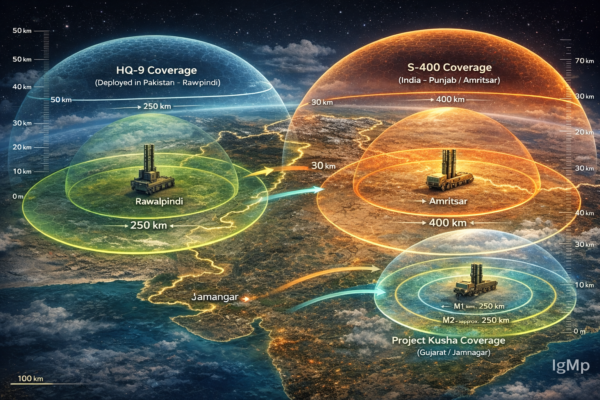
Automation and decision support are also being woven into this framework. Engagement logic is expected to prioritise cost-effective responses, ensuring that expensive long-range interceptors are reserved for genuinely high-value threats. This layered, rational allocation of resources reflects operational experience and reduces the risk of depleting strategic interceptors against low-cost saturation attacks. It also signals a move toward smarter, data-driven air defence rather than purely reactive systems.
Strategic Analysis: How Project Kusha Changes India’s Air Defence Math
From a strategic perspective, Project Kusha is best understood not as a replacement for imported systems, but as a bridge between India’s existing layers and the future threat environment shaped by the People’s Liberation Army Air Force (PLAAF). Nowhere is this more relevant than along the Tibetan Plateau, where geography, basing patterns, and sensor limitations impose very different constraints on air operations compared to the plains.
PLAAF airbases in Tibet operate at high altitude, which affects aircraft payload, endurance, and sortie generation. To compensate, China relies heavily on force multipliers such as airborne early warning aircraft, aerial refuellers, and long-range sensors operating from safer rear areas. Project Kusha’s longest-range interceptors are being designed with exactly these high-value enablers in mind. By holding AWACS and tanker aircraft at risk from deep within Indian territory, Kusha has the potential to disrupt the entire kill chain rather than merely engaging frontline fighters.
This is where Kusha fills a critical doctrinal gap between systems like Akash-NG and long-range imported interceptors. Akash-NG is optimised for point and area defence against aircraft and cruise missiles at shorter ranges, while systems such as the S-400 are geared toward strategic area denial and ballistic missile defence. Kusha’s design emphasis on lighter, agile interceptors, networked targeting, and indigenous seekers suggests a focus on countering fast, maneuvering aircraft and support assets operating at extended ranges, especially in contested electromagnetic environments.
Equally important is the networking aspect. In a Tibet-centric scenario, terrain masking and line-of-sight limitations make reliance on a single radar risky. Project Kusha’s integration with India’s wider command-and-control grid allows engagement-quality data to be fused from multiple sensors, including distant radars and airborne platforms. This means batteries positioned deeper inside India can still threaten aircraft operating near or beyond the Line of Actual Control, without continuously exposing themselves through active emissions.
To better understand how Project Kusha fits alongside existing systems, a simplified comparison helps clarify roles rather than ranking platforms.
| Feature | Project Kusha (Indigenous) | S-400 (Russian) |
|---|---|---|
| Origin | India | Russia |
| Primary Role | Networked, layered air defence | Strategic long-range area denial |
| Design Philosophy | Lighter, agile interceptors with common airframe | Heavier interceptors with multiple missile types |
| Key Advantage | Indigenous seekers, algorithms, upgrade freedom | Proven deployment history and ballistic missile focus |
| Target Focus | Fighters, AWACS, tankers, cruise missiles | Ballistic missiles, bombers, large aircraft |
| Software Control | Fully sovereign | Dependent on Russian supplier updates |
This comparison highlights that the two systems are complementary rather than redundant. While the S-400 provides immediate, high-end deterrence against strategic threats, Project Kusha offers long-term flexibility tailored to India’s specific operational realities. Its indigenous nature allows rapid adaptation to evolving PLAAF tactics, new electronic warfare techniques, and changes in basing patterns across the plateau.
In strategic terms, Kusha also strengthens deterrence by complicating an adversary’s planning. When support aircraft can no longer operate with impunity, even advanced fighters lose much of their effectiveness. This shifts the balance from reactive air defence toward proactive denial of air operations, which is particularly significant in a region where escalation control and limited conflict scenarios are central to planning.
By anchoring itself between existing layers and future requirements, Project Kusha is not just filling a capability gap; it is reshaping how India can contest airspace across its most challenging frontiers.


