

Synopsis
Source : IgMp Bulletin

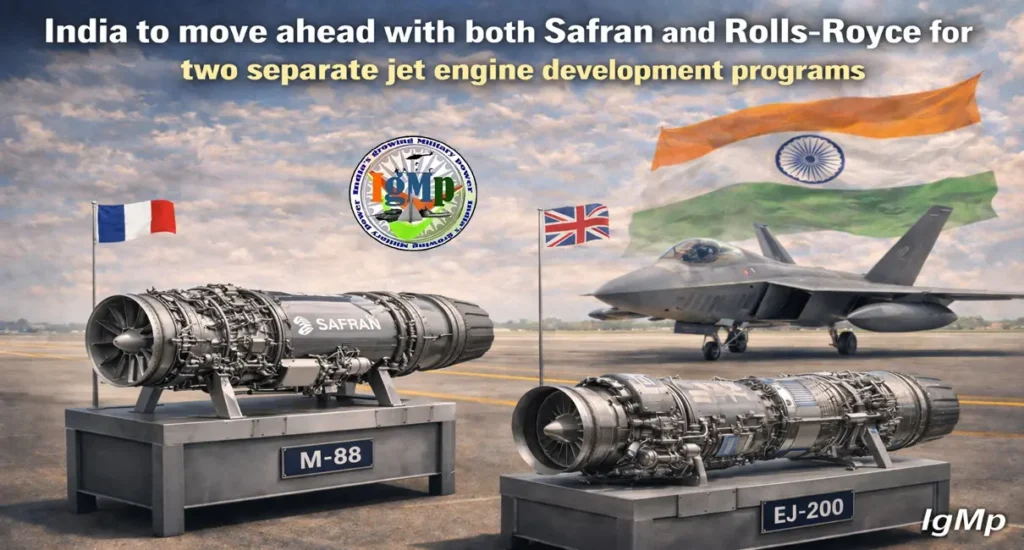
For decades, India’s ambition to build a world-class fighter aircraft powered by a fully indigenous engine has remained frustratingly out of reach. Airframes have improved, avionics have matured, and weapons integration has accelerated—but propulsion has remained the missing piece. Now, New Delhi appears ready to pursue a bold twin-track strategy, engaging both France’s Safran and Britain’s Rolls-Royce in separate yet potentially complementary jet engine development programs.
The timing is not accidental. India’s Advanced Medium Combat Aircraft (AMCA), its planned fifth-generation stealth fighter, cannot succeed without a powerful and reliable 110–120 kilonewton-class engine. This is not just about thrust; it is about thermal management, fuel efficiency, supercruise capability, and long-term upgrade potential. Engine technology determines whether a stealth platform can truly compete with aircraft such as the F-35 Lightning II or China’s Chengdu J-20.
Safran has signaled willingness to co-develop a next-generation engine tailored for AMCA Mk2, reportedly with deep technology transfer that includes access to critical “hot section” know-how. The hot section—where turbine blades withstand temperatures beyond 1,500°C—is widely regarded as the crown jewel of turbofan engineering. Mastery here requires advanced metallurgy, single-crystal blade casting, thermal barrier coatings, and high-pressure compressor expertise. These are technologies closely guarded by major powers because they underpin both military aviation and strategic autonomy.
At the same time, Rolls-Royce has proposed collaboration on a parallel path: helping India upgrade its long-troubled Kaveri engine program into a viable 90–120 kN powerplant. The original Kaveri project, launched in the 1980s alongside the Light Combat Aircraft program, struggled to meet thrust and reliability benchmarks. Eventually, the HAL Tejas entered service powered by American engines, notably the General Electric F404.
That dependence has exposed vulnerabilities. Delays in engine deliveries have slowed Tejas production lines, highlighting the risks of relying entirely on external suppliers. While co-production deals promise partial technology transfer, true co-development—where Indian engineers design, test, and refine core technologies—remains limited. India’s policymakers increasingly recognize that assembling engines is not the same as mastering them.
The emerging dual approach with Safran and Rolls-Royce reflects a pragmatic recalibration. Rather than betting on a single foreign partner, India appears willing to hedge. One program could power the AMCA’s higher-thrust variant, while another revitalizes indigenous capabilities for Tejas Mk2 or even future naval fighters. This layered strategy spreads risk, accelerates learning, and strengthens negotiating leverage.
Importantly, both European firms have deep industrial footprints in India. Safran recently expanded its engine maintenance and repair presence in Hyderabad, supporting the Dassault Rafale fleet. Rolls-Royce engines already power Hawk trainers and various naval platforms. These existing ecosystems make deeper collaboration more feasible than starting from scratch.
The geopolitical context also matters. India’s strategic environment has grown more complex, with persistent tensions along its northern borders and an increasingly assertive China in the Indo-Pacific. Engine independence is not a symbolic goal; it is insurance against sanctions, export restrictions, or supply chain disruptions. The experience of past technology denials has shaped India’s insistence on intellectual property rights and full-spectrum transfer.
Critics caution that engine development is a marathon, not a sprint. Even with foreign collaboration, designing and certifying a modern high-thrust turbofan can take a decade or more. It demands sustained funding, rigorous testing infrastructure, and a skilled workforce. India’s Gas Turbine Research Establishment and Hindustan Aeronautics Limited have accumulated valuable experience through setbacks, but scaling up to world-class standards will require continuity and policy stability.
Yet there is also opportunity beyond military needs. Advanced turbofan expertise can spill over into civilian aerospace, unmanned systems, and export markets. Countries that mastered engine technology—such as France—leveraged it into globally competitive aerospace industries. For India, success would not only power stealth fighters but anchor a broader high-technology manufacturing ecosystem.
Pursuing both Safran and Rolls-Royce simultaneously sends a clear signal: India no longer views propulsion as an unsolvable bottleneck. Instead, it sees it as the decisive frontier in achieving genuine aerospace sovereignty. Whether through joint design of a 120 kN-class engine for AMCA or the resurrection of a strengthened Kaveri derivative, the objective is the same—control over the heart of its combat aircraft.
The road ahead will be technically demanding and politically sensitive. Negotiations must secure real knowledge transfer, not just assembly rights. Domestic institutions must absorb and expand upon imported expertise. But if managed strategically, this twin-engine partnership model could finally end India’s decades-long propulsion dilemma and transform it from a buyer of engines into a builder of them.


