

Synopsis
- Engineers at the Defence Research and Development Organisation are working on a stealth-optimised air-launched variant of the Long-Range Land Attack Cruise Missile (LRLACM), pairing a redesigned low-observable airframe with an upgraded Manik turbofan engine developed by the Gas Turbine Research Establishment.
IgMp Bulletin

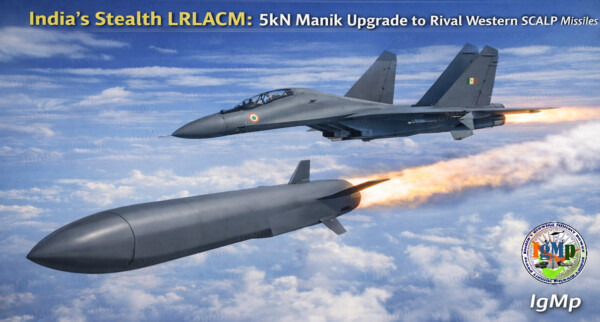
India’s long-range precision strike capability is entering a decisive phase as defence scientists refine the design of the country’s indigenous cruise missile family. Engineers at the Defence Research and Development Organisation are working on a stealth-optimised air-launched variant of the Long-Range Land Attack Cruise Missile (LRLACM), pairing a redesigned low-observable airframe with an upgraded Manik turbofan engine developed by the Gas Turbine Research Establishment. The evolving configuration aims to give the Indian Air Force a weapon combining the deep-strike reach of the indigenous missile programme with survivability features comparable to modern Western cruise missiles.
Recent operational experience has accelerated the urgency behind these upgrades. During Operation Sindoor in May 2025, the Indian Air Force demonstrated the effectiveness of long-range precision strikes using systems such as the SCALP-EG cruise missile and the BrahMos. Those missions highlighted the importance of stealth shaping and stand-off range in penetrating heavily defended airspace. Defence planners now want an indigenous missile that blends the SCALP’s low-observable characteristics with the LRLACM’s projected range exceeding 1,000 kilometres.
Expert Snapshot
| Feature | Baseline LRLACM (Naval/Land) | Stealth Air-Launched Variant (2026) |
|---|---|---|
| Airframe | Cylindrical (Canister-optimized) | Faceted / Trapezoidal (RCS-optimized) |
| Engine | 4.5 kN Manik Turbofan | 5.0 kN Uprated Manik |
| Intake | Fixed External | Shielded / Flush Intake |
| Range | ~1,000 km | 1,000 km+ (high-altitude launch) |
| Status | Induction / Testing | Carriage Trials (2026) |
Beyond the 4.5kN Barrier: The 5kN Manik Evolution
At the centre of the programme lies the Manik turbofan engine, a compact indigenous propulsion system developed specifically for India’s cruise missile projects. Earlier variants generated roughly 4.5 kilonewtons of thrust, but after high-altitude testing campaigns conducted in late 2025, the uprated 5 kN configuration is now being treated as the baseline engine for the broader Indigenous Technology Cruise Missile (ITCM) family.
Although the numerical increase appears modest, the additional thrust significantly improves the missile’s “energy margin.” In practical terms, this means the missile can sustain sharper manoeuvres during the terminal phase while carrying heavier guidance packages or electronic countermeasure payloads. Such manoeuvrability is critical when penetrating layered air defence systems that rely on interceptor missiles and high-precision radar tracking.
The extra thrust also improves efficiency when the missile performs terrain-following flight. Cruise missiles often hug the landscape at extremely low altitudes to remain hidden from radar. Maintaining such flight profiles requires frequent micro-adjustments in altitude and direction, which consume additional energy. The upgraded Manik engine gives designers the performance headroom needed to preserve range even during complex manoeuvres.
Faceted Airframes: Adapting the LRLACM for Contested Skies
Propulsion upgrades alone cannot guarantee survivability against modern air defence systems. Engineers are therefore exploring a redesigned airframe that shifts away from the cylindrical shape used by the naval and ground-launched versions of the LRLACM. Those missiles were built to fit inside sealed launch canisters, a configuration that simplifies storage and vertical launch from ships or land platforms but does little to reduce radar visibility.
The air-launched version has fewer structural constraints, allowing designers to experiment with faceted geometries similar to those seen in advanced stealth cruise missiles. Instead of a smooth cylindrical body, the new concept may adopt a trapezoidal cross-section with pronounced “chines”—sharp longitudinal edges that deflect radar energy away from the emitter. Such shaping reduces the missile’s radar cross-section in the S-band and X-band frequencies most commonly used by modern surface-to-air missile radars, including systems comparable to the S-400 Triumf.
Another major improvement involves the air intake feeding the turbofan engine. Traditional cruise missiles often feature exposed circular intakes that can act as powerful radar reflectors because the compressor blades inside the engine bounce radar signals directly back to the source. Designers are studying flush or shielded intake configurations that hide this reflective surface from frontal radar angles. Western stealth missiles frequently use similar intake geometries to reduce their visibility during the initial approach to defended targets.
Combined with terrain-following navigation, these structural changes could significantly shrink the detection window available to enemy air defence networks. A missile flying low to the ground with a reduced radar signature may only appear on sensors when it is already dangerously close to its objective.
Su-30MKI Integration: Leveraging the BrahMos Pylon
The integration path for the air-launched LRLACM is also advancing. Engineers at the Aeronautical Development Establishment are preparing captive carriage trials on the Sukhoi Su-30MKI, expected to begin during 2026. Instead of designing an entirely new mounting structure, the missile will initially use the reinforced pylon developed for the air-launched BrahMos-A missile.
Reusing the BrahMos pylon offers several advantages. The structure has already been certified for heavy stand-off weapons and proven during operational deployments. By leveraging existing infrastructure, engineers can accelerate integration timelines while reducing development costs. This approach also simplifies logistics for the Indian Air Force, which already operates squadrons trained to deploy large stand-off munitions from the Su-30MKI platform.
Once released from the aircraft at high altitude, the cruise missile would unfold its wings and transition into autonomous flight. High-altitude release increases range by allowing the missile to convert gravitational potential energy into forward momentum, potentially pushing operational reach beyond the baseline 1,000-kilometre mark.
Beyond technical performance, analysts often examine such weapons through the lens of strategic economics. A stealth-optimised LRLACM is expected to cost roughly ₹10–12 crore per unit, yet defending against it could require interceptor missiles costing several times more. This imbalance creates what defence planners call a “cost imposition strategy,” forcing adversaries to spend disproportionately larger resources to defend against comparatively inexpensive offensive weapons.
For India, developing a stealthier air-launched cruise missile also strengthens deterrence by giving the armed forces more flexible stand-off strike options. Instead of sending manned aircraft deep into contested airspace, fighters can launch precision weapons from hundreds of kilometres away. As air defence systems continue to evolve, combining long range with stealth shaping and improved propulsion may prove essential for maintaining credible strike capabilities in the Indo-Pacific theatre.


