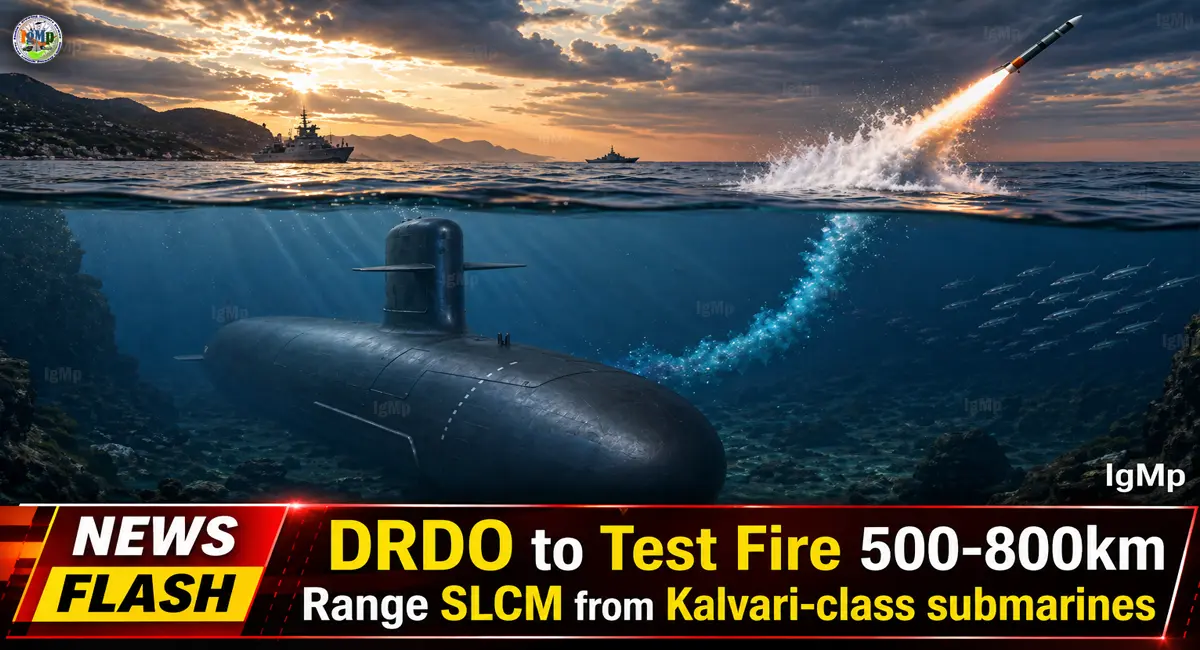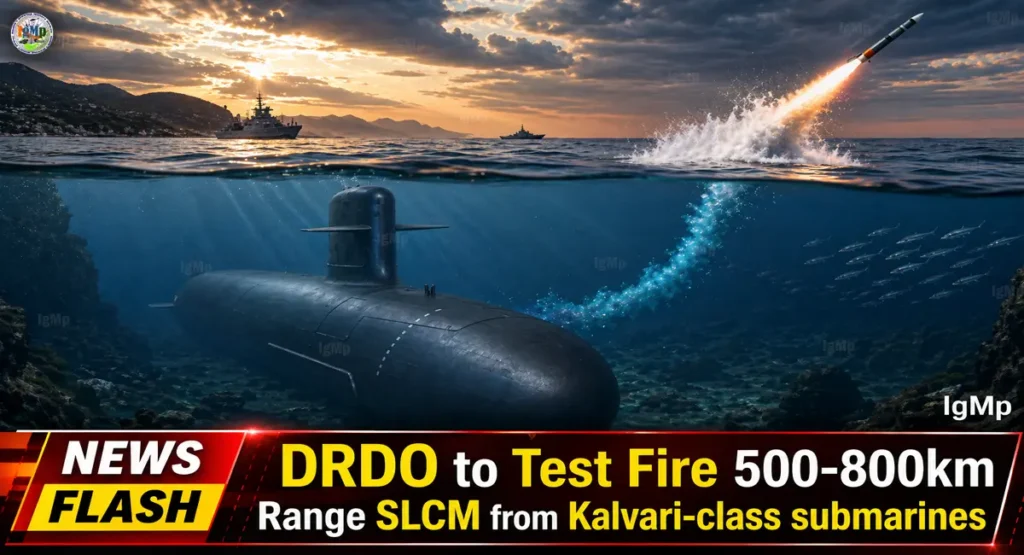
India is preparing for a major leap in underwater strike capability with its new Submarine-Launched Cruise Missile (SLCM) program. DRDO is developing this missile for launch from the Indian Navy’s Kalvari-class submarines, giving these boats a much stronger conventional land-attack role.
Unlike traditional anti-ship torpedoes, this missile will allow submarines to strike targets deep inside enemy territory without exposing themselves near hostile coastlines. This changes the role of conventional submarines from sea denial platforms into strategic strike assets.
The missile uses technology from the Nirbhay cruise missile and the newer Long-Range Land Attack Cruise Missile (LRLACM) program. However, DRDO has redesigned the submarine version for underwater launch, smaller dimensions, and torpedo-tube compatibility.
This project also supports India’s future submarine planning, especially the Project-75(I) program, where long-range land attack capability will become an important operational requirement.
How Tube-Launch Technology Makes the SLCM Possible
The Science Behind Underwater Launch
Launching a cruise missile from a submarine is far more complex than firing it from a land vehicle. The missile must first survive underwater pressure before it even begins flight.
DRDO places the SLCM inside a sealed watertight launch capsule. This container protects the missile from hydrostatic pressure when the submarine operates at depths between 50 and 80 meters. At these depths, the surrounding water creates enormous external force.
The capsule moves through the standard 533mm torpedo tube, which means the Navy does not need a separate vertical launch system for deployment. This makes integration faster and cheaper for existing Kalvari-class submarines.
After launch, compressed gas pushes the capsule out of the tube. It rises toward the sea surface while maintaining structural stability. Once it reaches the correct point, the missile exits the container, ignites its booster, and begins powered flight.
This underwater-to-air transition is the most dangerous phase of the launch. Even a small failure can destroy the missile. DRDO validated this critical stage during pontoon launch trials conducted in late 2024, which marked a major technical milestone.
India Moves Toward Sub-Launched Cruise Missile Power with Kalvari-Class Trials 🇮🇳🔥
India is preparing a major leap in naval strike capability as DRDO plans live firing trials of an indigenous Submarine-Launched Cruise Missile (SLCM) from frontline submarines.
> Next phase:… pic.twitter.com/3X0itYMFIz— The Tathya (@_TheTathya) April 23, 2026
Why DRDO Reduced the SLCM Weight to 975 kg
Smaller Missile, Bigger Operational Advantage
The baseline Nirbhay missile weighs around 1,500 kg and launches from a mobile land platform. That design works well for ground operations, but submarines require a much lighter and more compact weapon.
DRDO reduced the submarine variant to nearly 975 kg so it could fit safely inside a torpedo-tube launch envelope. This reduction improves storage flexibility and allows submarines to carry more strike weapons alongside standard torpedoes.
The missile still uses the indigenous Manik Small Turbo Fan Engine (STFE), which gives it efficient long-range subsonic cruise performance. DRDO also adds a solid rocket booster to handle the initial launch phase after surface breakout.
This design creates a balance between size, survivability, and strike capability. A heavier missile may offer more range, but it would reduce deployment practicality for frontline submarines.
The lighter configuration gives commanders better mission flexibility during real operations in the Arabian Sea and the Bay of Bengal.
Nirbhay vs SLCM: What Actually Changed
The SLCM shares its technological roots with Nirbhay and LRLACM, but it is not simply the same missile placed underwater. DRDO changed the design to meet the demands of submarine warfare.
| Feature | Baseline Nirbhay (Land) | SLCM (Submarine Variant) |
|---|---|---|
| Weight | ~1,500 kg | ~975 kg |
| Launch Platform | Mobile Launcher (TEL) | 533mm Torpedo Tube |
| Engine | Manik (STFE) | Manik (STFE) + Solid Booster |
| Max Range | 1,000 km | 500 km initially, expandable to 800 km |
The range reduction serves a practical purpose. A submarine-launched missile must prioritize launch safety, compact structure, and underwater survivability before maximum distance.
Future versions may reach the full 800 km operational envelope, but the initial deployment focuses on reliability and repeatable launch success.
How the 800 km SLCM Changes India’s Deterrence Strategy
Range is not just a technical number. It directly shapes military strategy.

An 800 km strike radius allows a Kalvari-class submarine to hit critical inland targets while staying far outside the enemy’s immediate anti-submarine warfare screen. This creates what defence planners call a stand-off advantage.
Without this capability, submarines must move dangerously close to defended coastlines before launching an attack. That increases the risk of detection by maritime patrol aircraft, sonar networks, and enemy hunter-killer submarines.
The SLCM closes this strategic gap. It allows the submarine to remain hidden while still delivering precision conventional strikes against command centres, logistics hubs, and high-value infrastructure.
This also strengthens India’s deterrence posture against regional rivals. A survivable underwater launch platform creates uncertainty for the adversary, and uncertainty itself becomes a strategic weapon.
Projected 2027 onboard trials will become the next major step. If these tests succeed, the missile will also strengthen the requirements framework for future Project-75(I) submarines.
The real importance of this missile lies beyond range figures. It gives India a stealth-based conventional strike option that reduces dependence on exposed land launch systems.
In modern naval warfare, the platform that remains unseen often delivers the most decisive first strike. DRDO’s SLCM could make that advantage far more powerful for the Indian Navy.