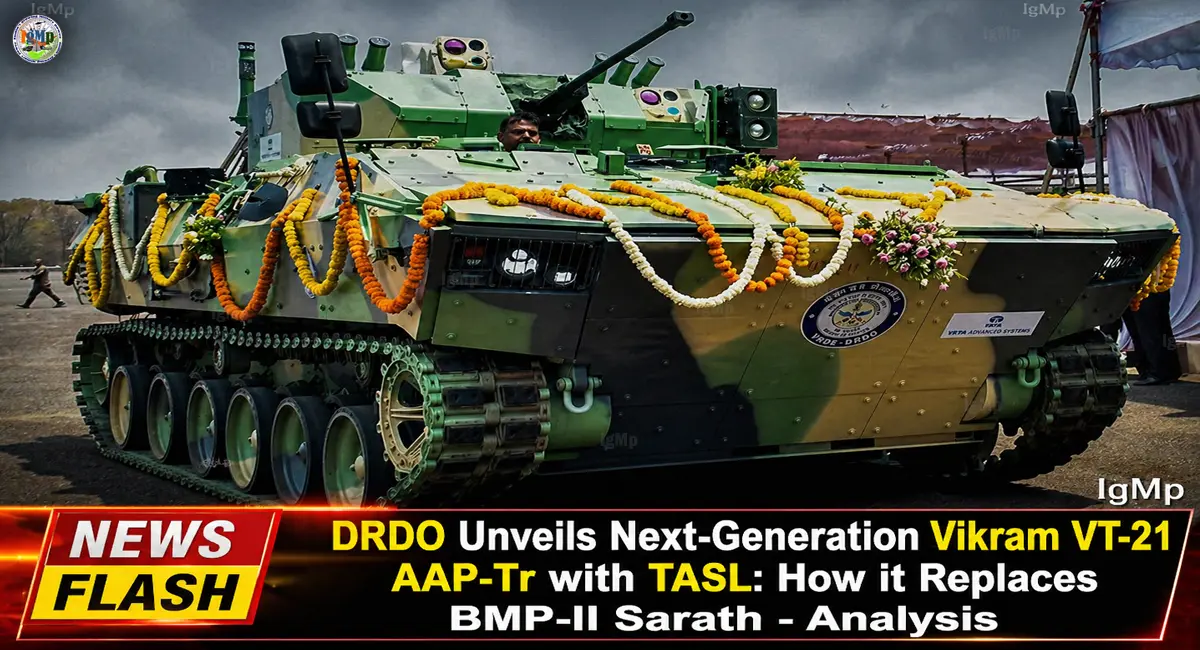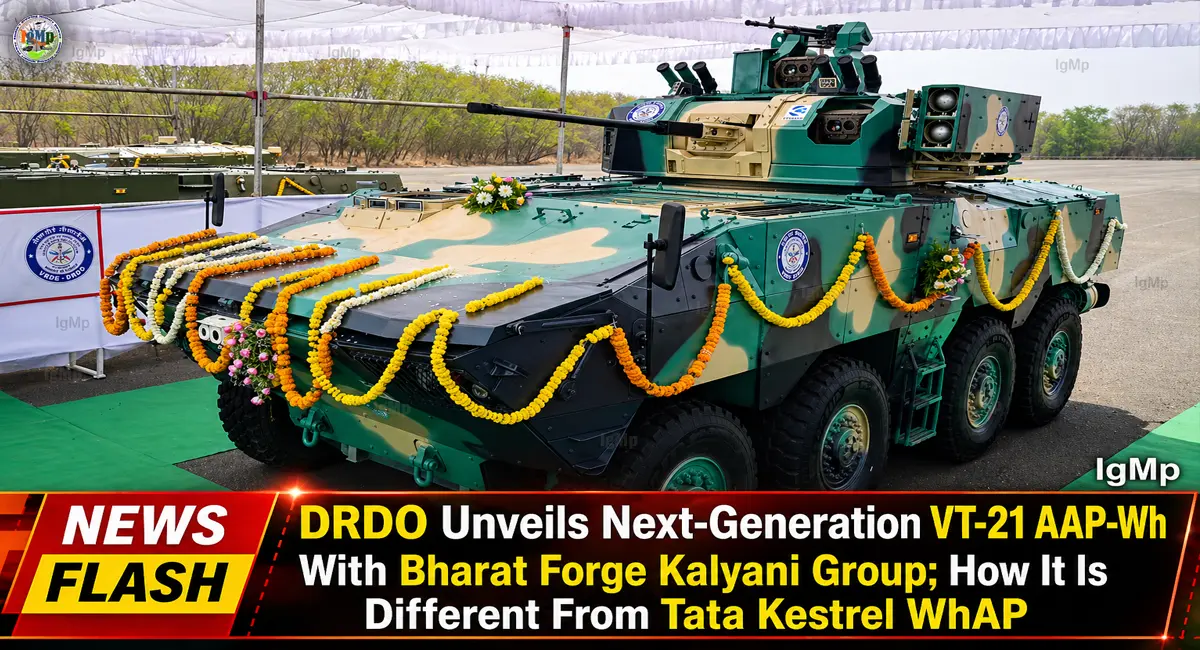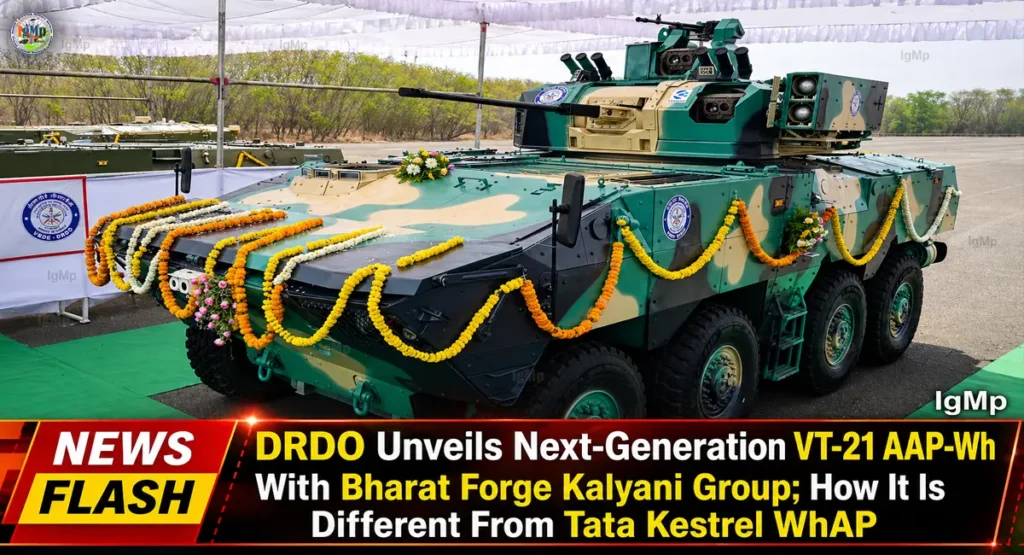
The Vikram VT-21 AAP-Wh is India’s first Gen-2 Advanced Armoured Platform (Wheeled), developed jointly by DRDO and Bharat Forge’s Kalyani Group. DRDO officially unveiled the new 8×8 combat vehicle on April 25, 2026, at VRDE Ahilyanagar, marking an important step in India’s effort to modernize mechanized infantry platforms.
Unlike the earlier Tata Kestrel WhAP, which served as the proof-of-concept platform for India’s wheeled armoured vehicle program, the VT-21 AAP-Wh arrives as a far more combat-ready system. It carries a crewless 30mm turret, improved mine and IED protection, and a lighter but stronger composite hull built using advanced material science.
This vehicle is not just another infantry carrier. With the integration of Nag Mk-2 anti-tank guided missiles, the new platform can also operate as a dedicated tank hunter, giving frontline formations greater flexibility during high-intensity combat.
The VT-21 AAP-Wh shows how India is moving from basic indigenous development toward battlefield-ready armoured systems designed for both plains warfare and high-altitude deployment.
Why Bharat Forge’s VT-21 AAP-Wh Is a Game Changer for Mechanized Infantry
Composite Armour and Better Survivability
The biggest leap in the VT-21 AAP-Wh comes from its advanced hull design. Instead of relying mainly on conventional steel protection, the platform uses GFRP (Glass Fiber Reinforced Plastic) and CFRP (Carbon Fiber Reinforced Plastic) in key structural areas.
Many reports simply call this a composite hull, but the real value lies in how these materials improve battlefield performance. CFRP reduces vehicle weight by nearly 20 to 25 percent while maintaining strong protection against blast effects and battlefield fragmentation.
This lower weight improves the power-to-weight ratio and helps the vehicle move faster across difficult terrain. It becomes especially useful in high-altitude regions like Ladakh, where thinner air affects engine performance and mobility.
The stronger hull also improves resistance against mines and roadside IED attacks. For infantry combat vehicles, survivability against underbody explosions matters just as much as frontal armour.
This makes the Kalyani-DRDO platform better suited for modern hybrid warfare, where threats come from both tanks and hidden explosive attacks.

Strategic Versatility and the Crewless 30mm Turret
More Than Just a Troop Carrier
The VT-21 AAP-Wh moves beyond the traditional role of an armoured personnel carrier. Its crewless 30mm remote-controlled turret gives soldiers stronger firepower while improving crew safety inside the protected hull.
Because the turret operates remotely, the crew stays under armour during combat. This reduces battlefield exposure and improves survivability during urban operations or high-threat frontline engagements.
The integration of Nag Mk-2 ATGMs changes the platform even further. This turns the vehicle into a true anti-armour asset rather than a simple infantry transport system.
That distinction matters. A troop carrier moves soldiers to the battlefield. A tank hunter shapes the battlefield by destroying enemy armour before infantry even dismounts.
This dual-role capability gives commanders more tactical options without needing separate specialized vehicles for every mission.
The strong power pack, 8×8 mobility, and modular design also improve strategic versatility. The platform can support rapid deployment across deserts, plains, and mountain sectors with fewer logistical compromises.
What Is the Difference Between VT-21 AAP-Wh and Tata Kestrel WhAP?
From Gen-1 Proof of Concept to Gen-2 Combat Platform
The Tata Kestrel WhAP proved that India could build a modern wheeled armoured vehicle with strong mobility and amphibious capability. It established the foundation, but it remained closer to a developmental benchmark than a fully mature combat platform.

The VT-21 AAP-Wh represents the next stage of that evolution. It takes the WhAP concept and turns it into a battlefield-focused Gen-2 system.
| Feature | Tata Kestrel WhAP | Vikram VT-21 AAP-Wh |
|---|---|---|
| Generation | Gen-1 Proof of Concept | Gen-2 Combat Platform |
| Primary Role | Infantry Carrier | Infantry Carrier + Tank Hunter |
| Turret | Conventional Weapon Station | Crewless 30mm Remote Turret |
| Hull Material | Standard Armoured Structure | GFRP + CFRP Composite Hull |
| ATGM Capability | Limited Integration | Nag Mk-2 Dedicated Integration |
| High-Altitude Suitability | Moderate | Strongly Optimized |
The comparison shows a clear generational leap. The Kestrel proved the concept. The VT-21 AAP-Wh prepares it for serious frontline deployment.
This is why the Army will likely view the new vehicle not as a replacement alone, but as the mature version of India’s original wheeled armour vision.
Editor’s Analysis
The real importance of the VT-21 AAP-Wh lies in doctrine, not just design. India needs faster, lighter, and more survivable platforms for future mechanized warfare, especially across the northern borders.
Heavy tracked vehicles remain essential, but they cannot solve every battlefield problem. The VT-21 AAP-Wh fills the gap between speed and protection by offering strategic mobility with strong anti-armour punch.
Its unveiling at VRDE Ahilyanagar on April 25, 2026, also signals something bigger. Bharat Forge and DRDO are no longer building only prototypes for exhibitions. They are building platforms designed for deployment.
If the Army moves forward with large-scale induction, the VT-21 AAP-Wh could become the true successor to the Kestrel and one of the most important indigenous wheeled combat systems of this decade.