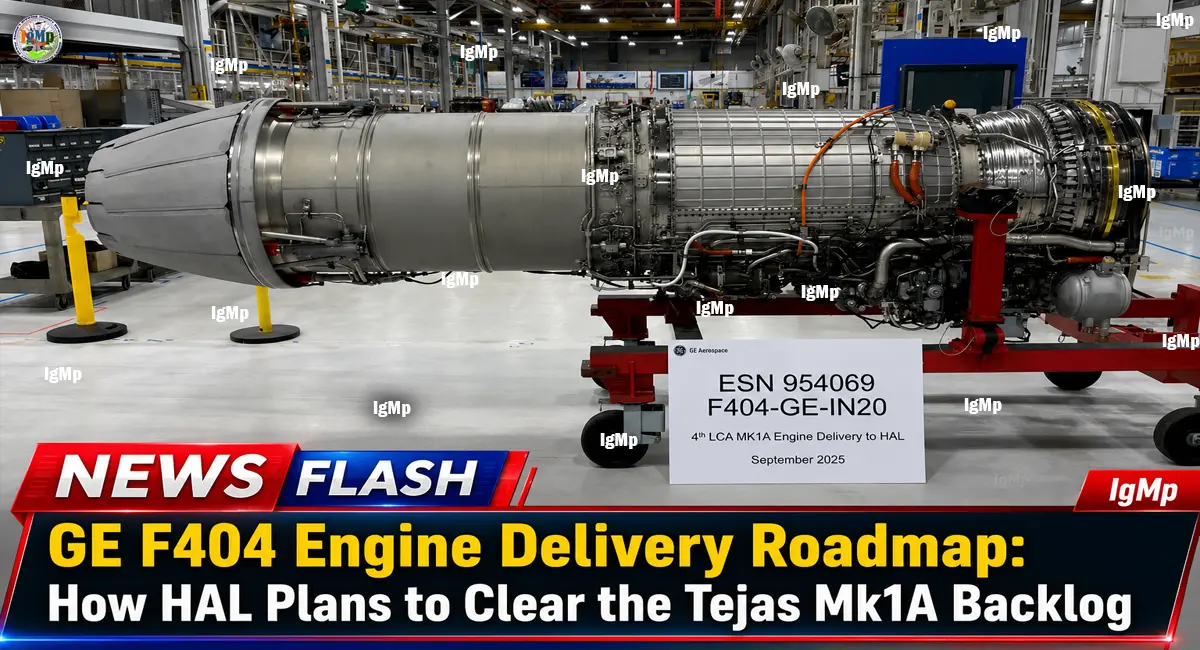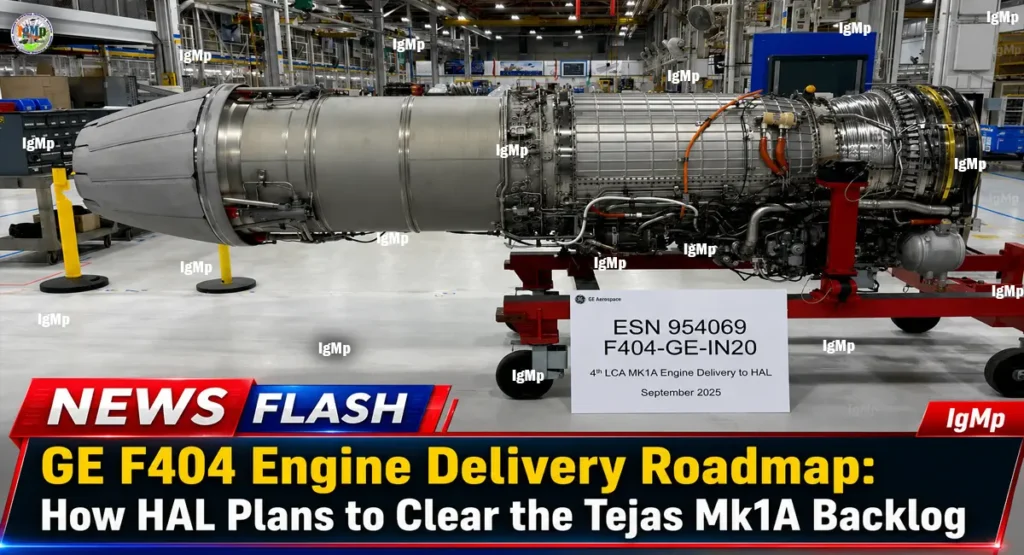
The Tejas Mk1A programme is approaching a decisive phase in 2026: the problem is no longer simply whether Hindustan Aeronautics Limited (HAL) can build the aircraft, but whether the supply of GE Aerospace F404-IN20 engines can finally match its production capacity.
Recent updates point to a more predictable delivery pipeline. HAL CMD D.K. Sunil has indicated that GE is expected to supply 24 F404-IN20 engines during FY2026–27, with production scaling toward 30 engines annually thereafter. That would materially change the production equation for the Tejas Mk1A, provided the delivery schedule is sustained.
IgMp Key Strategic Takeaways
- The Delivery Ramp: The latest reported roadmap points to 24 F404-IN20 engines in FY2026–27, followed by a target of around 30 engines annually.
- Clearing the Gliders: A steadier engine pipeline gives HAL the opportunity to progressively complete airframes already advanced through production and testing, rather than allowing engine availability to dictate the final assembly tempo.
- The Bigger Fix: GE’s planned India-based F404-IN20 depot, supported by GE technical expertise, could reduce future sustainment bottlenecks by improving repair and overhaul turnaround times.
FY2026-27 Roadmap: 20-22 F404-IN20 Engines to Clear Aircraft Backlog
The central question for HAL is how quickly an improved engine flow translates into aircraft deliveries.
The most recent publicly reported figure is 24 engines for FY2026–27, equivalent to roughly two engines per month on average. If that flow is maintained consistently, HAL should have considerably more flexibility to complete aircraft that have progressed through the production system but remain constrained by engine availability.
Earlier reporting indicated that multiple Mk1A airframes had already been built or test-flown while awaiting engines, highlighting the disconnect between HAL’s airframe production capability and the availability of the imported powerplant.
The analytical significance is straightforward: once engines arrive predictably, HAL can move from backlog clearance to production-rate management. That is a much healthier position for a fighter programme.
| Contract / Phase | Engine Quantity | Timeline / Role | Aircraft Link |
|---|---|---|---|
| Initial contract | 99 F404-IN20 | Original production requirement | 83 Tejas Mk1A |
| Follow-on requirement | 113 F404-IN20 | Supports expanded production | Additional Mk1A fleet |
| FY2026–27 reported rate | 24 engines | Near-term supply ramp | Backlog clearance |
| Longer-term target | ~30 engines/year | Sustained production | Supports higher HAL output |
The combined 212-engine requirement across the two reported orders provides a long-term supply framework, but the immediate challenge is execution: an engine arriving several years late has a very different operational value from the same engine arriving on schedule.

Why Restarting the F404 Production Line Caused a 2-Year Bottleneck
The F404-IN20 problem illustrates a classic aerospace manufacturing vulnerability: a mature engine design does not necessarily mean a mature, continuously running production line.
The F404 family has a long service history, but the specific IN20 configuration required for India’s Tejas Mk1A programme had to be brought back into a production ecosystem after a prolonged gap. Re-establishing suppliers, tooling, specialised components and quality-control processes created a bottleneck that was amplified by the complexity of aerospace supply chains.
This is why the delay had an outsized impact. HAL could continue manufacturing substantial portions of the aircraft, but without the engine, a completed airframe cannot become an operational fighter.
The latest delivery ramp therefore matters more than any single monthly shipment. The real test is whether GE can establish a repeatable production cadence that HAL can plan around.
Scaling to 30 Units: Supporting the 83 + 97 Tejas Mk1A Fleet
If GE reaches approximately 30 F404-IN20 engines annually, the strategic equation changes again.
HAL’s challenge will shift from waiting for engines to synchronising engine arrivals with final assembly, flight testing, certification and IAF acceptance. The reported target is significant because it aligns more closely with the production tempo required to sustain a meaningful annual fighter output rather than merely recovering from the existing backlog.
There is also a second, less visible development that could prove important over the long term. In April 2026, GE Aerospace announced a contract with the Indian Air Force to help establish an in-country depot for F404-IN20 engines. The facility is expected to be owned, operated and maintained by the IAF, with GE providing technical inputs, training, support personnel, spares and specialised equipment. The objective is to reduce dependence on overseas repair infrastructure and improve turnaround times.
That could be as important as increasing production. Fighter availability depends not only on how many engines are delivered, but also on how quickly engines can be repaired, overhauled and returned to service.
The bottom line is that the Tejas Mk1A programme is entering an execution window. A sustained F404-IN20 supply of 24 engines in FY2026–27, followed by approximately 30 annually, could allow HAL to finally convert accumulated airframe production into aircraft deliveries at scale.
The next milestone is therefore not another promise of supply. It is consistent monthly engine arrivals, rapid integration of available airframes and a measurable rise in Tejas Mk1A aircraft entering IAF service.