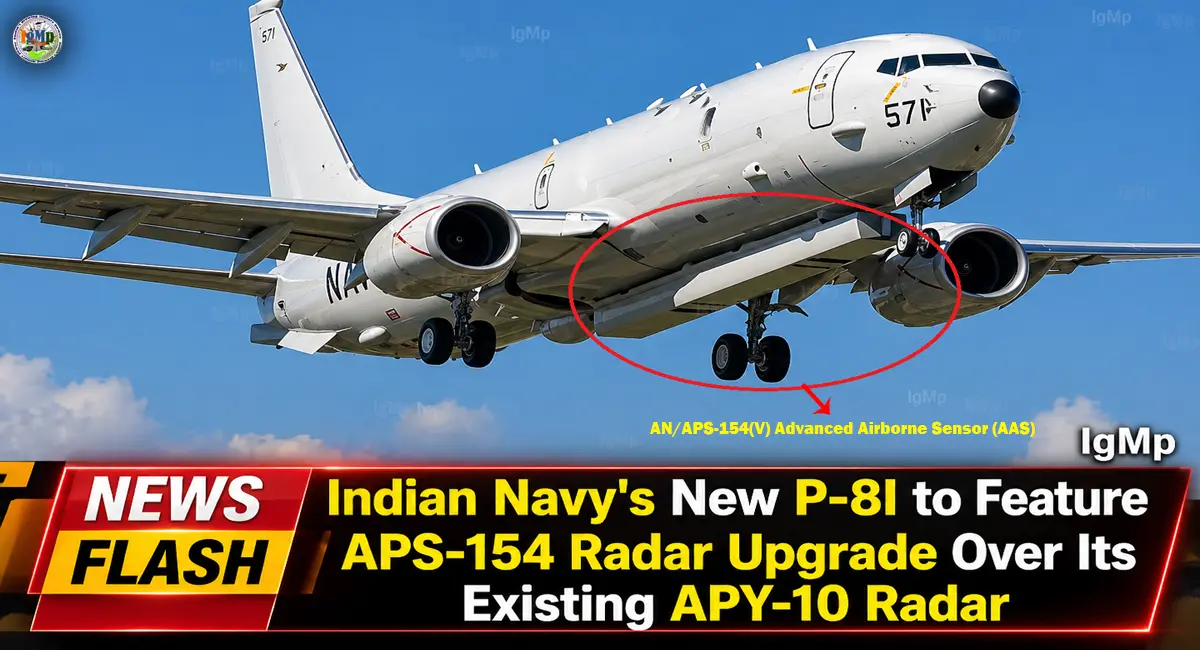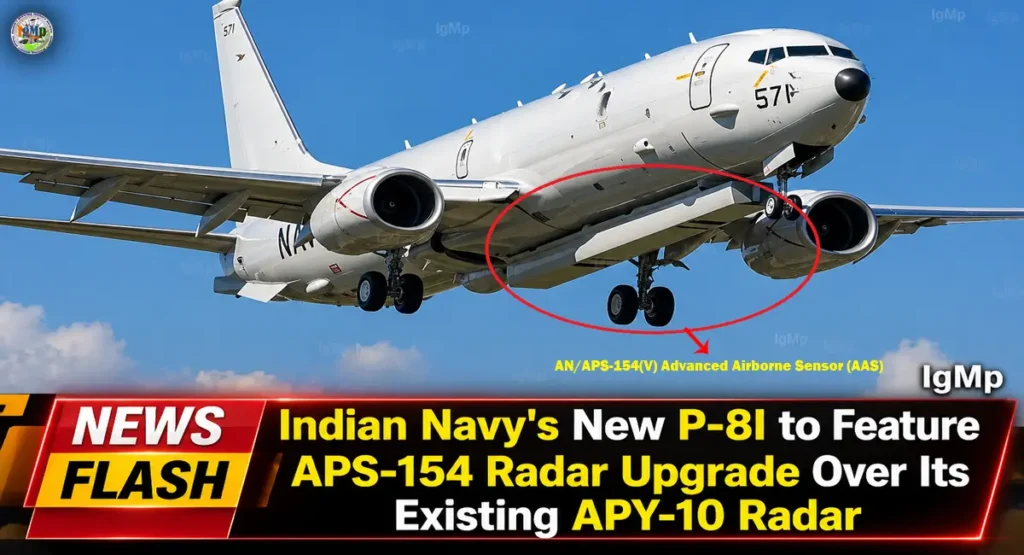
The Indian Navy is preparing to strengthen its long-range maritime surveillance with the AN/APS-154(V) Advanced Airborne Sensor (AAS) radar for its future P-8I Poseidon fleet. This upgrade gives India a major advantage in detecting stealthy submarines and tracking suspicious activity across the Indian Ocean Region.
Unlike the current AN/APY-10 radar, which focuses mainly on surface search and periscope detection, the APS-154 adds advanced wake detection, moving target tracking, and high-resolution maritime surveillance. It helps the aircraft find what normally stays hidden beneath the sea.
For Indian naval planners, this is not just another radar upgrade. It directly addresses the growing challenge of Chinese submarine deployments and the increasing presence of dual-use surveillance vessels like the Yuan Wang-class in the Indian Ocean.
The real value of this system lies in one question: how do you detect a submarine that does not want to be seen?
How Does the AN/APS-154(V) Detect Submerged Submarines?
Tracking the Wake Instead of the Hull
The AAS radar detects subtle surface disturbances caused by deep-running submarines rather than trying to see the submarine itself.
A submerged submarine creates pressure changes and water movement below the surface. These movements form tiny surface deformations, often called a Kelvin wake, even when the submarine stays far below visual range.
The APS-154 uses high-resolution AESA technology to detect these small changes in ocean patterns. Instead of searching only for surfaced parts like periscopes or snorkels, it studies the sea surface itself.
This makes the system far more effective against modern submarines that avoid exposing any visible structure above water. It turns invisible movement into a trackable signature.
The radar also uses onboard processing algorithms to separate real submarine wakes from normal ocean clutter like waves, currents, and fishing traffic. This software layer is just as important as the radar hardware.
Why Is the AAS Radar Pod Canoe-Shaped?
The Hydraulic Pod and 360-Degree Vision
The APS-154 does not sit permanently inside the aircraft nose like the older APY-10. Instead, it uses a long external pod with a canoe-shaped design mounted under the fuselage.
This pod lowers through a hydraulic arm during operations. It moves below the aircraft’s engines and body to create a clear line of sight on both sides.
That design solves a major radar limitation. A fixed nose radar often loses visibility because the aircraft structure blocks part of the scanning field. The AAS avoids that problem by physically lowering the radar into a better position.
It also uses a double-sided AESA antenna, which allows simultaneous scanning of both port and starboard sides. This creates much wider coverage and improves maritime surveillance during long patrol missions.
For anti-submarine warfare, this wider vision means fewer blind spots and faster target confirmation.
APY-10 vs APS-154(V): What Changes for the Indian Navy?
The current AN/APY-10 radar already gives the P-8I strong maritime surveillance capability. It performs well in surface search, periscope spotting, and air-to-air tracking.
The APS-154 moves far beyond that role. Its AESA architecture allows the radar to perform multiple missions at once instead of switching between tasks.
For example, it can map a coastline using Synthetic Aperture Radar (SAR) while also tracking a moving vessel using Moving Target Indication (MTI). This multi-role flexibility gives commanders faster decision-making during real operations.

| Feature | AN/APY-10 (Current P-8I) | AN/APS-154(V) AAS |
|---|---|---|
| Radar Type | Mechanically Scanned / Hybrid | AESA |
| Antenna Design | Single-face Nose Mounted | Double-sided Pod |
| Scanning Capability | 240° Forward View | Near 360° Coverage |
| Main Role | Surface Search | Wake Detection + ISR |
| Sub-Surface Detection | Limited | High-resolution Wake Analysis |
This comparison explains why the new system becomes a strategic sensor, not just a better radar.
Why This Upgrade Matters in the Indian Ocean
China’s growing submarine activity in the Indian Ocean has changed the region’s security balance. Research ships like the Yuan Wang-class often operate as dual-use platforms. They collect oceanographic data, map seabed routes, and support long-term submarine operations.
That creates what many naval officers call underwater blindness, especially near chokepoints like the Malacca Strait.
The APS-154 helps reduce that blind spot. It improves India’s ability to track both submarines and the support networks behind them.
There is also an important sovereignty angle. While the hardware comes from the United States, India focuses on keeping operational control of raw mission data through secure Indian-controlled systems under COMCASA-era frameworks.
This means the radar strengthens capability without weakening decision-making independence.